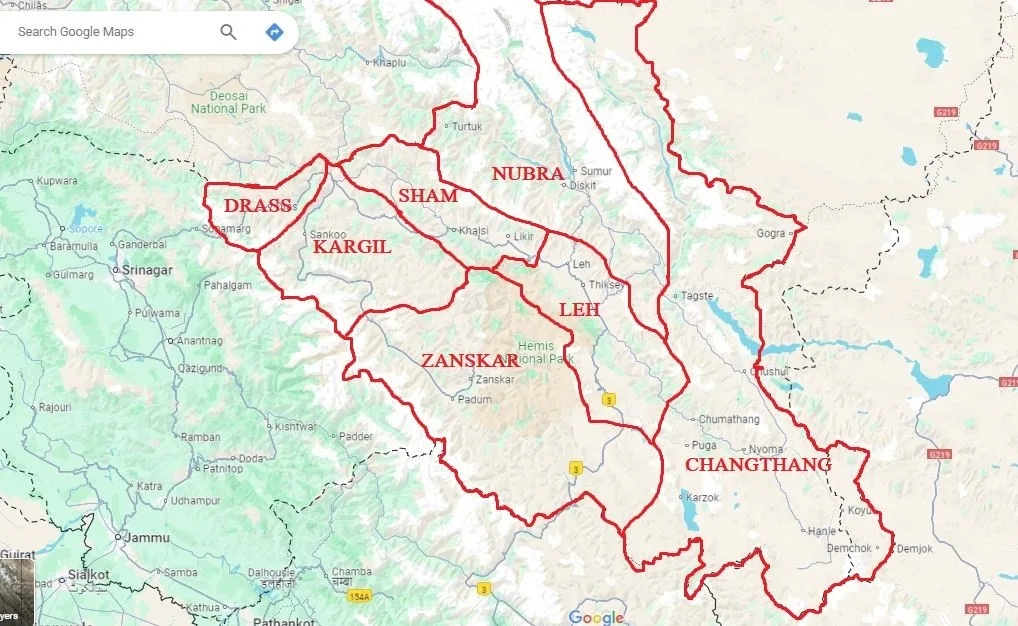
Centre has approved the creation of five new districts in Ladakh, significantly reshaping the governance structure of the Union Territory. With this move, Ladakh now has seven districts instead of just two earlier, namely Leh and Kargil.
The newly created districts include Nubra, Sham and Changthang carved out of Leh, and Zanskar and Drass carved out of Kargil. The notification was issued by Lieutenant Governor Vinai Kumar Saxena on April 27, 2026, although the proposal had already been approved by the Ministry of Home Affairs in 2024.
The government has described this restructuring as a long-pending demand of the people aimed at improving governance and ensuring development reaches even the most remote regions of Ladakh.
Why Ladakh needs more districts
To understand the reasoning behind the decision, it is important to look at Ladakh’s geography and population distribution. Ladakh is India’s second-largest Union Territory by area but one of the least populated, with just over three lakh people spread across vast, high-altitude terrain.
The region is known for its extreme weather, difficult terrain, limited connectivity and scattered settlements. Earlier, the entire Union Territory was governed through just two districts, Leh and Kargil. This made administration challenging, especially for remote areas located far from district headquarters.
Villages in regions such as Nubra Valley, Changthang Plateau, Zanskar and Drass often faced difficulties in accessing basic government services, healthcare, education and grievance redressal systems.
By creating smaller districts, the government aims to decentralise administration and bring governance closer to the people. Each new district will have its own administrative machinery, including district officials, police and development authorities, allowing for more focused governance.
A Long-standing local demand
The demand for separate districts in Ladakh’s sub-regions is not new. Residents of areas like Zanskar, Nubra and Changthang have been seeking district status for years, citing neglect, poor infrastructure and lack of administrative attention.
For instance, Zanskar, a Buddhist-majority region earlier part of Kargil district, had long complained about being governed from a distant headquarters with limited connectivity. Similarly, remote areas in Leh district like Nubra and Changthang also demanded better administrative structures.
The creation of new districts is therefore being seen by many local groups as a response to these long-standing demands.
Several organisations, especially from Buddhist-majority regions, have welcomed the move, calling it a historic step towards development and better governance.
Opposition from Muslim organisations
Despite the administrative reasoning, the decision has faced strong opposition from several Muslim organisations and political groups, particularly from the Kargil region.
Leaders from groups such as the Kargil Democratic Alliance have alleged that the move is an attempt to “divide” the region and weaken the ongoing demand for statehood and constitutional safeguards under the Sixth Schedule.
Some political leaders have also raised concerns over the distribution of districts along religious lines. They argue that while Muslims form a slightly larger share of the population, they now have fewer majority districts compared to Buddhists.
Prominent voices have termed the move as “gerrymandering” and accused the Centre of attempting to alter the demographic balance.
Why ‘Gerrymandering’ claims do not hold
However, a closer look at the facts shows that these claims do not stand up to scrutiny. The concept of gerrymandering refers to the manipulation of electoral boundaries to influence election outcomes. In Ladakh’s case, this argument does not apply for a simple reason: Ladakh does not have a legislative assembly.
The Union Territory is directly governed by the Centre and has only one Lok Sabha seat. The creation of districts does not change electoral constituencies, voting patterns or representation in Parliament.
Therefore, the new districts have no impact on elections, either at the local or national level.
The restructuring is purely administrative and aimed at improving governance, not altering political representation.
District creation based on Geography
Another important point is that the new districts largely follow existing geographical and demographic realities. Leh region has traditionally been Buddhist-majority, while Kargil has been Muslim-majority.
The sub-regions carved out into new districts already had distinct identities. For example, Zanskar has historically been a Buddhist-majority area, while Drass is predominantly Muslim.
The new district boundaries have not been artificially drawn to create religious divisions but rather formalise existing regional distinctions.
Reports point out that district formation is not based solely on population but also on factors like geography, accessibility, administrative convenience and local needs.
Resource allocation
Some leaders have also raised concerns that the creation of more districts could lead to unequal distribution of funds and resources.
However, government officials argue that the opposite is likely to happen. With more districts, resources will be decentralised, allowing each region to receive dedicated budgets and focused development.
Earlier, large districts like Leh and Kargil had to manage vast areas with limited administrative capacity. With smaller districts, governance is expected to become more efficient and responsive.
Misinterpretation of population data
Opposition leaders have cited population figures to argue that Muslims are underrepresented in terms of district numbers. However, this comparison overlooks key aspects.
Districts are not meant to represent population proportion like electoral constituencies. Instead, they are administrative units designed to ensure effective governance.
In fact, even after the division, Kargil district alone has a large number of villages compared to many of the newly created districts. The variation in district size is largely due to geography and population density rather than any deliberate bias.
Statehood demand remains unaffected
Another major concern raised by opposition groups is that the new districts could weaken the demand for statehood in Ladakh.
However, reports point out that statehood is a political issue, while district creation is an administrative decision. The two are not directly linked.
The demand for statehood and inclusion under the Sixth Schedule remains unchanged and will be addressed separately by the government.
While the move has sparked political debate and opposition from some quarters, the government maintains that it is aimed at improving governance and ensuring development reaches remote areas.
Claims of gerrymandering do not hold in the absence of electoral implications, and the restructuring largely reflects existing geographical and demographic realities.
As Ladakh adapts to its new administrative structure, the focus will remain on whether the move succeeds in delivering better governance, infrastructure and opportunities to its people.