
A clear and disturbing pattern of Islamist radical penetration was laid bare across Kerala on ‘Vishu’ week. What should have been a period of sacred reflection for the Hindu Malayali New Year was instead weaponised by radical elements seeking to desecrate the very soul of the festival.
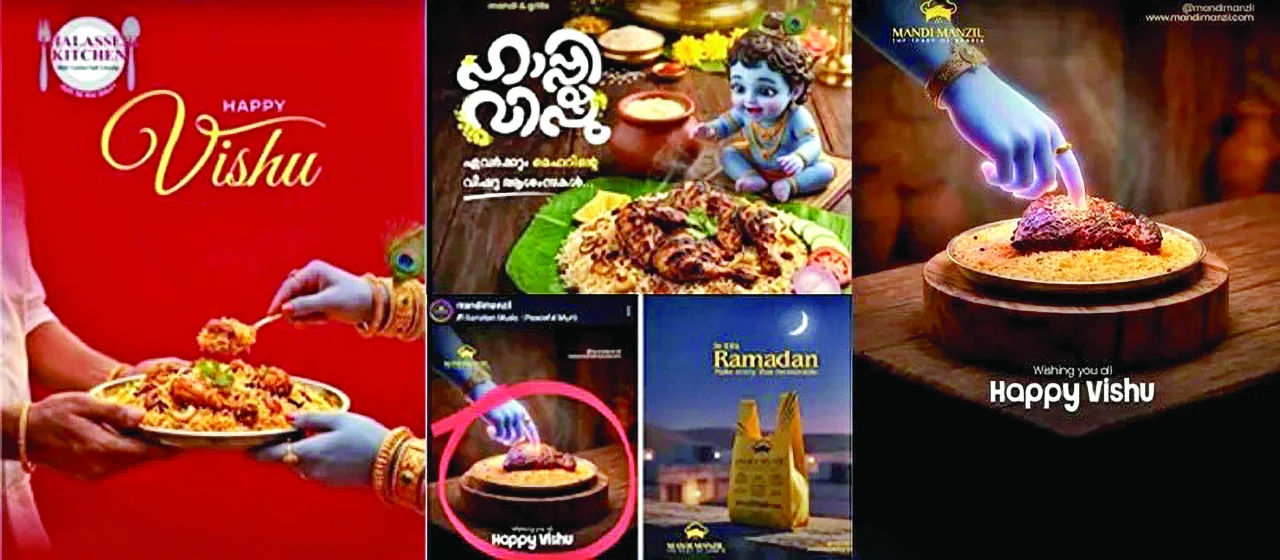
In a coordinated effort, a group of Muslim-owned restaurants specialising in Arabian non-vegetarian cuisine released a provocative ad poster depicting the ‘Vishu Kani.’ This sacred ‘first sight’—traditionally a meticulous arrangement of harvest produce, fruits, grains, silver, and gold cantered around the idol of Bhagwan Krishna and adorned with Kani Konna flowers—was hijacked and distorted to serve a radical agenda.
Targeting Bhagwan Krishna
The provocation began with the systematic mockery of Bhagwan Krishna, the central deity of the Vishu Kani. Days before Vishu, a network of Muslim-owned restaurants released social media advertisements depicting the sacred “first sight” of the New Year. The restaurant ad posters featured the child form of Sri Krishna, complete with the traditional mayilpeeli (peacock feather) in his hair, and blue in colour, but with a disturbing twist.
The little Krishna, venerated as a most adorable and sacred figure, was depicted reaching out to grab an Arabian non-vegetarian platter served on a holy banana leaf. This imagery is a direct insult to Hindus and Krishna devotees, who revere Bhagwan as holy and strictly vegetarian—the divine protector who would never cause harm to an animal—and that too related to ‘Vishu’ festival.
Hindu Community Unites
To millions of devotees, this is not mere “creative license”; it is a profound violation of their faith. The posters were first rolled out by Meher Mandi & Grills in Cherthala, Alappuzha. Their advertisement immediately grabbed eyeballs due to the offensive and negative portrayal of Bhagwan Krishna.
As the poster gained traction, Hindu social media handles rose in fierce opposition against the portrayal. However, within no time, the same pattern of restaurant ad posters—using the child form of Bhagwan Krishna grabbing the Arab non-veg platters with the Vishu Kani appeared across the digital space.
It must be noted that the facial expression of the little Krishna, shown grabbing at the Arabic non-veg food, was one of surprise and eager—as if the deity were being tempted by the meat platter. This deliberate depiction of a sacred figure appearing lured by non-vegetarian food added a deeply provocative layer to the imagery.
These blasphemous posters were widely shared by Muslim handles across all social media platforms, including WhatsApp, indicating a coordinated campaign.
This was clearly not a careless mistake by some designer. It was a coordinated effort – a calculated test to see how much they could twist and mock Hindu sacred symbols before anyone pushed back.
The lack of a formal police investigation remains a critical concern, as analysts suggest the “so-called creativity” behind these ads originates from a single, unified source. Despite the appearance of these posters across multiple districts and locations, the identical “blasphemy templates” point toward a centralised narrative and a coordinated operation.
Individual citizens have lodged multiple police complaints in response to the provocations. Furthermore, major organisations including the Bharatiya Janata Party, Vishva Hindu Parishad, and Hindu Aikyavedi have also filed formal police complaints to demand accountability for the coordinated campaign.
Eateries Ridiculing Sri Krishna
- Meher Mandi & Grills
- Yamama Shawaya,
- Go Grill
- Mandi Manzil
- Arabian Majlis
- Thalasseri Kitchen – Calicut Beach, Kozhikode
Nadawi Mandi Restaurant
As the row intensified, an FIR was filed against the restaurant owners under Section 192 of the Bharatiya Nyaya Sanhita for allegedly provoking with intent to cause a riot. Owners of the restaurants Arshad Asharaf, Shamnas Kunhimuhammed, Musthafa Kunduvayil and Shahul Hameed, Muhammed Shahin, who run Meher Mandi & Grills in Cherthala, were booked based on complaints. The owners were later released on bail due to the lack of strong sections.
Anatomy of Provocation
- Epicentre: Campaign first traced to Meher Mandi & Grills in Cherthala, Alappuzha
- Pattern: Within hours, identical posters appeared from Yamama Shawaya in Malappuram, Thalasseri Kitchen, Nadawi Mandi in Bengaluru.
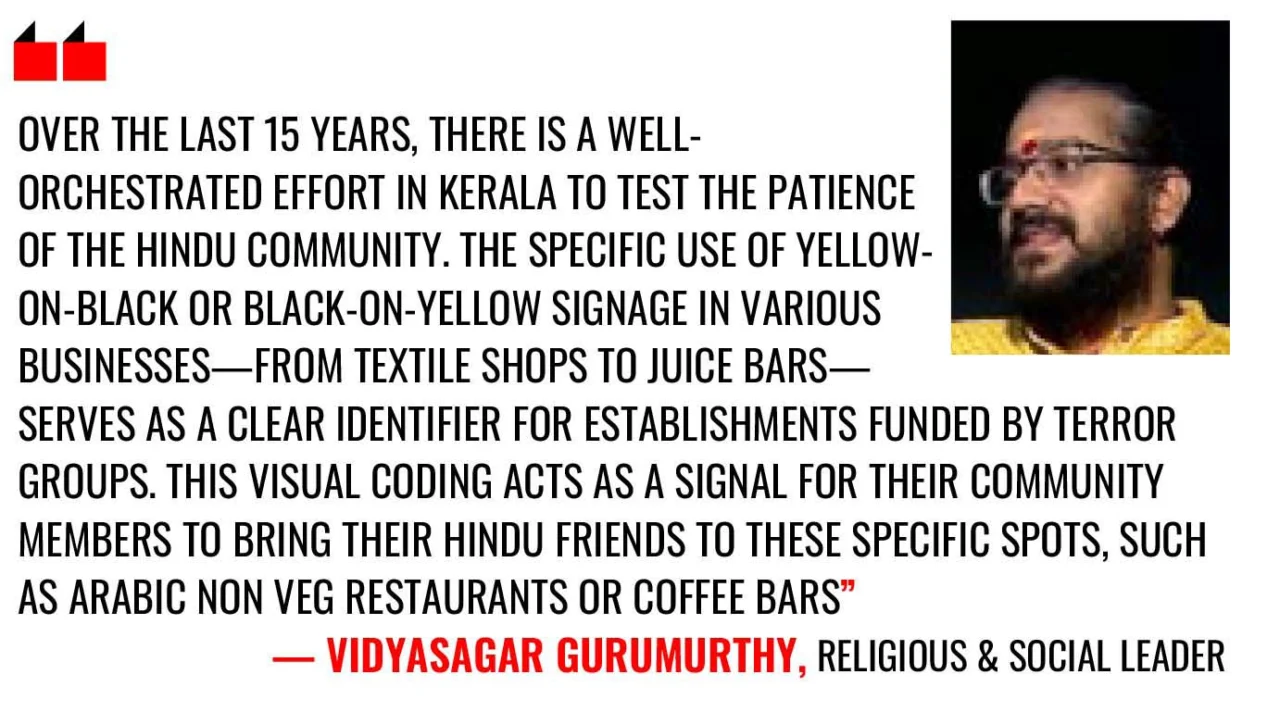
- Common Thread: Share a specific ideological profile, with owners linked to Muslim League or radical SDPI.
Decoding Vishu & Vishu Kani
Vishu, the traditional New Year festival of Malayali Hindus, represents the sacred dawn of the year and a moment of deep civilisational continuity. Typically observed in mid-April, the festival is centred around the Vishu Kani, or “sacred first sight,” which is believed to determine the blessings and hope for the entire year ahead.
This ritual involves the meticulous arrangement of a traditional brass Uruli before sunrise, containing golden Kani Konna flowers, fresh harvest fruits, grains, silver, money, and a sacred mirror, all positioned around an idol of Bhagwan Krishna.
Celebrated as the first prayer of the year, it is a living memory passed down through generations, often drawing the community from across the globe back to their homes to experience this auspicious beginning.
The specific theme portrayed in the restaurant advertisements exactly resembled the sacred Vishu Kani, featuring an idol of Bhagwan Krishna. ‘Test Dose’ of Desecration: How a Coordinated Digital Strike Targeted the
Soul of Vishu
In the murky lexicon of organised cultural aggression, there is a term gaining traction among security analysts and community leaders: the “Test Dose.” It is a psychological reconnaissance mission—a calibrated provocation designed not to inflict maximum immediate damage, but to serve as a high-stakes litmus test.
This is the “test dose” of radicalisation that has plagued Kerala for decades. We have seen this strategy before. In 2021, the same radical groups marched through the Malabar region, openly proclaiming that the “swords of the 1921 Mappila Revolt” were never thrown into the sea. It was a chilling call echoing the Hindu genocide of 1921.
Simultaneously, the State witnessed an attempt to sanitise that brutal history. Kerala Government under CPM leader Pinarayi Vijayan initially planned to celebrate the centenary of the revolt, while a high-profile film sought to heroise Variyamkunnan, the man who steered the mass rape of Hindu women and slaughter of Hindus. These plans were only shelved after a massive, uncompromising pushback from the Hindu community.
From the glorification of a genocidal past to the mockery of a sacred present, the goal is the same: The slow Arabisation of Kerala. The cycle of aggression is continuous; the end of one provocation is merely the launchpad for the next.
Historians point to the 1990s in the Kashmir Valley. There, too, the process began with “small insults” and the normalisation of cultural mockery. When the community failed to respond in an organised, consequential manner, the “Test Dose” graduated to the final solution: Exodus. n