Former Army Chief Manoj Mukund Naravane’s recent statement has given a new twist to the ongoing political debate surrounding the 2020 India-China border standoff. He clarified that the government provided the Army with complete support and full freedom to make decisions.
Former Army Chief Naravane explicitly stated that during the standoff with China in 2020, the government never left the Army isolated. He explained that the government stood firmly by the Army at every level and the forces were granted complete freedom to take decisions based on the prevailing circumstances, including the authority to open fire on Chinese troops should the situation deteriorate. Following his candid public statement to the media, it has now become abundantly clear that the allegations leveled against the ruling dispensation by the Congress and specifically by Rahul Gandhi lacked any credibility whatsoever. This entire episode appears to have been orchestrated solely to corner the ruling party under the pretext of the India-China border issue and to tarnish its public image!
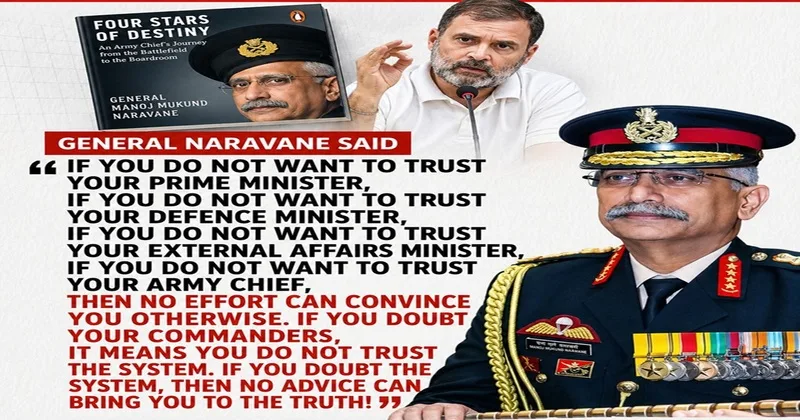
Notably, on February 2 and 3, Rahul Gandhi raised the issues of Chinese intrusion and the review of the ‘Agniveer’ scheme in Parliament, citing MM Naravane’s book, “Four Stars of Destiny”. He had alleged that, at the time, the government had left the Army to fend for itself. To lend weight to his claims, he had even brought a copy of the book with him to Parliament. Now, General Naravane’s assertion that the government gave him a “free hand” signals that the top leadership reposed complete faith in the military’s capabilities. Conversely, the Congress party’s allegation that the government “abandoned” the Army not only appears to be divorced from the facts but also amounts to undermining the role of the military leadership itself.
Prime Minister Narendra Modi’s directive- “Do whatever you deem appropriate”, stands as a symbol of the utmost trust placed in the military leadership. Far from being an indication of a lack of direction, this instruction was, in fact, a clear signal of strategic autonomy. In a war-like situation, taking swift decisions is essential; if, in such circumstances, the Army were required to await political clearance at every step, it could prove detrimental to national security. Viewed from this perspective, the decision taken was both pragmatic and mature.
General Naravane’s assertion that “the Armed Forces should not be politicized” points to a vital tradition within Indian democracy. The Army has historically remained insulated from political influence, and this very detachment constitutes the bedrock of its professional credibility. When we look back, the sequence of events on the night of August 31, 2020, comes to mind. As Chinese tanks advanced toward Rechin La, the Army Chief reached out to Defence Minister Rajnath Singh, National Security Advisor Ajit Doval, and External Affairs Minister S. Jaishankar. Ultimately, the message arrived from the Prime Minister: “Do whatever you deem appropriate.” It was a pivotal moment wherein the political leadership reposed complete faith in the military leadership.
The Congress party portrays this entire sequence of events as a “lack of instructions,” whereas the reality is quite different. From a military standpoint, this constituted a “delegation of authority”- that is, entrusting decision-making powers to the appropriate level. It is an established military doctrine that a commander, who possesses an intimate understanding of the ground realities, is best positioned to make the most effective decisions. Consequently, the assertion that the government failed to take a decision is, in essence, a misinterpretation.
A Balanced Perspective on the Agnipath Scheme
The Agnipath scheme, too, sparked political controversy; however, General Naravane clarified that while it is natural for any new policy to be a subject of debate, once a decision has been finalized, it becomes the Army’s duty to implement it. Throughout this entire controversy, General Naravane’s stance has been noteworthy. He neither sided with any political party nor did he fuel unnecessary controversy. Today, he presented the facts objectively and upheld institutional propriety. Even regarding his book, he stated that if the government found any content objectionable and withheld clearance, it was entirely within the government’s prerogative to do so. This statement serves as a testament to his maturity and discipline.
The Congress Narrative: Fact or Political Expediency?
The manner in which Rahul Gandhi leveled allegations in Parliament, citing General Naravane’s alleged book, “Four Stars of Destiny”- raises several questions. This is particularly pertinent given that the publisher, Penguin Random House India, has explicitly clarified that the book has not yet been published. In such a scenario, is leveling allegations in Parliament based on an unpublished and unverified source a hallmark of responsible politics, or is it merely a calculated political strategy? It suggests that the Congress party is willing to go to any lengths to malign the nation, the armed forces and the government. Viewed in this light, the entire episode shatters the false narrative propagated by the Congress, a narrative that consistently sought to portray India’s military might and the Indian government as weak, based on claims that China had seized Indian territory.
Politics vs. National Security: Where Should the Priority Lie?
This entire episode has once again raised the question: Should politics be played over grave issues such as national security? Is the role of the opposition merely to level allegations, or does it also bear the responsibility of offering constructive suggestions? When soldiers stand guard at the borders, defending the nation, the political class is expected to demonstrate solidarity rather than engaging in divisive rhetoric.
General Naravane’s statement today has made it abundantly clear that, during the crisis of 2020, a strong sense of coordination and trust prevailed between the government and the armed forces. The allegations leveled by the Congress fail to withstand scrutiny when measured against this reality. Furthermore, General M.M. Naravane’s message to Rahul Gandhi and the Congress- stating, “If you do not wish to trust your Prime Minister, if you do not wish to trust your Defence Minister, if you do not wish to trust your External Affairs Minister and if you do not wish to trust your Army Chief- then no amount of logical reasoning can alter your mindset”, truly reflects a Congress mentality capable of fabricating any falsehood to serve its own political ends.