NEW DELHI: The sharpest critique of Pakistan’s role in the current US–Iran mediation effort is not coming from a rival government or a partisan commentator, but from Aimen Dean, a man who once operated at the very heart of global counterterrorism.
Who is Aimen Dean, and why his words carry weight
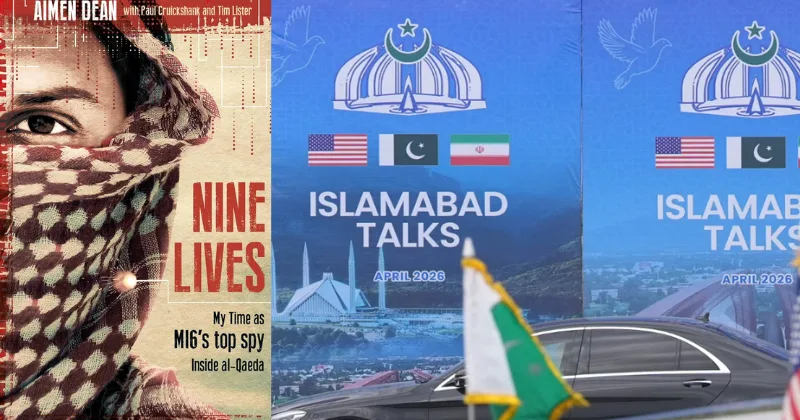
Aimen Dean is not a casual observer. A former MI6 asset who infiltrated Al-Qaeda and later authored Nine Lives: My Time as MI6 Spy Inside Al-Qaeda, Dean is widely regarded in intelligence circles as one of the most effective human assets in the post-9/11 war on terror. His career straddles militant networks, Western intelligence, and financial systems used in terror funding.
When such a figure dismisses Pakistan’s mediation as “pure manipulation dressed up as statecraft,” it is not rhetoric. It is an insider’s pattern recognition.
“Not mediation, but intervention”
Dean’s central argument is blunt: Pakistan is not, and has never been, a neutral intermediary between Washington and Tehran.
“If you’re looking for a polite take, this isn’t it. I’ve said it repeatedly on the Conflicted podcast: Pakistan was never a neutral mediator between Washington and Tehran. Not for a second. What we’re watching now is not diplomacy, it’s pure manipulation dressed up as statecraft.”
If you’re looking for a polite take, this isn’t it.
I’ve said it repeatedly on the Conflicted podcast: Pakistan was never a neutral mediator between Washington and Tehran. Not for a second. What we’re watching now is not diplomacy, it’s pure manipulation dressed up as… https://t.co/p1kyX557tp
— Aimen Dean (@AimenDean) April 22, 2026
In his assessment, the current effort under Pakistan’s Army leadership, particularly Asim Munir, reflects a long-standing strategic doctrine. The country presents itself as a facilitator while actively shaping outcomes to serve its own geopolitical calculus. Dean accuses Pakistan of selling US President Donald Trump a fantasy, a pipedream. “And Trump – obsessed with the optics of a deal – bought it,” Dean writes.
From an Indian vantage point, this observation aligns with decades of experience. Whether in cross-border terrorism or regional diplomacy, Pakistan has repeatedly positioned itself as both participant (read aggressor/terror manufacturer) and referee.
Dean goes a step further. He argues that what Islamabad offered Donald Trump was not a pathway to peace, but an illusion, the idea that Iran could be coaxed into a grand bargain through flattery and incentives.
That premise, he insists, fundamentally misunderstands the ideological core of the Iranian regime.
The Afghanistan precedent, a warning ignored
Dean’s most damning comparison is historical. He invokes the episode of Osama bin Laden being found in Abbottabad during the US raid on Abbottabad, deep inside Pakistan, not in some remote tribal wilderness.
“We’ve seen this movie before. The United States spent years, treasure, and blood in Afghanistan, only to discover that Osama bin Laden, and his network, were living comfortably in Pakistan all along – while Pakistan was simultaneously cashing in on US counterterrorism billions in funding. They didn’t fail to find the target. They bloody managed it,” Dean argues.
For Dean, that moment exposed a structural reality. Pakistan, while officially allied with the United States, simultaneously harboured and leveraged the very networks Washington was fighting.
His conclusion is chilling in its simplicity: the “hunt” was never meant to end because it was too profitable to sustain. “Why end the hunt when the hunt itself pays and pays pretty well?” he rightly puts it.
From India’s standpoint, this mirrors long-held concerns about selective counterterrorism and the use of non-state actors as strategic assets.
Iran talks, buying time, not peace
Applying that lens to the present crisis, Dean argues that Pakistan’s intervention came at a critical juncture, when Iran was under maximum pressure: militarily strained, economically squeezed, and diplomatically isolated.
Instead of facilitating resolution, he believes Islamabad effectively bought Tehran time.
Recent developments appear to reinforce the fragility of the process. Iran has shown reluctance to participate in talks as long as the US maintains its naval blockade, while planned diplomatic engagements, including Vice President JD Vance’s visit to Islamabad, have been postponed amid uncertainty.
Iran’s envoy Amir Saeid Iravani has indicated talks could happen, but only if Washington alters its posture. Meanwhile, mixed signals from both sides suggest that the so-called mediation has struggled to produce tangible progress.
Dean would argue that this is precisely the point.
Delay, diffusion, and strategic ambiguity serve the interests of a mediator that is not truly neutral.
The Gulf contradiction
One of Dean’s more striking observations concerns Pakistan’s apparent willingness to risk alienating Gulf nations, despite its deep economic dependence on them.
With thousands of missiles and drones reportedly targeting the Gulf states hosting large Pakistani expatriate populations, he questions how Islamabad can claim neutrality while appearing aligned, even tactically, with Tehran’s interests.
For India, which has carefully balanced its own relations with both the Gulf and Iran, this inconsistency underscores a key distinction: New Delhi’s diplomacy has increasingly been seen as transparent and interest-driven, rather than opaque and transactional.
A familiar pattern, a predictable outcome
Dean frames the situation as a repeat of a familiar script:
“Five years from now, looking back, this could read like a familiar chapter: First Afghanistan – undermined from within. Now Iran – diluted from without,” Aimen Dean adds.
In both cases, Pakistan emerges not as a stabilising force, but as an actor shaping the battlefield while maintaining plausible deniability.
“In both cases, Pakistan didn’t just mislead Washington. It shaped the battlefield to its advantage, all while claiming partnership with a clueless US administration. And Washington, once again, chose to believe what it wanted to hear,” Dean minces no words.
For Indian policymakers and observers, this reinforces a long-standing strategic caution: that Pakistan’s role in regional crises often extends beyond what is visible at the negotiating table.
The larger takeaway
What makes Dean’s critique particularly potent is not its tone, but its provenance.
This is not ideological commentary. It is an assessment grounded in operational experience within the very networks and conflicts he references.
His warning is clear. When a state repeatedly positions itself as indispensable to conflict resolution, it is worth examining whether the conflict itself has become part of its leverage.
In the unfolding US–Iran tensions, Pakistan’s role may well be judged not by its stated intentions, but by the outcomes it enables, or delays.
And if Dean’s reading of history holds, those outcomes may serve Islamabad first, and peace only incidentally.