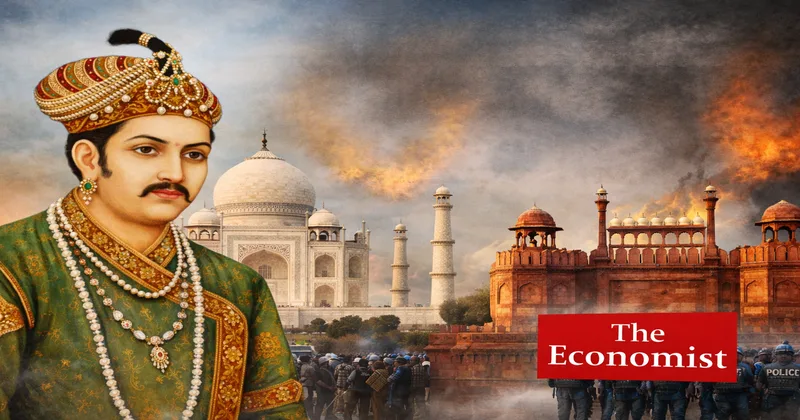
The Economist’s piece borrows directly from the famous Monty Python routine “What have the Romans ever done for us?” listing supposed “benefits” to mock critics. How unoriginal. In fact, typical, I must say.
It tries to look clever but is instead deeply selective. The Roman analogy works because Rome built civic systems for its citizens. The Mughal comparison collapses because it glosses over a fundamental difference.
The Mughals were not building for a shared civic identity. They were ruling, extracting, and monumentalising power over a pre-existing civilisation far older and far more evolved than themselves.
This is not about denying contributions. It is about restoring proportion and exposing the erasure of conquest, coercion, and civilizational disruption that made those contributions possible.
You asked for it, dear Economist. Here’s a counter to every lie you state.
“The Mughals became Indian… their achievements are Indian achievements”
This is assertion masquerading as conclusion.
The Mughal state remained culturally and politically Persianised, with elites tracing lineage to Central Asia and consciously maintaining that identity.
Persian dominated administration, court culture, and historiography. The ruling class did not dissolve into the civilisational fabric. It sat above it, governing rather than belonging.
As experts and history pundits such as Professor BB Lal etc. demonstrated through decades of archaeological work, Indian civilisation shows deep, unbroken continuity long before and long after the Mughal period. The Mughals did not create that continuum. They inserted themselves into it.
Adapting to local conditions through alliances or patronage was a necessity of rule. It was not evidence of civilizational assimilation. There is a difference between learning to govern a land and becoming part of its soul.
“Temple destruction is true… humiliation is contested”
This framing attempts to soften what is already established.
Temple desecration is not a fringe claim. It is supported by inscriptions, court chronicles, and archaeology. Work linked to the “very humble, scholarly, and honest to his sworn duty” Professor KK Muhammed and also BB Lal, particularly in Ayodhya, confirmed structural remains of earlier temples beneath later Mughal era constructions of mosques. These are material findings, not ideological assertions.
Under brutal and biased Mughals such as Aurangzeb, orders targeting prominent temples like Kashi and Mathura are documented.
Jizya taxation that targeted only non-Muslims (read, Hindus) formalised religious hierarchy. There was incentive to adopt Islam, torture and persecution to adhere to one’s ancestors’ Sanatani Bharatiya legacy. These were not isolated incidents but part of governance choices that shaped lived reality for large sections of the population.
Calling this “contested” does not erase the record. It only signals reluctance to confront it fully.
“Language—Hindi owes much to the Mughals”
This confuses influence with origin.
Hindi’s structure is rooted in Sanskrit and Prakrit traditions that evolved over millennia. Persian and Arabic vocabulary entered through prolonged political dominance and courtly patronage, not through cultural benevolence. Even the word “Hindu” originates from the Sanskrit “Sindhu,” later adapted into “Hind” in Persian usage.
Similarly, there is an argument about Urdu. Urdu is profoundly and undeniably Indian. Its grammar, sentence structure, core vocabulary, and flowing sweetness (“mithaas”) derive directly from Prakrit-derived Indo-Aryan language, especially the Braj Bhasha and Khariboli dialects of the Delhi-Mathura-Agra heartland. Without this native grammatical backbone, there would be no Urdu as we know it; it is not a foreign transplant.
The Mughals (and later Persianate courts) contributed heavily to its refined vocabulary, literary polish, and Persian-Arabic script, but they did not “create” it. Urdu emerged as a natural evolution of local Indian speech, Braj/Hindavi boli, absorbing Persian, Arabic, and Turkish words much like English absorbed Norman French while remaining Germanic at its core.
The Mughals patronized and shaped a courtly register; they did not import a ready-made language from Central Asia or Persia. Calling Urdu “Mughal” or purely “foreign” ignores its living Indian soul and denies credit to the poets, soldiers, and common people of the subcontinent who forged it over centuries.
For official use alongside Hindi (the other face of the same Hindustani coin), Urdu deserves recognition as a classical modern Indian language, rooted in Prakrit/Braj soil, enriched by Persian elegance, and belonging fully to India’s composite culture. It is no more “alien” than the Sanskrit tatsams in Hindi or the Dravidian layers in many Indian tongues. Denying its Indianness is historically inaccurate.[Ma1]
Languages evolve under power. That does not mean they are gifts from those who wielded it.
[Ma1]
“Cuisine—Mughals gave India its food culture”
This is an elegant exaggeration.
Mughal courts certainly refined and popularised A FEW dishes, blending Persian techniques with Indian ingredients. But India’s culinary heritage, with its sophisticated use of spices and regional diversity, predates the Mughals by thousands of years. Archaeological evidence points to early forms of earthern ovens (like tandoors) in the subcontinent long before Babur’s arrival.
What emerged in Mughal kitchens was a courtly fusion cuisine sustained by imperial wealth. It was not a gift to the masses. It was an expression of elite luxury made possible by the resources of the land. Luxury that the Mughals and their nobles were dazzled by, hitherto absent in the land of their forefathers, at least in terms of opulence and abundance.
“Architecture—Mughal monuments define India”
They are magnificent, but they are not foundational. They ought to be strong and stunning after the blood, toil, and money of the citizens that went into it.
The Taj Mahal and Red Fort stand as symbols of imperial power and aesthetic ambition. They were funded through heavy agrarian taxation and built by Indian artisans. Their primary purpose lay in commemoration and authority, not civic utility.
They exist alongside a far older and equally sophisticated architectural tradition that includes Ajanta, Ellora, Khajuraho, Konark, and Hampi. India’s architectural genius did not begin with the Mughals, nor did it depend on them.
What the Mughals built, they built to glorify themselves and their rule, not to create enduring public infrastructure for the populace.
“Syncretism—Sufism and Indo-Islamic culture blended India”
Syncretism existed in small negligible patches, and it was neither uniform nor uninterrupted.
Akbar’s reign saw experimentation with pluralism. Mind you, only dabbling, it never became the bedrock of his governance. Nor a ‘sarva dharma sama bhava’ policy cast in stone. Aurangzeb’s policies reversed much of that accommodation.
Let me quote Dr Babasaheb Ambedkar here. “These invasions of India by Muslims were as much invasions of India as they were wars among the Muslims themselves. This fact has remained hidden because the invaders are all lumped together as Muslim without distinction. But as a matter of fact, they were Tartars, Afghans and Mongols. Muhammad of Ghazni was a Tartar, Mahommed of Ghori was an Afghan, Taimur was a Mongol, Babar was a Tartar, while while Nadirshah and Ahmadshah Abdalli were Afghans. In invading India, the Afghan was out to destroy the Tartar and the Mongol was out to destroy the Tartar as well as the Afghan. They were not a loving family cemented by the feeling of Islamic brotherhood. They were deadly rivals of one another and their wars were often wars of mutual extermination. What is, however, important to bear in mind is that with all their internecine conflicts they were all united by one common objective and that was to destroy the Hindu faith” – Source: Dr Babasaheb B R Ambedkar, Pakistan or The Partition of India, Dr Babasaheb Ambedkar – Writings and Speeches Vol. 8, pg 57, Dr Ambedkar Foundation, New Delhi, 2014NSCN-IM) on August 3, 2015.
During the same period, the Bhakti movement gained strength, Sikh resistance intensified, the Rajputs rose in revolt, albeit not unified (and therefore lacked the formidable touch) and Maratha power rose in defiance.
This was not seamless cultural blending. It was a landscape shaped by interaction, tension, negotiation, and resistance. Exchange occurred, but so did conflict. Ignoring one distorts the other.
What the Article Omits: Extraction, Taxation, and Power
The Monty Python-style listing of “benefits” avoids a crucial question. Who paid for them?
Mughal revenue systems extracted a significant share of agricultural produce, often ranging between 30 and 50 per cent in many regions. This wealth sustained imperial courts, military campaigns, and monumental architecture.
This was not a system designed for equitable development. It was centralised extraction. The splendour of the court stood in stark contrast to the burden on the agrarian population that financed it.
As Prafulla Ketkar writes: “For the secularists, the assertion that Mughals are not our heroes is the real problem. The heritage they see in the Moghul era is the sole source of their communal secularism. While doing so connecting all Bharatiya Muslims with the Mughal identity is the biggest injustice they do with Muslims. Knowing very well that Mongols, Turks, Afghans were fighting among themselves, and as Dr Ambedkar explained, “They were all united by one common objective, and that was to destroy the Hindu faith.” Who were the first victims of this forged unity? – The present-day Muslims of Bharat. It was their ancestors who faced the sword of forced conversion. In turn, this process sowed the seeds of pan-Islamism among Muslims and damaged the real assimilative culture of Bharat.”
Privileges often aligned with power structures, and resistance to that power was met with force. The brutalisation of those who defied imperial authority forms an essential part of the record.
Brutality and Resistance: The Cost of Defiance
The narrative of refinement and culture often omits the stark reality of repression.
Chhatrapati Sambhaji Maharaj, who resisted Mughal expansion, was subjected to prolonged torture and execution under Aurangzeb. His death was not merely political. It was demonstrative, intended to break resistance.
Similarly, the killing of the Sahibzada Zorawar Singh and Sahibzada Fateh Singh, the young sons of Guru Gobind Singh, stands as one of the most chilling episodes of the period. Their execution for refusing to convert remains etched in collective memory.
What just and fair system of rule produces such outcomes for dissent, faith, or resistance?
The rise of Sikh militarisation, Maratha expansion, and Rajput assertion was not accidental. It was a response.
“They brought the BJP to power”
This is rhetoric, not analysis.
Modern political movements arise from a range of factors, including governance, economics, and identity. Historical memory plays a role, but it is not manufactured in isolation.
Archaeological work, including that associated with KK Muhammed, has reinforced that disputes like Ayodhya are rooted in layered history. To reduce contemporary political developments to a Mughal “legacy” is to oversimplify and distort. If the BJP had indeed come to power in a simple anti-Mughal plank, it could not have sustained for so long, term after term at the Centre, and across several states in India. Mere sentiments cannot win elections, nor sustain political fortunes.
India Before the Mughals: The Missing Civilisation
The most striking omission in the article is the civilisational depth that preceded the Mughals.
India had already developed urban systems, philosophical traditions, political empires, scientific knowledge, and global trade networks. From the Indus Valley to the Vedic age, from the Mauryas to the Guptas, from the Cholas to Vijayanagara, the subcontinent was a thriving centre of human achievement.
The Mughals did not create this. They entered it.
Babur and the Myth of Civilisational Benefactor
The romantic framing of Babur as a founder of Indian greatness collapses under closer scrutiny.
Author Aabhas Maldahiyar, in his work on Babur, draws from primary sources to present a far less sanitised picture. Babur emerges not as a civilisational bridge-builder but as a hardened Central Asian warlord driven by ambition, displacement, and the lure of India’s wealth.
His own writings reflect a sense of outsiderhood and conquest, not belonging. The empire that followed was built on that foundation. It was not an organic flowering of Indian civilisation but an assertion of power over it.
Why Their Homeland Was Different
Babur’s origins lay in regions with limited agricultural productivity and smaller populations. India’s fertile plains, dense population, and established economic networks made it vastly richer.
The prosperity of the Mughal Empire was drawn from Indian resources. It was not a reflection of the economic strength of the lands from which its rulers came.
The Pattern Before the Mughals: Power Through Displacement
The Mughal model followed earlier precedents.
Policies like those of Muhammad bin Tughlaq, including the forced shift to Devgiri (later renamed by them as Daulatabad) in Maharashtra near Chhatrapati Sambhajinagar (earlier Aurangabad), reshaped demographics and culture through coercion. Populations were moved, institutions were planted, and regions were reorganised to consolidate control.
These were not acts of benign integration. They were exercises in power, often carried out at significant human cost, leaving long-term imprints on the subcontinent’s political landscape.
So, dear Economist…
Your argument works as satire, but collapses as history.
Yes, the Mughals left behind monuments, art, and elements of cultural fusion. But these were produced within a framework of conquest, extraction, and unequal power.
They did not come to belong. They came to rule, to reshape, and to draw from a civilisation already rich in every sense.
India’s story did not begin with them. And it certainly does not depend on them.