

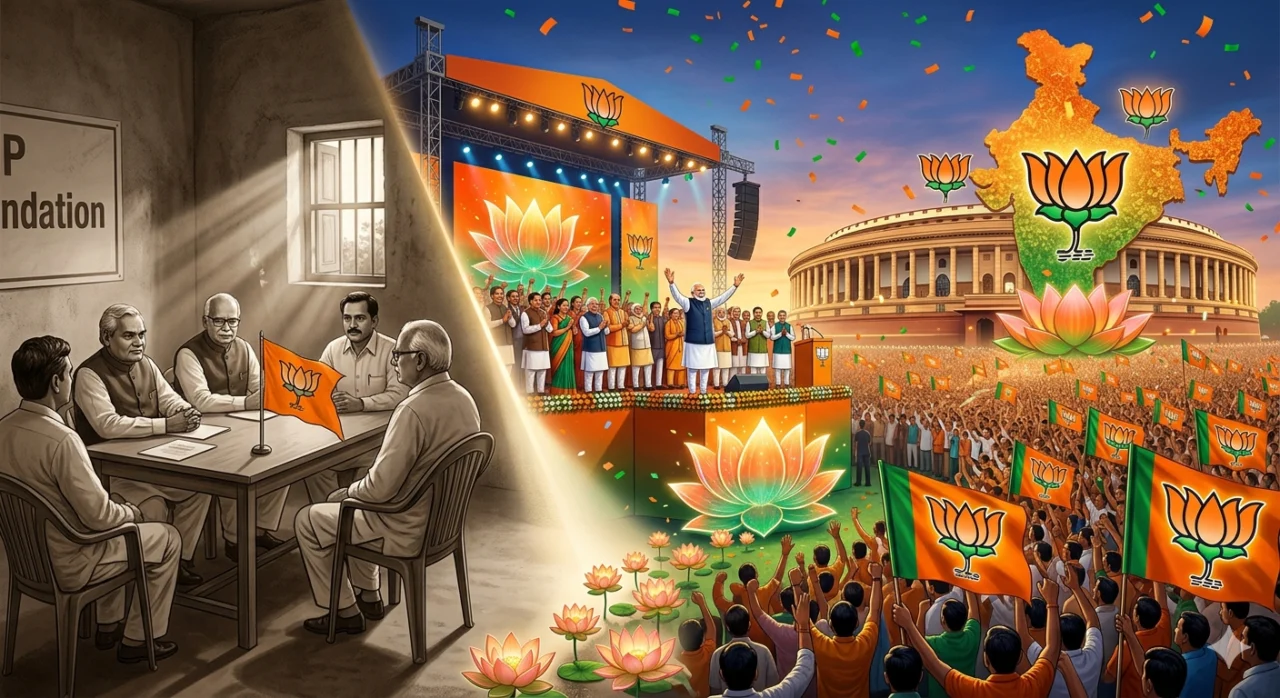
The journey of the Bharatiya Janata Party (BJP) is one of the most remarkable political transformations in modern democratic history. In just over four decades since its formal inception on April 6, 1980, the party has evolved from a marginal political force into the dominant axis of Indian politics. Today, it governs the world’s largest democracy and is the largest political party globally, in terms of both membership and influence.
Ideological Roots and Formation
The BJP’s origins can be traced back to the Bharatiya Jana Sangh, established in 1951 by Syama Prasad Mookerjee. The Jana Sangh was rooted in a nationalist ideology that sought to redefine India’s political identity along civilisational lines, drawing intellectual inspiration from the Rashtriya Swayamsevak Sangh (RSS).
The political upheaval caused by the Emergency, imposed by Prime Minister Indira Gandhi, led to the formation of the Janata Party in 1977, a coalition of anti-Congress forces, including the Jana Sangh. However, ideological contradictions within the Janata Party led to its disintegration in 1980, paving the way for the birth of the BJP under the leadership of Atal Bihari Vajpayee, its first president.
Early Struggles and Political Marginality
The BJP’s initial years were marked by struggle and limited electoral success. In the 1984 Lok Sabha elections, held in the aftermath of Indira Gandhi’s assassination, the party managed to win just two seats. This was in stark contrast to the landslide victory of the Indian National Congress, which secured an overwhelming majority.
Yet, even this modest beginning carried symbolic importance. Leaders like Chandupatla Janga Reddy and A.K. Patel emerged as early torchbearers, helping the party maintain a foothold in the national political landscape. The BJP used this period to consolidate its ideological base and expand its organisational network.
The Turning Point: Expansion in the Late 1980s and 1990s
The late 1980s marked a turning point for the BJP. In the 1989 general elections, the party increased its tally to 85 seats, signalling its arrival as a serious national contender. By 1991, it had firmly established itself as a major political force.
This period also witnessed the BJP’s shift toward assertive cultural nationalism, mobilising support through mass movements and grassroots campaigns. The party’s ability to connect ideological narratives with electoral strategy played a crucial role in its rise.
The 1990s culminated in the BJP forming the government at the Centre, first briefly in 1996 and later more durably under Atal Bihari Vajpayee in 1998 and 1999. Vajpayee’s leadership helped the BJP transition from a cadre-based party to a coalition-builder capable of leading the National Democratic Alliance (NDA).
The Modi Era: Consolidation and Dominance
The most decisive phase in the BJP’s rise began in 2014, when Narendra Modi led the party to a historic victory in the Lok Sabha elections. For the first time in three decades, a single party secured a clear majority on its own, marking a fundamental shift in India’s coalition-era politics.
In 2019, the BJP not only retained power but expanded its mandate, crossing the 300-seat mark in the Lok Sabha a feat it had never achieved before. Equally significant was its vote share, which exceeded 30 per cent, indicating that one in every three voters supported the party.
This period also coincided with the sharp decline of the Indian National Congress. From a high of 415 seats in 1984, the Congress was reduced to just 44 seats in 2014 and 52 in 2019. The inverse relationship between the BJP’s rise and Congress’s decline underscores a structural shift in Indian politics.
Expanding Footprint Across States
Beyond national elections, the BJP has achieved remarkable success at the state level. Today, it governs or shares power in 18 states across India, including politically significant regions such as Uttar Pradesh and Bihar.
The party’s longest tenures have been in Gujarat and Madhya Pradesh, where it has ruled for over two decades, albeit with interruptions. These states have served as laboratories for governance models that the BJP later scaled to the national level.
However, the party’s expansion has not been uniform. It continues to face challenges in southern states such as Kerala, Tamil Nadu, Andhra Pradesh, and Telangana, where regional parties dominate. Similarly, while it has made significant gains in West Bengal, it has yet to capture power there.
Strength in the Rajya Sabha
The BJP’s rise is also evident in the Rajya Sabha, where it crossed the 100-member mark for the first time since 1990. Although it still falls short of a majority in the 245-member House, the party has steadily increased its presence from just 55 members in 2014.
This growth reflects the BJP’s expanding control over state legislatures, which elect members to the Rajya Sabha. It also brings the party closer to achieving a historic milestone: becoming the first non-Congress party to secure a majority in both Houses of Parliament.
Organisational Strength and Membership
One of the BJP’s defining features is its formidable organisational structure. With a claimed membership exceeding 180 million, it is the largest political party in the world—surpassing even the Chinese Communist Party.
This vast network is built on a disciplined cadre base, largely supported by the RSS and affiliated organisations. The BJP has also embraced modern techniques, such as digital membership drives and data-driven campaigning, to expand its reach.
The party’s emphasis on grassroots mobilisation ensures that it remains connected to voters at the local level. This organisational depth has been a key factor in its consistent electoral success.
Ideological and Political Significance
The BJP’s rise is not merely an electoral phenomenon; it represents a broader ideological shift in Indian politics. The party has positioned itself as the custodian of a Bharat-centric worldview, advocating for the decolonisation of India’s intellectual and political frameworks.
Its governance model combines economic development with cultural nationalism, appealing to a wide spectrum of voters. This dual approach has enabled the BJP to transcend traditional caste and regional barriers, creating a pan-Indian political identity.
Challenges and the Road Ahead
Despite its dominance, the BJP faces several challenges. Regional parties continue to wield significant influence in states where the BJP has limited presence. Economic issues, social cohesion, and governance delivery will also shape its future trajectory.
Moreover, as the principal pole of Indian politics, the BJP must balance its ideological commitments with the practical demands of governance. The party’s ability to adapt to changing political dynamics will determine whether it can sustain its dominance in the decades to come.
From its humble beginnings in 1980 to its current status as a political juggernaut, the BJP’s journey is a testament to strategic vision, organisational strength, and ideological clarity. It has reshaped the contours of Indian politics, replacing the Congress-centric system with a new paradigm centred around itself.
As it celebrates its 46th foundation day, the BJP stands not just as a party, but as a defining force in India’s democratic evolution one that continues to influence the nation’s political, cultural, and ideological landscape.