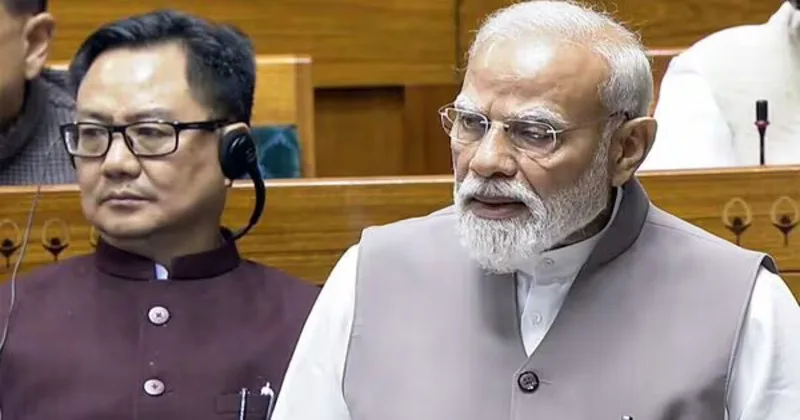
Prime Minister Narendra Modi addressed the Parliament(Lok Sabha) on March 23 amid escalating geopolitical conflict in West Asia. PM Modi mentioned the confrontation between the US-Israel axis and Iran that is flaring with larger regional repercussions as highly perplexed and worrisome. He asserted that the West Asia crisis severely impacted the global economy, global energy structure and the lives of millions of people. India has considerable strategic interests in the West Asian landscape in terms of energy security, safety of diaspora and other economic aspects, PM Modi added.
For example, nearly one crore Indians reside across the gulf countries and their safety is of utmost priority. Similarly, the vast majority of crude oil import to India is from the gulf region, which aids to sustain the Indian economy. India also has a huge extent of trade and commercial interests in West Asia that surpasses the benchmark of USD 100 billion. Critical vessels and large scale commercial shipments bound to India pass through West Asia encompassing a large number of Indian crew members, PM Modi illustrated the multi-dimensional strategic importance of West Asia to India.
Speaking in the Lok Sabha. https://t.co/BIrR385m4O
— Narendra Modi (@narendramodi) March 23, 2026
Safety of Indians is of utmost priority
PM Modi during his address to Parliament reiterated for the safety of the vast Indian diaspora residing across the conflict-ridden gulf region. During the phone conversation with the leaders of the various gulf countries, the Prime Minister said that he has stressed about the safety of the Indian community. All the leaders have in fact assured the safety and security of the Indian diaspora, PM Modi added.
Also, the Indian Embassy and consulates in the gulf countries ensure the safety of the Indians, issue regular advisories and 24/7 control rooms are operated for emergency assistance. PM Modi also highlighted that since the US-Israel and Iran conflict broke out on February 28 more than 3,00,000 Indians have been evacuated safely from the gulf region and have landed in India. Thousands of people have returned from Iran itself, PM Modi asserted.
PM Modi also said that CBSE schools operating in the gulf countries for the benefit of the Indian community have postponed the class 10 and 12 exams to ensure the safety of the students. PM Modi finally affirmed that the Indian government is ready to render all kind of assistance to the Indian diaspora in West Asia as their safety and well-being is the utmost priority.
Ensuring energy security
As India largely depends on the gulf countries to import crude oil, LPG, LNG and for other energy sources, since the conflict broke out, the Government of India is accelerating all measures to ensure the energy security of the country. For example, India is ramping up domestic production of LPG, PM Modi said. India is also in continuous contact with various gulf economies to ensure smooth transportation of the India-bound oil tankers and vessels through Strait of Hormuz and other critical routes. As an impact many oil or LPG vessels have been safely docked in Indian ports since the war began, PM Modi highlighted.
PM Modi also spoke about the energy import diversification strategy of India to ensure energy security. Prior to 2014, India was importing crude oil, LNG and LPG from only 27 countries. However, now this has been raised to a remarkable 41 countries. Thus, a major boon to the energy security of India. Also, the country has more than 3 lakh metric tonnes of strategic petroleum reserves. This is apart from the oil held with the private companies. The crude oil refining capacity of India has also increased, PM Modi mentioned the energy buffer and safety net of India as import from West Asia dwindles amidst escalating conflict. The government is also striving to further diversify its energy sources to ensure energy security of India, PM Modi affirmed.
India’s renewable energy march aids in the moment of crisis
PM Modi in his Parliament address also exclaimed how the overarching renewable energy initiatives taken by the government is helping the country to cope up with the energy demands during the time of conflict. For example, continuous effort of the government towards ethanol blending has helped to reduce dependency on oil imports. Today, petrol contains 20 per cent of ethanol. Similarly, electrification of railways, consistent encouragement to adopt electric mobility, vast network of metro across the country have reduced our vulnerability to oil crisis, PM Modi asserted.
These are the long-term strategic vision of the government coming to aid during the crisis and helping to run the Indian economy in an unhindered way. Thus, PM Modi stated that energy is the global economic need and West Asia is the biggest source to fulfill global energy demands. Thus, India is ensuring all necessary measures to reduce the adverse impact of the energy crisis. In this direction, India has taken many short-term, medium-term and long-term goals to ensure the energy security of India even during unforeseen emergency scenarios.
India assures protection of farmers interests
PM Modi also stated that the interests of the farmers will be protected at any cost and the heat of the conflict will not haunt the agricultural sector. In this direction, India is scaling up domestic production of urea fertilizers to deal with the shortage encountered due to the West Asia crisis. New Delhi is also working towards import diversification of the urea and other fertilizers. Also, encouraging farmers to take up domestic fertilizers, organic manure and other nature-friendly agricultural methods to cope up with the fertilizer shortage, PM Modi stressed.
Further, farmers are encouraged to use solar pumps thus reducing their dependency on diesel. These visionary renewable measures from the government are indeed aiding to protect the interests of farmers at times of global conflict. Also, as summer is nearing demand for electricity/power supply will spike. To fulfill the needs of the people, the government is stepping up domestic coal production, ensuring unhindered power production and supply. Also, encouraging people to switch to renewable sources such as rooftop solar, gobar gas etc., PM Modi highlighted. Also, the ramping up of production of civil nuclear energy under the SHANTI Act will help to fuel the energy demands of India. Thus, the decades of policy vision and efforts of the government are reaping fruits today amidst the crisis, PM Modi stated.
India is prepared to deal with the crisis as it did during covid
Prime Minister Narendra Modi illustrated the preparations of India during the covid-19 pandemic. How the country successfully overcame the pandemic similarly, the government is preparing to successfully deal with the impact of the West Asia crisis as well. During covid, the global supply chain was severely disrupted. However, India ensured the fulfillment of all the basic necessities. Similarly, India will ensure its energy security and other economic or security priorities during the conflict in West Asia, PM Modi affirmed.
The Prime Minister finally urged the warring parties to de-escalate and take the path of dialogue, diplomacy and conflict resolution. He reiterated for the safety of the Indian diaspora, safe passage of the Indian vessels and committed to ensure the energy security of the country. PM Modi asserted that humanitarian causes and peace should prevail. India counters every challenge with long-term vision, clarity and strategic patience, PM Modi concluded.