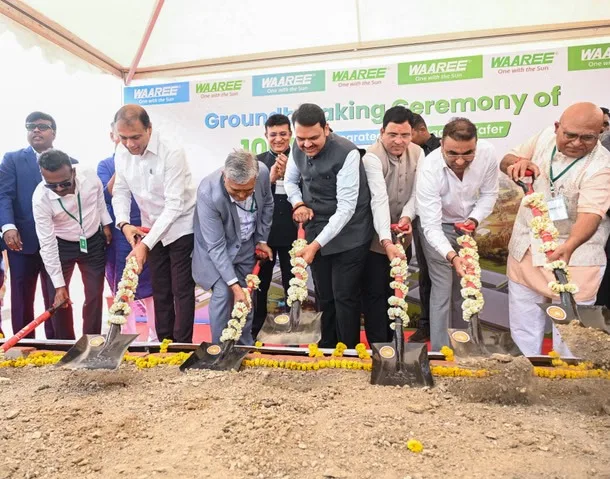
Expanding India’s renewable energy manufacturing capacity, Devendra Fadnavis performed the groundbreaking ceremony for a massive solar manufacturing facility being developed by Waaree Energies.
The project, located in the Butibori industrial area of Nagpur, will be India’s largest integrated solar ingot and wafer manufacturing complex once completed.
The ceremony marked the beginning of construction for the ambitious project, which is designed to significantly strengthen India’s solar manufacturing supply chain and reduce dependence on imported materials used in photovoltaic technology.
The upcoming facility will be developed with an estimated investment of approximately Rs 6,200 crore and will be spread across nearly 300 acres of land.
Once operational, the plant will house a manufacturing capacity of 10 gigawatts (GW) each for solar ingots and wafers. These components form the critical base materials used in the production of solar photovoltaic cells and modules.
Reports say that establishing domestic capacity in ingot and wafer production is crucial for India’s long-term renewable energy ambitions. At present, a significant portion of these materials is imported, particularly from global manufacturing hubs.
By developing domestic capabilities at such a large scale, the project aims to strengthen India’s position in the global solar manufacturing value chain.
The Butibori project is expected to play a major role in expanding India’s upstream solar manufacturing sector, which currently has limited domestic capacity.
Solar ingots and wafers are essential building blocks in the solar photovoltaic manufacturing process. They serve as the base material from which solar cells and modules are ultimately produced.
With this facility, India is expected to significantly increase its domestic production of these critical components, thereby improving supply chain resilience and supporting the country’s renewable energy targets.
The project aligns closely with the Government of India’s broader push to build self-reliance in strategic manufacturing sectors under the vision of “Atmanirbhar Bharat.”
Beyond its industrial significance, the project is expected to deliver major economic benefits to the region.
Officials estimate that the facility will generate more than 8,000 direct and indirect employment opportunities once operational. These jobs will include roles in manufacturing, engineering, logistics, supply chain management, and associated services.
The project is also expected to contribute to regional economic development in Maharashtra by attracting ancillary industries, creating new skill development opportunities, and strengthening the state’s industrial ecosystem.
The establishment of a large-scale manufacturing complex is likely to further enhance Nagpur’s position as a growing industrial hub in central India.
Speaking on the occasion, Hitesh Doshi highlighted the strategic importance of the project and the choice of location.
Doshi noted that Nagpur offers strong logistical advantages due to its central location within India and its connectivity to major industrial corridors across the country.
The region also possesses a well-developed industrial ecosystem and infrastructure, making it an ideal destination for large-scale manufacturing projects.
He expressed gratitude to the Maharashtra government for extending support and facilitating the development of the project.
Founded in 1990, Waaree Energies has emerged as one of India’s leading renewable energy manufacturers.
The company currently operates advanced manufacturing facilities with a global solar photovoltaic module production capacity of approximately 22.3 GW.
In addition to module manufacturing, the company also has solar cell manufacturing capacity of up to 5.4 GW.
With the addition of the Nagpur facility, Waaree aims to further expand its presence across the solar manufacturing value chain by strengthening upstream production capabilities.
The Butibori facility is expected to significantly increase India’s domestic ingot and wafer manufacturing capacity. According to company estimates, the project could potentially quintuple the country’s current capacity in this segment.
Such expansion is considered critical for supporting India’s long-term clean energy transition. As the country accelerates its adoption of solar power to meet climate commitments and energy demands, reliable domestic manufacturing infrastructure becomes increasingly important.
By reducing reliance on imports and strengthening supply chains, the project will help ensure greater energy security while supporting the growth of India’s renewable energy sector.
The initiative also reflects India’s broader strategy of building a robust domestic manufacturing ecosystem capable of supporting the nation’s rapidly expanding solar power capacity.