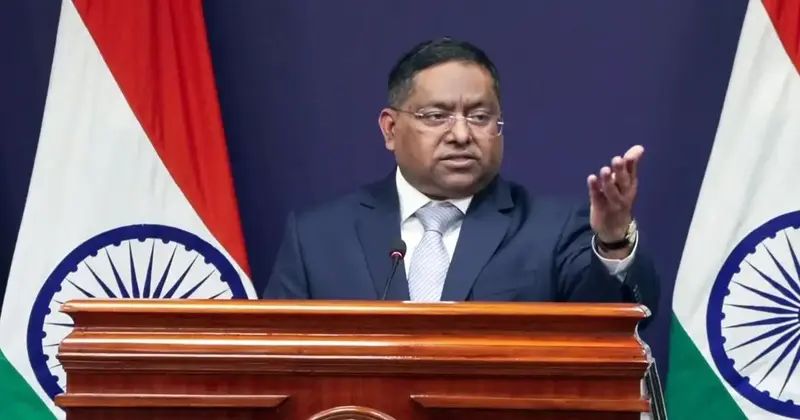
New Delhi: The Ministry of External Affairs(MEA) on March 12, Thursday rejected Pakistan’s statement on the India-Canada nuclear cooperation agreement, asserting that India’s credentials on non-proliferation are impeccable. During a press briefing, MEA spokesperson Randhir Jaiswal said the statement by Pakistan is baseless. He emphasised that India’s commitment to non-proliferation is well-recognised globally, while Pakistan, with its documented history of clandestine nuclear proliferation, lacks credibility in commenting on export controls or proliferation risks.
“We reject this statement made by Pakistan on the matter. India’s credentials regarding non-proliferation are impeccable and well recognised by the global community. A country with a well-documented history of clandestine nuclear proliferation can hardly preach the virtues of export controls and proliferation risks. Such ludicrous statements are nothing more than an attempt by Pakistan to distract from its own abysmal record”, MEA statement said.
Earlier, Pakistan had expressed concerns over the long-term uranium supply deal between India and Canada and potential cooperation on small modular reactors and advanced nuclear technologies. Pakistan’s Ministry of Foreign Affairs spokesperson Tahir Andrabi argued that civil nuclear cooperation must follow a non-discriminatory, criteria-based approach applicable to all states outside the Nuclear Non-Proliferation Treaty(NPT). He claimed that selective exceptions weaken global non-proliferation norms and could destabilize regional and international peace and security.
Andrabi also criticised India for not placing all civilian nuclear facilities under International Atomic Energy Agency(IAEA) safeguards, raising questions about non-proliferation assurances accompanying the agreement. He suggested that assured external uranium supplies could free India’s domestic reserves for military purposes, potentially accelerating the growth of its nuclear arsenal and deepening strategic asymmetries in South Asia.
India and Canada have significantly strengthened their bilateral partnership by sealing major agreements on the supply of uranium and critical minerals, while committing to a target of USD 50 billion in annual trade by 2030. Following high-level discussions on March 2, Prime Minister Narendra Modi and his Canadian counterpart, Mark Carney, finalised a strategic framework aimed at revitalising a relationship that has transitioned toward “new energy, mutual trust and positivity”. A cornerstone of the visit was a USD 2.6 billion agreement for long-term uranium supply, intended to bolster India’s civil nuclear energy sector.
Prime Minister Modi highlighted the depth of this collaboration, stating, “In civil nuclear energy, we have signed a landmark deal for long-term uranium supply. We will also work together on small modular reactors and advanced reactors”.
Also Read: BNP’s electoral victory sparks debate over future of democracy in Bangladesh
MEA rejects Pakistan’s allegations on aggravating skirmishes with Afghanistan
MEA also rejected Pakistan’s allegations of aggravating skirmishes with Afghanistan, calling them “baseless” and accusing Pakistan of blaming others for its own misdeeds. During the weekly press briefing, the Ministry of External Affairs spokesperson, Randhir Jaiswal, dismissed Pakistani claims and stated that Pakistan’s history of state-sponsored terrorism undermines its credibility.
“On Pakistan, about the statement that they had made. So, on that, I would like to say that we reject such baseless allegations. It has become second nature for Pakistan to blame India for its misdeeds. As a state sponsor of terrorism for decades, Pakistan has zero credibility when it comes to cross-border terrorism; no amount of storytelling is going to alter this reality, nor is anyone fooled by Pakistan’s assumed victimhood”, he said.
Pakistan and Afghanistan have exchanged airstrikes and claims of casualties along the Durand Line in February. Pakistan launched air strikes on Afghanistan’s capital, Kabul and other cities, as clashes escalate along the two countries’ shared border. On February 27, Pakistan launched airstrikes targeting Kabul and other Afghan cities. Pakistan’s Defence Minister, Khawaja Asif, declared an “open war”, stating that Pakistan’s “cup of patience has overflowed”. He accused the Taliban of harbouring global terrorists and exporting militancy. The Afghan Ministry of National Defence claimed that 55 Pakistani soldiers were killed in retaliatory operations along the Durand Line on February 26. The Durand Line dispute and the Taliban’s return to power in 2021 have fueled tensions between Pakistan and Afghanistan, with frequent clashes reported.
(With Inputs from ANI)