After 800 years of invasionary Islamic rule, resulting in the destruction of temples, gurukuls and therefore the associated livelihoods of artisans dependent on the traditional temple systems for their own survival, India bore colonisation under various European rulers, including the British via their East India Company in Bengal. This ‘business house” was established via a bloody Battle of Plassey, leading to the infamous “Black hole of Calcutta” term coined by the British to galvanize the British Crown into adopting even more barbaric methods to crush the natural Indian desire for autonomy. The massacre of Sanyasis in Bengal, who had opposed the destruction being practiced by this new foreign oppressor, caused Indians to rise in anger against this unholy massacre, sensing the attempt to erase their own civilizational identity with the death of their religious and spiritual leaders: those who were the bastions of traditional Sanatan Dharma.
When the British therefore began establishing their railways in India, Indians recognized that this was a further effort to smuggle away their own resources into the coffers of this foreign ruler, and as the decades progressed, Britain extended contracts to other railway companies in various regions of India, not simply for the commercial transport of raw material into the harbours to be shipped to England, but for transport of the Indian people themselves, into these same harbours particularly in Calcutta and Madras, to the British plantation colonies overseas as labourers. This, and an array of human abuses, from man-made famines, duplicitously termed as droughts in India, to crushing taxes imposed on Indian villages, to the confiscation of property from families, claiming only sons could be legitimate heirs to inherit, roused Indians into fighting for their freedom from this tyrannical rule of their land and people.
When Indians were sent to Trinidad in 1845 therefore, this was the background present in India: something which colonial apologists mask, saying only instead that India was poor and backward and Indians were happy to flee, leaving family and motherland behind, but meticulously omitting who it was that was making India poor. Yet history cannot be concealed forever. By 1857, Indians were ready for a methodically planned overthrow of foreign rule and their combined efforts in that year, brought Britain to its knees. So terrified was Britain, that the East India Company was disbanded and brought directly under the control of the British Crown and the British began an open policy of human trafficking to remove the Freedom Fighters from Indian soil, in terror of further uprising from them, which might lead to the collapse of British rule in India.
British-trained historians in the distant plantation colonies, even in the current era, propagate the aim of Britain to create loyal British subjects, with the intention of espousing British history, culture and religion as superior to that of the Indians. Claiming that only impoverished labourers happy to flee a caste-ridden India, were those shipped overseas, the British tacitly hid that Indians from all backgrounds were affected by the inhumane laws passed by the British Government, aiming to replace the Indian civilization with a British one. But by forcing Indians of all professional backgrounds abroad, Britain failed to erase their traditional knowledge and skills. Presumptuously assuming that driving them into a slave-like labour system, thousands of miles away from their homeland, would have resulted in the degradation and loss of their millennia- old identity and practices, Britain demonstrated an arrogant oversight, namely, that the same Indians who were so keen to fight for their freedom from imposed British rule in India, would simply abandon this loyalty to their identity, knowledge and traditions in a new environment.
Instead, the reverse occurred. As far as possible, in the absence of elders and a larger ancient, familiar societal structure, these Indians retained their culture not simply out of respect for their own struggle in their motherland before their transportation and effectual incarceration overseas, but as part of their Dharma, that is, their perceived duty, that no matter the circumstances, they were obligated to retain and practice their duty via their professions, to the best of their ability, regardless of the results. This psyche of duty then, could not be erased just by a change of environment. It indicates too, that this retention of traditional knowledge systems, whether in punditai, music, dance or education, was itself a means of carrying on the struggle for India’s freedom from foreign domination and oppression.
This historical background is critical in truly appreciating the retention of Indian values among the Indians of the West Indies, an earlier Indian Diaspora, different from the Non-Resident Indians and now termed as the People of Indian Origin. Their deliberate adherence to ancient morals and values despite time and distance, are worthy of respect especially when they intentionally do so in a Western environment, with little to no support from the wider Indian population in a now independent India.
Consequently, when the Indian Prime Minister was welcomed in Couva, Trinidad, on the 3rd of July 2025 with the beat of massive Tassa drums by the musicians from the Swaha Hindu College, this was not an ordinary cultural display meeting the Indian leader. This was an echo of centuries of resilience and pride in identity and tradition, from the descendants of those first ‘shipped overseas’ by the British 180 years earlier. Notable among these Tassa players was a girl beating the largest Tassa drum, reminiscent of the Ganapati Utsav festival in Maharashtra where girls march while beating such drums, chanting “Ganapati Bappa Morya!”. Mrs. Savitri Maharaj-Ramdial, a retired Secondary School principal, whose family was instrumental in both temple and school construction in southeast Trinidad, was interested to meet this Tassa player to learn how she had acquired skill in this cultural instrument and balanced it with her academic and later professional life. The retired Principal approached the editors, Prof. Kapil Kumar and Dr. Maharaj-Ramdial, and hence, this article with Ms. Sapna Ramlochan was born: who was not only a Tassa player but a clay murti sculptor.
Sapna came from Sangre Grande, a borough with a Spanish name which means, ‘Plentiful Blood’, referring to a fierce war between the Carib tribe of indigenous Amerindian people who originally inhabited Trinidad, giving their name to the entire Caribbean region, when the Spanish conquistadores attempted to annihilate them, some 500 years ago. This area of Northeast Trinidad remained mainly unsettled for the consequent centuries due to the continued presence of Carib descendants, but when the 19th century arrived, the new European colonisers: the British, sought to utilize more areas of the island for their personal economic prosperity and hence sent Indians to this region of Trinidad primarily to work on cocoa and coffee estates in the densely forested region. There was no animosity between the Amerindian and Indian people and today the area is a thriving economic one, containing the descendants of both as well as other races.
Despite this northeastern area being more remote than the western coastal region which the British used as harbours for the Indians they forcibly brought to Trinidad, Indians retained their customs, religion and heritage regardless of which part of Trinidad they were sent to. This was not limited to speaking their traditional languages for generations, which has only now been largely lost, but by the retention of their art forms, value system and respect for their heritage, despite their motherland India now being some 10,000 miles away. Regardless of little to no way to ever return to India, which was under British rule, just as was Trinidad, the inherent love for their homeland defied the obstacles of time, distance, language, racial discrimination and indeed, neglect from India, to result in the private construction of temples and schools by the Hindu community which simultaneously maintained its’ heritage and grew financially prosperous. It is due to this presence of temples and schools that Sapna’s artistry in music and sculpting was nurtured.
This, therefore, is not a story of a remote region in a far away island with an alienated pocket of primarily north Indian descendants, who held onto a traditional culture despite isolation, but one of Indians who defied all odds, while engaging with others in a Western society, which was also shaped by Macaulayan principles of enforcing Indian inferiority and imposing British superiority. British politician Thomas Macaulay’s English Education Act of 1835, while devised for the era, ensured the preservation of India’s traditional knowledge and identity, and also shaped the perception and teaching of Indian history and heritage in all British colonies, even in their post-independence era. Consequently, this is an account where Indians outside India, collectively enforced their ancestral history by associating themselves even more strongly with their heritage, unflinchingly to the present generation, and consciously refused to be coloured by the colonial narrative which surrounded them.
Sapna’s story then, is not a singular exception of Hindu artistic cultural retention in Trinidad, but a moving example of how Indians abroad conscientiously retained their identity while many in India, who remained in their own homeland, renounced this identity and sought to adopt that of the West instead. The Macaulayan mentality worked in India, but oddly enough, not so well in other British colonies, where Indians were not in the majority and therefore faced not just political but societal opposition to retain their heritage and culture, and yet still did.
In this area then and with this historical context, we have Sapna, who on her own began playing the Tassa around the age of 12 after she had entered the Swaha Hindu College in 2005 and eight years later, she sculpted her first murti of Lord Ganesh. This indicates two things: that the generations of those of Indian origin in Trinidad, who had been forced out of India 180 years ago by the British for daring to fight against British rule, did not only preserve Hinduism and cultural ancestral traditions as their wealth, but transmitted them in the contemporary scenario so rigorously that many of in India cannot replicate it. In addition, the Hindu schools in Trinidad have played a major role in sustaining and promoting Hinduism; its culture, art forms and festivals and Sapna is one among the many students, who even after graduation and as a young adult, voluntarily chooses to carry forward Hinduism in spite of aggressive conversion attempts by the preachers of other religions.
Besides the schools, it is also the family environment that motivated the young and according to Sapna, “I learnt from observing and practicing with my eldest brother, Amitraj. I then went on to play at events with him and my uncles and cousins.” Fully committed to this musical tradition, her family makes their own drums, in which her brother Amitraj specialises. “At that time, females in Tassa drumming weren’t a common sight, so being maybe the first or one of the first and very few females around playing the instrument that I chose to play, that was my motivation. I was driven by being a young lady, navigating a traditionally male dominated field.” Her parents’ support turned out to be the greatest strength besides her other family members like her aunts, uncles, three brothers, Amitraj, Aditya and Arun and their families. Friends Sachin and Suraj also encouraged and perform with her. Often, they play and practice rhythms, sometimes even creating new beats. On occasions like Ramleela and Ganesh Utsav they volunteer their performance, whic,h according to her, is a “balance of discipline, fulfillment and love towards our drumming.”
Despite her innate talent and the supportive family environment, she saw playing the Tassa publicly as a challenge for her as a female. Rather than withdraw though, this perception of it as a challenge drove her to master the art of drumming by rigorous practice. Another instance perhaps of the ancestral determination to retain our culture regardless of perceived difficulty. This honing of her skills, led to appreciation of her performances, which in turn further developed her confidence. While performing on stage while drumming she stated, “When I perform at first, I feel nervous and then it fades away as I feel proud and energized. The audience is always a huge encouragement.”
In a traditionally male-dominated field, without any inferiority complex she now proudly performs and expresses her emotions. In her own words, “I grew up around Tassa, stemming from my grandfather, uncles, eldest brother and male cousins, and I was always exposed to my heritage throughout my home and school life, which made me curious and eager to learn.”
It was this a combination of growing up in a Hindu home, attending a Hindu school and the influence of temple attendance that had evoked the opportunities for her to master the art of drumming as a musician and then decide to develop herself in other forms of art, by becoming a sculptor to create murtis. In this regard, having participated in the school’s Ravana effigy burning for Ramleela, she was inspired to create a Holika structure on her own for her temple during the Phagwa celebrations.
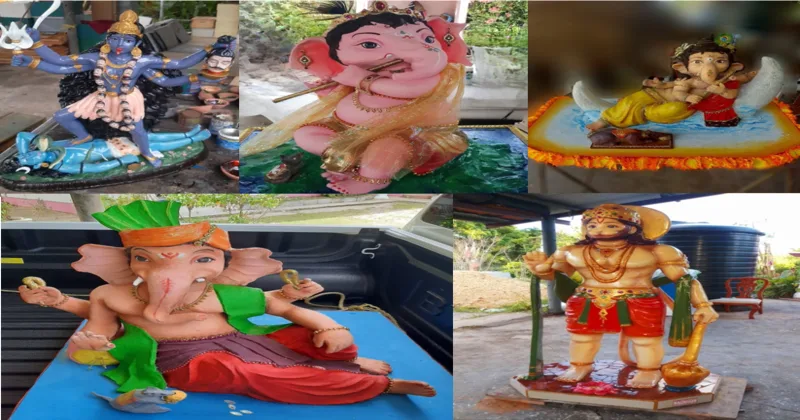
Then in 2013, she was asked to create a murti by the Swaha Tulsi Manas Mandir. The only knowledge she had about the Ganesh Utsav was through her attending the drumming at the Visarjan of the Ganesh murti but had no experience in clay work of creating a Murti. However, she took it as yet another challenge, as she had a deep desire to keep the religious tradition alive and a sense of pride in showcasing Indian heritage. She succeeded. After this, there was no going back and in her own words, “Creating murtis equally attracts me [as does drumming] for a different yet equally powerful reason; the beauty of crafting and the connection it brings. Knowing that people honor my murtis in worship and offer well-wishes and blessings unto me, that fills me with contentment and gratitude which motivates me to keep creating. Both drumming and murti-making allows me to explore my skills, embrace and successfully overcome challenges, all while sharing something meaningful with others.”
The general appreciative attitude towards retaining Hindu culture was demonstrated by the wider Trinidadian Hindu society as temple members and Hindu spiritual leaders came forward recognising the talent of this young lady. She was invited to perform more Tassa performances, while concurrently, the demand for her clay murtis increased.
She herself took the decision to engage in sculpting with reverence, and still collects the material for these clay murtis with her family members by visiting the local nearby river banks to source the clay themselves, sometimes accompanied by temple members. The preparation for her art work starts with a simple prayer, a lit diya and bhajans in the background. According to her, many of the traditional Indian techniques of making murtis have been preserved in Trinidad though local adaptations have also been added. Online videos of making murtis in India are a secondary source of learning. Having created a life size concrete Murti of “Hanuman Baba” Sapna also plans to work on other forms of murtis. Like a true artisan, Sapna pushes herself forward with the desire to excel in handcrafting the murtis in order to achieve unique and enchanting designs. She learns by watching the videos of professionals and expressed her hope of visiting India to refine her skills further and interact with sculptors and artists.
Just like her desire to learn, she is also expansive in hoping that other young people are encouraged to embrace these traditions for playing the Tassa or murti making as they are, “…Not just arts but living parts of our identity”. She considers this as, “carrying forward the wisdom of ancestors to inspire contemporary and future generations.” True to her desire that other young people enter and engage with these forms of art, Sapna encourages young children to learn the art of shaping clay murtis and tries to engage whoever is nearby also in the process whether a niece or an aunt. She derives a sense of spiritual fulfillment, knowing that she has done something worthwhile as the murti will be used in worship and devotion. This makes her feel humbled and gives an innate feeling of completion of having fulfilled a purpose. She also believes that honouring and preserving these art forms, makes her celebrate the shared history of India and Trinidad that has kept the ancient creativity and culture alive.
As regards her achievements and continuity in both the fields she stated, “the beauty of a completed Murti, the process and overcoming the challenges, the amazement and joy of an audience during a Tassa performance, all bring about a sense of feeling that I was “chosen” for this. It feels like serving a purpose.”
Tassa drumming, though waning its popularity in India, remains extremely popular in Trinidad during weddings, festivals, cultural events, religious occasions as well as private celebrations. It is for this reason that it was selected as one of the celebratory ways to honour the arrival of the Prime Minister of India in July 2025, for which Sapna herself was commended at the Mahatma Gandhi Cultural Centre in August 2025 by the Indian High Commission. For her, “It was an absolutely exhilarating experience, one that filled me with pride and endless gratitude for getting the chance to showcase our culture before such an esteemed and distinguished guest. A proud moment in my family, my temple, my community and by extension my country. It was indeed an unforgettable honour.”
This mentality of pride in her heritage and Indian culture was shared by others in the audience, who, while not being performers, still proudly shouted “Jai Shree Ram” and “Bharat Mata Ki Jai” during this visit. For the Indian descendants in Trinidad, there is immense delight in saying Sitaram and Jai Sri Rama, as this population still regularly uses these traditional greetings among fellow Hindus. Another area then, in which the Macaulayan mindset failed to corrupt self-esteem in their religion and identity. While Hindus in India now proclaim these chants since the rebuilding of the long-awaited and much cherished Rama Mandir in Ayodhya, there are Hindus who staunchly retained respect and pride in Sri Rama, despite never being in India for generations nor seeing the new Sri Rama Mandir either. Sapna’s work and performance then, some 10,000 miles away from India, should certainly inspire Hindu girls in India to devote some years of their lives in actively engaging in their religion and culture, beyond festival celebrations, through rich art forms which remain highly admired and cherished far outside of Bharat as a mark of reverence for the adherence to ancient professional skills which foreign invaders and colonizers sought to eradicate. Their continuation, through such artisans in the present, goes hand in hand with the continuation of Hinduism itself through its cultural practices and religious customs.