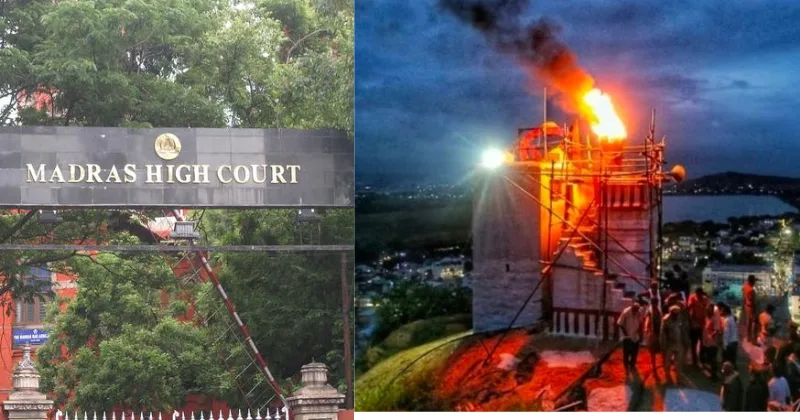
Madurai Bench of Madras High Court has suggested that the Tamil Nadu government allow a group of five persons named by the court to offer symbolic prayers (not lighting a lamp) atop the Thiruparankundram hill for 15 minutes to prove the govt shows respect to the earlier orders of the court.
Justice G R Swaminathan, while hearing the contempt proceedings initiated against the Madurai District Collector, CoP, Dy. CoP and Temple EO for not implementing the court orders, was dealing with a Contempt Petition filed under Section 11 of the Contempt of Courts Act, 1971 to initiate contempt proceedings against the contemnors/respondents and punish them for the wilful disobedience of the order of the High Court in WP(MD)No.33197 of 2025 dated 01.12.2025.
The judge said, “This is only a suggestion and not a direction”. Earlier, the state submitted that it would get back to the court after consulting higher authorities. The matter was posted for hearing at 4 pm on March 4.
Earlier, the Madurai Collector filed an additional affidavit stating that he promulgated the prohibitory orders on December 1, 2025 only to prevent a law and order situation and not to hinder temple authorities from enforcing the HC’s order to light deepam at the stone pillar atop the hill.
In his affidavit, the District Magistrate KJ Praveen Kumar said, “One factor that I had kept in mind was that the temple management/Devaswom would be enabled to implement the said order only if there is no law and order situation in the hillock area. The prohibition issued under Section 163 of BNSS, 2023 by me definitely did not contemplate the hindrance to temple officials/Devaswom lighting the lamp in accordance with the judgment of the Hon’ble High Court dated 01.12.2025.”
In his response, Justice GR Swaminathan said, “I suggest that respect to the order passed by this Court can be shown by permitting a group of exactly five persons to be named by this Court to go to the lower peak of the hillock where Deepathoon lies so that symbolic prayers can be offered. I further indicate that this entire exercise can be confined to 15 minutes. This is only a suggestion and not a direction.”
The judge said, “There is a saying that the proof of the pudding lies in the eating. The fact remains that on account of the prohibitory order passed by the District Collector, Madurai, the order passed by this Court was frustrated. The police took shelter only behind the order passed by the District Collector and, in fact, they made it clear that they were only enforcing the order passed by the District Collector while resisting the implementation of the order passed by this Court.”
The court said, “Senior Counsel as well as the Additional Advocate General submitted that they would get back on the suggestion made by this Court. Call this case on 04.03.2026 at 4.00 pm. Though the appearance of the contemnors, the Madurai Police Commissioner and Deputy Commissioner of Police, was earlier dispensed with, the court directed them to be present along with the jurisdictional Assistant Commissioner of Police and the Inspector of Police. The present trustees of Arulmigu Subramania Swamy Temple as well as its Executive Officer shall also be present in court. The Madurai Collector, the 4th contemnor, need not be present and could be represented by his counsel.”
Not satisfied with the reasons and unconditional apology offered by the Madurai District Magistrate in the lighting of Deepam at Thiruparankundram case, the court, on February 2, had directed the District Magistrate to file an additional affidavit and posted the matter to March 2, before questioning how the Collector passed prohibitory orders that frustrated the Court’s directions.
Justice Swaminathan closed a sub-application seeking to initiate contempt proceedings against State Minister S Regupathy for his reported statements relating to the Karthigai Deepam lighting issue. He said, “I conclude that Regupathy has given a mischievous political spin to the turn of events. Whether the issuance of prohibitory order by the Collector is an act of contempt or not is the subject matter of proceedings before the court. The rule of sub judice will kick in. Let the minister bear this principle in mind. In view of the stand taken by the Collector that he rejects the theory propounded by the minister, I deem it fit to close this sub-application. I make it clear that I will not hesitate to reopen this sub-application if the occasion demands.”
Adding further, the judge said, “I have no doubt that the statement attributed to the minister deserves severe condemnation. When the writ court had permitted lighting the lamp atop the hill, it is only the division bench or the Supreme Court that can hold otherwise. It is not for any other authority, let alone the State minister, to dare to say that such lighting cannot be permitted. When the matter has come within the domain of the court, the parties to the lis have to abide by the outcome of the judicial proceedings. After a verdict is pronounced, the only option open to parties is an appeal or review. One cannot pronounce opinions contrary to a judicial verdict in public. One can comment on or criticise the judgment. But the role of a regulatory authority ends when the court has given its judgment. It is shocking that such elementary knowledge is lacking on the part of a person who held the high office of Law Minister.”
DMK Minister Regupathy on January 7 told a Tamil daily, “If deepam was lit as per court orders, it would become a practice. Prohibitory order was imposed to stop lighting atop the hill. If it has to happen in one place it should happen in that place only. Dead bodies can be cremated only at the crematorium, not in every place. We will not allow lighting a lamp at a new place.”
His comments comparing the sacred Deepam to funeral fire, according to critics, amounted to disrespect to the Deepam.