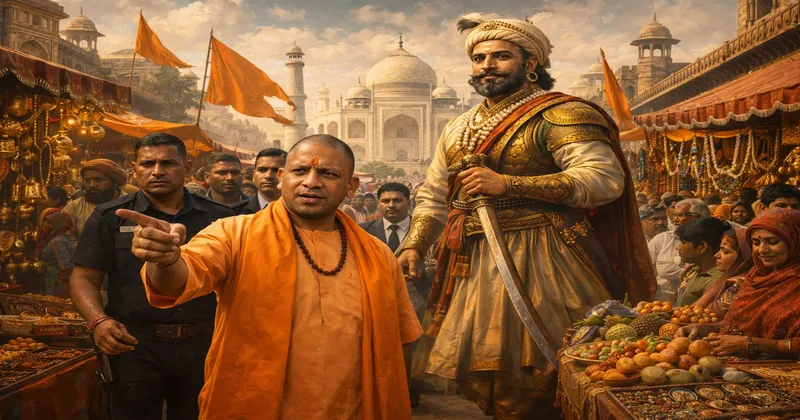
LUCKNOW: In a decisive blow to the crumbling facade of the Congress-led ecosystem and its anti-Hindu allies, Uttar Pradesh Chief Minister Yogi Adityanath has systematically dismantled the glorification of invaders that these parties nurtured for decades. For seventy years, the Congress and their ‘secular’ partners deliberately suppressed our civilisational pride to appease a specific vote bank, choosing to romanticise tyrants while burying the truth of our ancestors’ struggles. Standing tall during the discussion on the Budget in the State Assembly, the Chief Minister stripped away the romanticised veil of the Mughal era, exposing the dark, sordid history of Agra’s Meena Bazaar and announcing a monumental correction of history: the construction of a grand memorial to Chhatrapati Shivaji Maharaj on the very soil where tyranny once reigned.
Exposing the ‘Bazaar of Shame’
For decades, textbooks written with a biased lens portrayed the Meena Bazaar of Agra as a vibrant hub of Mughal culture and commerce. However, CM Yogi Adityanath has fearlessly called out this historical whitewashing. In a hard-hitting statement, the Chief Minister asserted that the Meena Bazaar was never a mere marketplace; it was a systemic tool of exploitation designed by Mughal rulers to demean the honour and dignity of Hindu sisters and daughters.
“How can our heroes be Mughals?” the Chief Minister questioned, echoing the sentiments of millions who believe that the celebration of invaders is a mark of a “slave mentality.” He emphasised that the Meena Bazaar served as a site of subjugation, where the modesty of the land’s original inhabitants was traded for the pleasure of the ruling elite. By acknowledging this historical trauma, the Yogi government has taken the first step toward healing centuries-old wounds by replacing a symbol of shame with a beacon of valour.
The Lion Returns to Agra
The centerpiece of this civilisational reclamation is the Chhatrapati Shivaji Maharaj Memorial and Museum. For too long, the narrative of Agra was confined to the marble tombs of invaders. Today, the focus shifts to the Hindavi Swarajya. It was in Agra where Chhatrapati Shivaji Maharaj famously looked the tyrant Aurangzeb in the eye, refused to bow, and executed a legendary escape that changed the course of Indian history.
The proposed memorial at the Kothi Meena Bazaar ground is not just a structure of stone and mortar; it is a declaration of identity. CM Yogi has directed that the museum be a “living, interactive experience.”
Dismantling the Mughal Narrative
The Yogi government’s crusade against the “Mughalization” of Indian heritage is relentless. The Chief Minister reminded the Assembly that the museum, originally conceived by the previous Samajwadi Party government to glorify Mughal history, has already been officially renamed the Chhatrapati Shivaji Maharaj Museum. “Our relationship is with Chhatrapati Shivaji Maharaj, not with the Mughals,” Yogi Adityanath declared, striking at the heart of the Islamic-inclined historiography that has dominated India’s academic landscape for 70 years. The message is clear: the era of glorifying those who destroyed temples and enslaved people is over. In the New Bharat, the statues of invaders will find no place, and their names will be erased from the pedestals of honour.
While the Shivaji Memorial stands as a sentinel of cultural pride, CM Yogi Adityanath’s address also highlighted a massive developmental overhaul that is transforming the face of Uttar Pradesh. The Chief Minister unveiled a slew of projects that prove that Vikas (Development) and Virasat (Heritage) go hand in hand.
Restoring the Sovereignty of Faith
The Chief Minister highlighted the miraculous transformation of our holiest sites. Icons of Hindu resilience- Kashi Vishwanath Dham, Ayodhya Dham, the Vindhya Corridor, Chitrakoot, and Naimisharanya – have been liberated from decades of infrastructural apathy.
“These are not just tourist spots; they are the beating hearts of our faith,” the CM asserted. By fortifying these centers with world-class amenities, divine lighting, and seamless connectivity, the government has ensured that devotees from across the globe can finally witness the majesty of Hindu heritage in its rightful, grand form. The massive surge in footfall is a direct answer to those who sought to diminish the influence of our temples.
Reviving the Epic Centers of History
The Chief Minister announced that the sacred soil of Hastinapur, Sarnath, Shravasti, and Bateshwar—the ancestral village of the great Atal Bihari Vajpayee – is being elevated to “Iconic City” status. These projects are not merely about urban planning; they are about reclaiming the geographical markers of our Puranic and historical identity.
Furthermore, the spirit of Yoga – Bharat’s gift to the world – is being enshrined at the Pura Mahadev Temple in Baghpat. By establishing an International Yoga and Wellness Center here, the government is rooted in the philosophy that true well-being stems from our ancient Vedic traditions.
A Digital Fortress for Our Heritage
In a landmark move to preserve our history for future generations, an MoU has been signed with Tata Sons to construct a Grand Temple Museum in Ayodhya. This museum will not just be a building; it will be a high-tech fortress of truth, using modern technology to showcase the state’s religious and cultural sovereignty, ensuring the struggle and triumph of the Ram Janmabhoomi movement is etched into the global consciousness forever.
Empowering the Local Hindu Economy
The Chief Minister also linked cultural pride with economic strength. By offering collateral-free loans of up to Rs2 lakh under the Mudra Yojana for homestays, the government is empowering local youth and families to become stakeholders in this spiritual revolution. This policy ensures that as our temples rise, our people prosper, creating a self-reliant economy rooted in Sanskriti.
CM Yogi Adityanath concluded with a vision of a “New Uttar Pradesh” – a state where the balance between Faith (Astha), Culture (Sanskriti), and Modern Development is absolute. This achievement marks the end of the “appeasement era” and the beginning of a golden age where the government and the people stand united in the service of the Nation and Dharma.