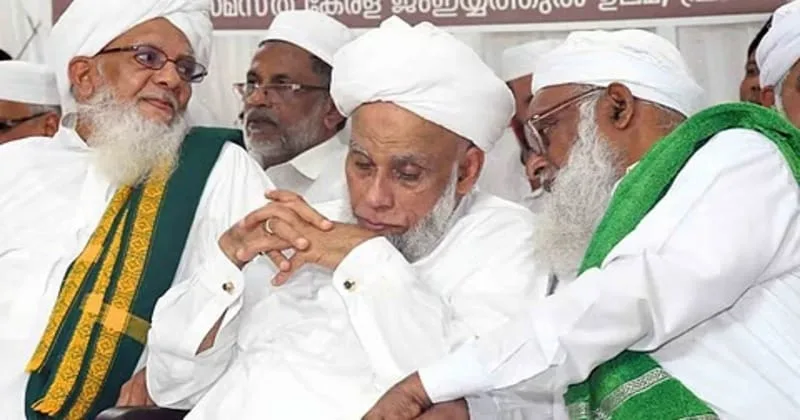
Kasaragod: The powerful Sunni clerical body Samastha Kerala Jam’iyyathul Ulama has triggered fresh controversy after adopting a series of resolutions at its 100th annual session in Kasaragod district, demanding sweeping changes to Kerala’s education calendar, public holidays, and district boundaries.
Through a formal resolution, Samastha urged the state government to declare at least three days of official holidays for both major Islamic festivals, arguing that current provisions are inadequate. The organisation also demanded that school and university examinations be rescheduled so they do not clash with Friday Jumu’ah prayers, claiming that conducting classes and exams during prayer time amounts to “injustice” toward believing students and teachers.
In addition, Samastha called for communal considerations to be factored into the general education calendar and pressed the government to implement earlier assurances on madrasa timings by issuing a formal order. These demands are an attempt to inject religious priorities directly into public administration, raising concerns about the erosion of secular educational norms.
The conference also revived a long-standing demand to split the Malappuram district and form a new district, citing administrative convenience and development needs. Samastha claimed Malappuram’s population has crossed 45 lakh and argued that its size warrants bifurcation. The organisation further sought similar consideration for districts such as Idukki, Ernakulam and Palakkad, calling for a comprehensive redrawing of district boundaries based on “scientific studies.” Malappuram was officially formed for Muslims in June 1969 by merging 13 taluks from Palakkad and Kozhikode districts, with an initial population of around 13.9 lakh. According to the 2011 Census, the population had already surged to over 41 lakh, reflecting one of the highest growth rates in the state. By Samastha’s own admission, the figure likely crossed 45 lakh by 2019.
However, this rapid demographic expansion has drawn sharp criticism, with many pointing to persistently high birth rates in the district as a key factor behind mounting pressure on land, infrastructure, education, and employment. Instead of addressing population stabilisation and governance challenges, Samastha is pushing for administrative restructuring that avoids confronting the root causes of the crisis.
Former Kerala BJP state president K Surendran openly questioned the political motives behind the demand. He said some sections are advocating Malappuram’s division primarily because it could create up to six additional Assembly constituencies, potentially reshaping the state’s electoral arithmetic.
Surendran’s remarks have intensified the debate that Samastha’s resolutions are less about development and more about consolidating demographic and political influence that calls for new districts, special holidays, and religion-specific academic scheduling, pointing toward a troubling pattern of communal bargaining, rather than inclusive governance. As Kerala grapples with shrinking resources and growing social pressures, Samastha’s latest demands as a bid to leverage population strength for administrative and political gains, raising uncomfortable questions about demographic imbalance, secular governance, and the future direction of the state.