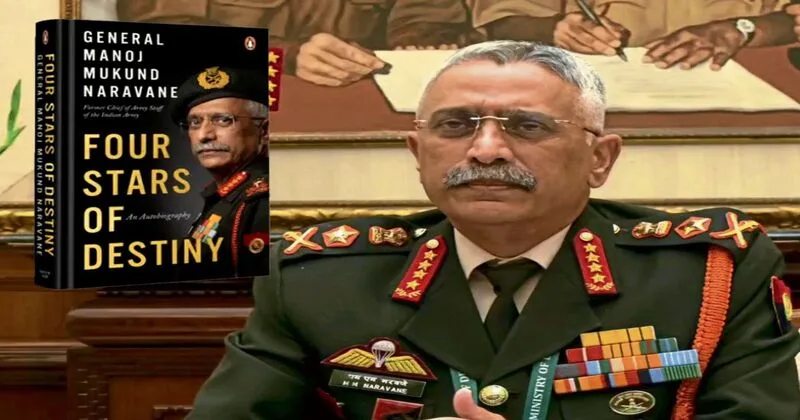
Rahul Gandhi, Leader of Opposition(LOP) in the Lok Sabha has caused controversy by trying to quote excerpts from General M.M. Naravane’s unpublished memoirs. Actually, he was quoting from an article published in the Caravan magazine which has used excerpts from the unpublished memoirs of General Naravane. This article is available on the social media and having gone through it, I am convinced that the article is a deliberate attempt to malign the Indian Army and its leadership. It is important to understand the military perspective of such unsubstantiated claims.
First, what is being claimed. The article states that on August 31, 2020 evening, when four Chinese tanks supported by Infantry troops were approaching Rechin La on the Kailash Range in Eastern Ladakh, Northern Army Commander sought directions from then Army Chief General Naravane. General Naravane is believed to have sought clear directions from the top including the PM, RM, EAM, NSA and CDS as to how to deal with the emerging situation.
The relations between India and China took a dramatic turn after a major violent clash between the Indian and Chinese troops on the night of June 15, 2020 at Galwan in Eastern Ladakh. When Indian troops went unarmed to convince the Chinese to remove tents pitched in the disputed part of the LAC, the Chinese attacked them with sticks, maces and barbed wire resulting in the death of 20 brave soldiers. The Indian troops did not open fire as per the rules of engagement prevailing then but inflicted heavy casualties on the Chinese side with their sheer bravery that resulted in death of more than 40 Chinese soldiers. After the Galwan clash, Indian Army lifted the restrictions on opening fire and the rules of engagement with the Chinese was changed. In addition, adequate reinforcements and strike elements were staged forward in Eastern Ladakh by the Indian Army.
Indian troops had shown great fighting spirit when they occupied the Kailash Range, right under the nose of Chinese forces on the intervening night the of August 29-30 2020. This massive feature has heights like Helmet Top, Black Top, Rezang La and Rechin La which dominate the Chinese Moldo Garrison, across the LAC. This Kailash Range was not held by India since the 1962 war. Even at such tough terrain and heights, Indian Army was able to induct medium tanks. Though Indian troops had just one day to prepare their defences on such difficult heights, it can be safely assumed that Indian troops were prepared to deal with the Chinese threat. At such high altitude of more than 12,000 feet, four tanks moving towards Rechin La were not a difficult target for the Indian troops.
Once Indian troops occupied the Kailash Range and the adjoining heights, Chinese local commanders had to show some reaction as a face-saving measure. Chinese forces knew that Indian troops all well entrenched at the dominating heights of Kailash Range and thus to evict them would need a major counter-offensive. In such high-altitude terrain, offensive operations require massive combat superiority, at times in 1:12 ratio and such operations may stretch to weeks and months. So, the movement of Chinese tanks supported by infantry was at best a method to check Indian troop’s reaction. The local commanders were fully empowered to deal with such a situation, even without any formal orders from the senior leadership.
Since the engagements with the Chinese were being closely monitored by the Indian authorities, then Army Chief General Naravane did the right thing by informing the higher authorities. Indian response, even if the conflict had escalated with the Chinese on the night of August 31 at the Kailash Range, would already be known to the Indian commanders in chain. The political leadership once again backed the Army leadership and gave them a free hand to deal with the situation on ground, as deemed fit by them.
As the events unfolded later proved, Chinese tanks retreated when they saw Indian tank guns pointing at them. Even after this incident, Indian troops had handled multiple Chinese provocative actions in Eastern Ladakh since then, duly supported by the political leadership under PM Modi. Under the same tradition, Indian armed forces were once again given a free hand by the political leadership during Operation Sindoor in May 2025.
To me, the timing of this article in the Caravan magazine is suspect. The magazine appears to have selectively quoted from the unpublished manuscript of General Naravane’s book. It also has to be understood that a communication of the Army Chief with the political leadership is classified secret information. No service chief would like to bring any such sensitive information in the public domain because it helps the adversary. During my military career, I have faced Chinese troops in Arunachal Pradesh and Sikkim but we had a free hand to deal with them as deemed fit. General Naravane himself has on record clarified in March 2021 that India has not ceded any territory to the Chinese.
Indian Army has withstood the might of the Chinese forces in Eastern Ladakh and gave a befitting reply to every Chinese provocation. Chinese finally gave up and agreed to a disengagement process in October 2024. The Chinese also agreed to patrolling of the LAC to pre-2020 positions and thus India has scored a major psychological victory the Chinese. Therefore, the statement of the LOP which questions the ability of the Indian Army leadership to deal with the Chinese threat is most unfortunate. Such insinuations, even if unintended, demoralise the soldiers and the officers who risk their lives day in and day out to defend the territorial integrity of the nation. The security & defence of the nation are not for politics and negative narrative building.