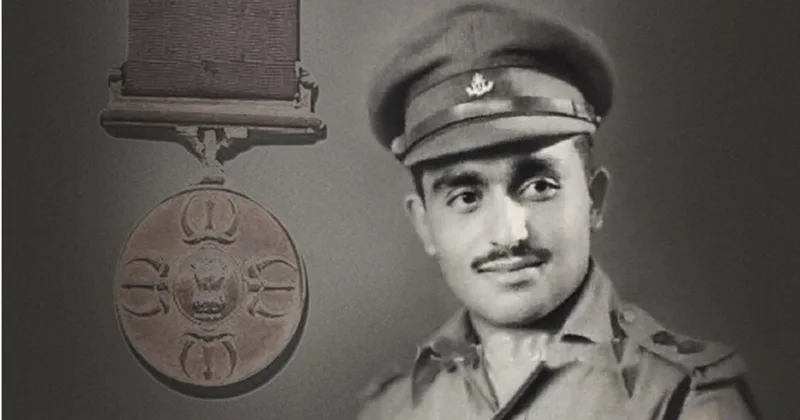
Today, January 31st, marks the birthday of the ultimate “Main Character” of Indian military history. If you think your Monday morning is rough, just remember that Major Somnath Sharma once held off a horde of 700 invaders while his left arm was in a literal plaster cast.
Talk about an unfair fight—unfair for the guys who thought a broken arm would slow him down.
The Badgam Bloodbath: A Lesson in “Not Today”
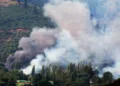
On November 3, 1947, the stakes were simple: if the Srinagar airfield fell, Kashmir fell. Major Sharma’s “D” Company of 4 Kumaon was sent to Badgam on a “reconnaissance” mission. It was supposed to be a quiet patrol, but instead, they walked into a hornet’s nest.
- The Deception: The tribal raiders (Lashkars) weren’t just charging blindly; they used local houses as cover and even dressed as villagers to get close. Suddenly, Sharma’s 90 men were being sniped at from 360 degrees.
- The “Human Loader”: Because his arm was in a cast from a hockey injury, Sharma couldn’t effectively fire his rifle. Most people would use that as a valid excuse to duck. Instead, he spent the battle sprinting between sections, distributing ammunition and manually filling the magazines for his Bren gunners. He was essentially a one-man supply chain under heavy mortar fire.
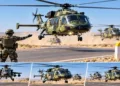
- The Six-Hour Stand: For six grueling hours, they held the ridge. Why? Because Sharma knew that every minute he stayed alive was a minute the Indian Air Force had to land Dakotas full of reinforcements at the nearby airstrip. He wasn’t just fighting a battle; he was buying time for a nation.
His final radio transmission remains the gold standard for “legendary last words”:
“The enemy is only 50 yards from us. We are heavily outnumbered. We are under devastating fire. I shall not withdraw an inch but will fight to the last man and the last round.”
The Legacy: First Among Equals
When the smoke cleared, the invaders were so depleted and demoralised by the resistance of this tiny group that they lost their momentum. They didn’t push to the airfield. Major Sharma’s sacrifice literally saved the valley.
His legacy isn’t just a statue or a name on a gate; it’s the DNA of the modern Indian Army. He was the first-ever recipient of the Param Vir Chakra, and his citation became the blueprint for what “conspicuous bravery” actually means. To this day, when a Kumaoni soldier enters battle, they carry the ghost of Somnath Sharma’s grit with them.
The Dharmic Swagger C The Vajra Connection
Somnath wasn’t just a soldier; he was a philosopher with a mission. Growing up, he was steeped in the Bhagavad Gita thanks to his grandfather. While other kids were playing marbles, he was internalising the concept of Dharma—doing the right thing because it is right, not for the reward. He lived the Kshatriya code so hard it felt like a scene pulled straight out of the Mahabharata. He knew the body was just a “suit”—the soul, much like his legacy, was fireproof.
This brings us to the Vajra Connection. The PVC medal features four replicas of Indra’s Vajra. According to ancient texts, the original Vajra was forged from the bones of Sage Dadhichi, who gave up his life so the gods could forge a weapon to defeat evil.
It is poetically perfect that the very first PVC went to Sharma. He became the modern Dadhichi—sacrificing his own “bones” (and that famous plaster cast) to forge the shield that protected India in its infancy. The medal wasn’t just a piece of metal; it was a cosmic recognition that some men are forged in the same fire as the gods.
Happy Birthday to the OG. Major Somnath Sharma: A man so tough, even gravity probably thought twice before pulling him down.