In an age dominated by algorithms and rapidly shifting political language, Prime Minister Narendra Modi consistently uses Sanskrit Subhāṣitas, which stand out as a civilisational choice. These ancient sayings are compact, poetic and philosophically rich. These sayings are woven into the Prime Minister’s articulation of governance, social reform and national purpose, which bridges Indian classical intellectual heritage with the demands of a modern republic.
From Mann Ki Baat to official social media communication, Subhāṣitas have increasingly become a medium through which complex contemporary issues such as economic self-reliance, environmental sustainability, gender justice, ethical leadership and social harmony are expressed in a language deeply rooted in Indian tradition.
Some of the recent Subhāṣitas shared by the Prime Minister on Twitter reflect the sincerity of governance.
Effort, Enterprise and the Indian Growth Story
अनुत्थाने ध्रुवो नाशः प्राप्तस्यानागतस्य च।
प्राप्यते फलमुत्थानाल्लभते चार्थसम्पदम्॥
This Subhāṣita, shared by the Prime Minister in early 2026, speaks directly to the youth and industrialists, workers and individuals involved in nation-building that without effort, a person not only loses future opportunities but also squanders past achievements. While continuous effort and striving lead to success, fulfilment and financial prosperity., This resonates strongly with the government’s emphasis on entrepreneurship, skilling and labour participation.
Schemes such as Startup India, Mudra Yojana, Skill India, and Production-Linked Incentive (PLI) initiatives are built on the assumption that state support must catalyse individual initiative rather than replace it. By invoking this Subhāṣita, the Prime Minister reinforced a cultural ethics where progress is not a matter of entitlement but of a collective effort. Thus, aligning ancient wisdom with modern economic policy.
Environmental Consciousness Rooted in Tradition
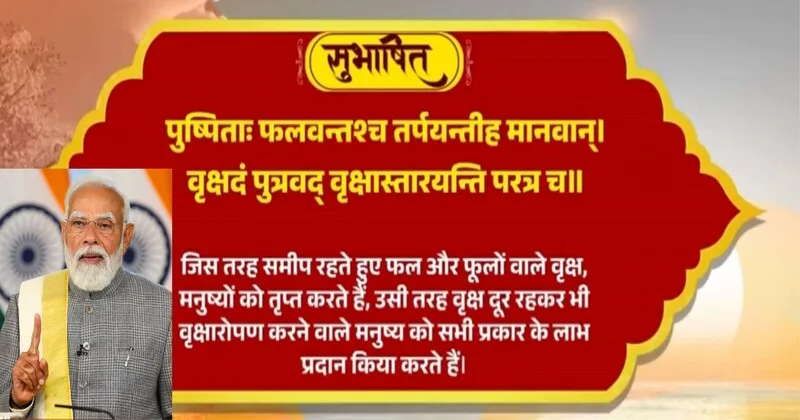
पुष्पिताः फलवन्तश्च तर्पयन्तीह मानवान्।
वृक्षदं पुत्रवत् वृक्षास्तारयन्ति परत्र च॥
In a world grappling with climate anxiety, the Prime Minister uses this verse in December 2025 to reframe environmental responsibility as a civilisational obligation rather than a regulatory imposition. The Subhāṣita likens tree planting to raising children as an act whose benefits extend beyond one’s lifetime.
This idea aligns seamlessly with India’s contemporary climate initiatives such as Mission LiFE, large-scale afforestation drives and India’s leadership in global climate forums. By invoking this verse, the Prime Minister positions sustainability not as a Western-imported concept but as a value deeply embedded in Indian philosophical outlook, where nature is seen as a partner in human prosperity.
Humility as the True Mark of Strength
एको बहूनामसि मन्य ईडिता विशं विशं युद्धाय सं शिशाधि।
अकृत्तरुक्त्वया युजा वयं द्युमन्तं घोषं विजयाय कृण्मसि॥
On the occasion of the Beating Retreat theme in 2026, the Prime Minister cited these Subhāṣitas as a rejection of ego-driven leadership. Where it means “O brave warrior! Your anger should be guided by wisdom. You are a hero among thousands. Teach your people to govern and wage war with honour. We want to cheer alongside you as you achieve victory.”
This Subhāṣita reflects the behaviour of warriors who act without self-glorification, emphasising that true courage lies in quietly and sincerely performing duty.
In today’s India, this message is relevant to public servants, security forces and political leadership. At a time when visibility often replaces substance, the verse underscores a governance ethic where results matter more than rhetoric. It also mirrors the Prime Minister broader narrative of nation-first service, particularly in the context of the armed forces, disaster response teams and frontline workers.
Reclaiming the Dignity of the Girl Child
दशपुत्रसमा कन्या दशपुत्रान् प्रवर्धयन्।
यत् फलम् लभते मर्त्यस्तल्लभ्यं कन्ययैकया॥
Few Subhāṣitas have carried as much contemporary social resonance as this one. By asserting that one daughter equals ten sons, the verse means that raising a daughter yields the same virtuous reward as raising ten sons.
कन्या को लक्ष्मी मानने वाले हमारे देश में 11 साल पहले आज ही के दिन बेटी बचाओ बेटी पढ़ाओ अभियान की शुरुआत हुई थी। यह बड़े गर्व की बात है कि आज भारत की बेटियां हर क्षेत्र में नित-नए रिकॉर्ड बना रही हैं।
दशपुत्रसमा कन्या दशपुत्रान् प्रवर्धयन्।
यत् फलम् लभते मर्त्यस्तल्लभ्यं… pic.twitter.com/OOnaRY6OKS
— Narendra Modi (@narendramodi) January 22, 2026
Prime Minister shared this Subhāṣita in the context of Beti Bachao, Beti Padhao, where it served as a dual purpose. First, it reframed gender justice as an indigenous moral principle, countering narratives that portray women’s empowerment as a modern or Western construct. Second, it supports the government policy push toward women-led development, evident in increased female participation in education, entrepreneurship, self-help groups and local governance.
Contentment, Compassion and Social Harmony
शान्तितुल्यं तपो नास्ति न सन्तोषात् परं सुखम्।
न तृष्णायाः परो व्याधिर्न च धर्मो दयापरः॥
In an era marked by consumerism, digital comparison and rising mental health challenges, this Subhāṣita offers a profound social critique. Peace, contentment and compassion are presented as higher ideals than material accumulation.
Prime Minister has used this verse to aligns with policy narratives around mental well-being, social cohesion and ethical consumption. It also complements initiatives such as Yoga Day, wellness missions and the broader call for responsible lifestyles under Mission LiFE. The verse acts as a moral reminder that national progress must not come at the cost of inner stability or social empathy.
Values That Sustain the Nation
सत्यं बृहदृतमुग्रं दीक्षा तपो ब्रह्म यज्ञः पृथिवीं धारयन्ति।
सा नो भूतस्य भव्यस्य पत्न्युरुं लोकं पृथिवी नः कृणोतु॥
This Subhāṣita articulates a foundational idea that nations endure not merely through power or wealth, but through values. Truth, discipline, knowledge and service are described as forces that uphold the Earth itself. The Subhashitam conveys the message that universal truth, strict discipline, a vow of selfless service, an ascetic life and continuous action guided by profound knowledge are the foundation of the entire Earth. Providing us with vast lands, this Earth shapes both our past and our future.
In contemporary governance discourse, this verse reinforces the Prime Minister’s emphasis on ethical institutions, transparency and accountability. It echoes policy reforms aimed at reducing corruption, improving service delivery and restoring public trust in institutions. The verse elevates governance from a technical exercise to a moral responsibility.
Sanskrit as a Living Language of Governance
The most symbolic step in this journey was the presentation of Mann Ki Baat in Sanskrit, signalling that the language is neither obsolete nor ceremonial. Prime Minister also affirmed Sanskrit’s relevance as a living intellectual tradition and capable of engaging with modern national concerns.
Ex IIAS Fellow Prof. Jai Ram Singh says that “Our Prime Minister often quotes sayings in his ceremonial and general speeches, Mann Ki Baat etc. ‘Subhasitas’ are from ancient texts which has unfathomable depth of knowledge, philosophy and thought pertinently relevant for all times to come, for the survival and upliftment of the mankind and it also encompasses the view of the history of World thoughts that has emerged from Hindu history, philosophy, Dharma and Vedic Sciences.”
This move to share Subhāṣita also reflects a broader cultural resurgence in which India’s classical languages are being repositioned as sources of contemporary insight rather than relics of the past.
Prime Minister uses Sanskrit Subhāṣitas to represent a conscious effort to re-anchor India’s modern transformation in its civilisational ethos. Each verse functions as a moral compass, guiding public discourse toward responsibility, balance and purpose.
In reconnecting governance with ancient wisdom, these Subhāṣitas remind citizens that India’s journey forward does not require abandoning its past. On the contrary, India’s strength lies in its ability to modernise without forgetting who it is.