Decades of engagement of the Indian higher education system in the global scenario had been largely characterized by students and faculty members moving to other countries and global collaborative research endeavors influenced by foreign universities. This mobility has ensured success stories in selected instances, it has also pointed to deficiencies in the internal higher education system of India. NEP 2020 has launched the Indian higher education system in an entirely new way by making internationalization at home the center point of engagement. NEP 2020 emphasizes it to be an experience that would increasingly need to occur in India.
Internationalisation at Home as described in policy statements is not a rhetorical intention but it remains as a functional strategy to bring international standards, global curriculum, collaborative research and intercultural academic engagement directly to the Indian campuses. The assumption remains very simple, India cannot perpetually look towards sending its students overseas to tap into the global academic environment. If India aspires to develop as a genuine global knowledge node, internationalisation needs to happen at the level of their university.
The policy logic of internationalisation at home
NEP 2020 places the need for internationalisation at home at once an academic requirement and economic necessity. On the academic side it is known that interaction with global knowledge systems enhances learning outcomes, research and prestige of the institution. On the economic side, it suggests the high foreign exchange outflow associated with large-scale outgoing students going abroad. Contrary to not allowing students to go abroad, it aims at building domestic substitutes with academic standards comparable to the foreign destinations.
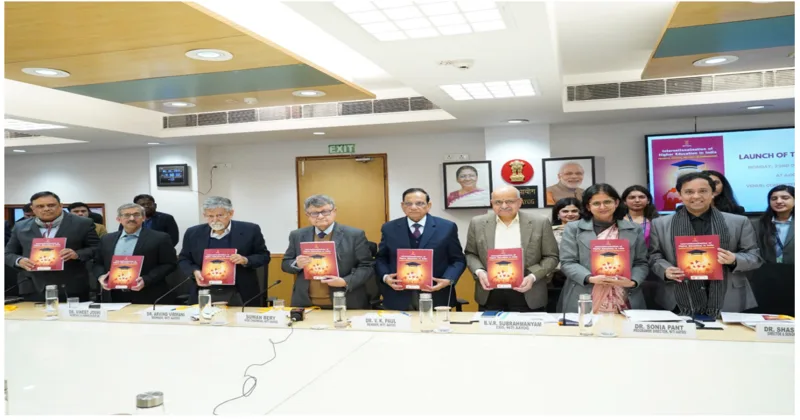
NITI Aayog releases report on Internationalisation of Higher Education in India
NITI Aayog released the policy report “Internationalisation of Higher Education in India: Prospects, Potential, and Policy Recommendations”, a comprehensive roadmap to position India as a global hub… pic.twitter.com/seG4Jkygci
— NITI Aayog (@NITIAayog) December 23, 2025
According to the study conducted by the NITI Aayog on the internationalization of higher education, the need of internationalize at home has been asserting that the only way for the internationalization of higher education to scale in India. With over four crore students in higher education, the involvement of only a few will be possible in international education.
This strategy resonance with the demographics of the Indian subcontinent. It has the world’s youngest population. The call on the Indian institutions of higher education for globally competent skills is growing.
Mobility centric to curriculum centric
One of the major defining characteristics of internationalisation at home in the NEP 2020 is the focus on the curriculum and learning rather than the mobility aspect. The policy urges Indian institutions to re-develop curricula with foreign institutions and introduce globally benchmarked learning materials and globally accepted credit systems. Such an approach provides students with the same academic exposure in India itself.
NITI Aayog pointed that this type of curricular globalisation helps enhance academic integration by reducing fragmentation. When curricula are made global, credit transfer systems become easy, double degree programmes are made feasible and academic mobility both inward as well as outward is made more organized. It need to be made contextual, meaning they should not lead to intellectual dependency. It should be made relevant in Indian contexts.
This curriculum-focused approach also pervades other aspects such as the methods of evaluation, research ethics and teaching pedagogy. Internationalisation at home, encompasses not just the inclusion of foreign subject matter but also a re-evaluation of the way by which the learning of that very knowledge can occur.
Faculty and research a medium for internationalization
NEP 2020 acknowledges that sustainable internationalization cannot and should not be implemented by students alone. The role of faculty members and research networks is decisive in this process. This is why it focuses on faculty exchange and research collaborations that bring global knowledge to Indian institutions.
The NITI Aayog report points out that the quality of research in India appreciably improves if collaboration between scientists and researchers is institutional networks. The fact is that joint publications, common labs and collaborative research projects are known to impact citations and relevance of research. By allowing foreign researchers to work in Indian institutions and thereby allowing Indian faculty to function within a global research framework, thus institutions are developing in house capabilities.
This approach also tackles an age-old problem of an imbalance in the distribution of internationalization. Elite institutions always led in internationalization efforts and state universities, community colleges were merely onlookers. But through internationalization at home there is hope that this will change.
One of the key enablers of internationalization at home is regulatory reform. To support the implementation of NEP 2020 there are guidelines issued by the University Grants Commission (UGC), which promote collaborative interactions between institutions, joint degree programs and the existence of foreign universities in India.
The NITI Aayog report particularly emphasized the need for a clear regulatory environment to prevent the kind of collaborations that are ad hoc and lack academic content. The regulatory environment enables a clarity regarding the standardization of credit transfer, faculty interaction and quality assurance, to a degree for the Indian as well as international players.
The report also indicates that institutional preparedness differs. While some have the capacity in the administrative and research structures that would easily facilitate fast internationalization, many have limitations pertaining to governance, finances and human resource capacity. Internationalization at home is both a question of policy and building institutional capacity.
Cultural integration without intellectual dilution
One of the most striking features of NEP 2020’s globalisation at home strategy is the thrust on aligning globalisation at home to Indian traditions in knowledge systems. Instead of treating global and Indian knowledge systems as divergent approaches to higher education, NEP 2020 seeks to align them. This has emerged in NEP 2020’s thrust on both Bharatiya Gyan Parampara and global curricula.
The NITI Aayog report presents this convergence as an opportunity rather than a trade-off. A set of institutions which offer a globally comparable quality of education in tune with Indian traditions of thinking has a better chance of luring foreign students and professors in search of fresh intellectual outlooks. The internationalization of the domestic academic ecosystem thus becomes a mutual process where Indians learn from the world and the world learns from Indian intellectual traditions.
This approach also responds to the criticism that internationalization can cause cultural homogenization. In this respect, NEP 2020 aims to ensure that internationalization enriches, rather than diminishes, academic diversity.
Constraints and structural challenges
Despite this promising future for internationalisation at home, there are visible obstacles in its path. According to the NITI Aayog report, administrative diversification, resource inequality and faculty members without international exposure are some of the challenges that persist. There is no dedicated international office or competent administration in most of these institutions nor is there resource provision for such projects.
Language issues, administrative delays and inconsistent incentives within the institutions add to the insufficiencies with the implementation of internationalisation. Sometimes internationalisation initiatives leave the realm of agreement and do not reach the academic interface at all. All of the facts highlight that internationalisation in the home environment is not a matter of flipping a policy switch but rather is a long-term change within an institution.
Why internationalisation at home is significant in the case of India
Internationalisation at Home in NEP 2020 essentially has an aim of building capacities. It aims at developing a system of education that cannot just assimilate international knowledge but also produce original research and then retain that talent. The strategy of low reliance on international mobility ensures a inflow of finances in the country.
It helps these internationalised studies. When these studies are integrated into the country systems, students from all socio-economic classes can take advantage of them. It opens the doors of international studies to the masses and forms the backbone of the human capital plan.
The conclusion of the NITI Aayog study states that internationalisation at home is not an alternative to engagement but the basis of engagement. When India focuses on enhancing institutional excellence within the country, it is positioning itself to engage the world on an egalitarian basis. Thus, NEP 2020 becomes something that not only reacts to the trends in the world but also tries to redefine India’s positioning in them.