Historical debates often ignite divisions between communities, yet retelling profound truths may bridge those divides, bringing harmony amid the complexities of the past. These days, a profound truth demands retelling.
In the twilight of the early 18th century, when shadows of deceit hung long across the face of India, a flame of truth flickered in the darkness. This was no ordinary light, but the luminous spirit of Guru Gobind Singh, the tenth Guru of the Sikhs.
The late 17th century and the twilight of the early 18th century were the most tumultuous periods in Sikh history. Events that changed the course of India’s history forever occurred back then. One in 1675, the martyrdom of Guru Teg Bahadur Singh Ji who volunteered to sacrifice to protect the religious freedom of every religion existed back then: two, the formation of the Khalsa Panth by Guru Gobind Singh in 1699. Three in 1705, uniquely remembered in history ‘The Zafarnama’ (The Letter of Victory) from Guru Gobind Singh to Aurangzeb, changed history forever.
When the blood of four sons (Char Sahibzaade) had soaked the earth, Aurangzeb, the epitome of deceit, was intoxicated by the illusion of triumph. And those sycophant Hill Chiefs (Pahadi Rajas) scurrying to feast on the perceived corpse of the Khalsa visualised Guru Gobind Singh as a broken man, his decimated army, and a faith in submission, like most of the others did back then. Under this backdrop of that landscape, Guru Gobind Singh’s pen became a sword and Zafarnama was incarnated.
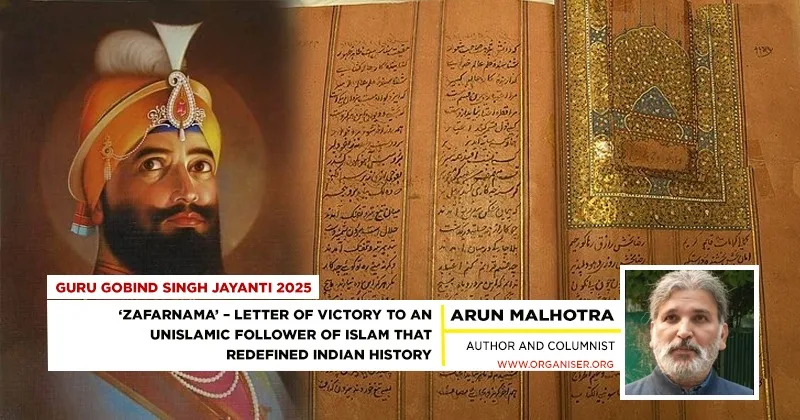
The Zafarnama written in Persian-Arabic script, stands as a timeless masterpiece in world literature that transcends its historical context embodying spiritual and eternal justice. It is Guru Gobind Singh’s powerful declaration of victory over Aurangzeb establishing that the timeless truth stays victorious forever.
What led to the incarnation of the Zafarnama? Aurangzeb, the Mughal Emperor, had negotiated a peace accord and had sworn upon the holy Quran invoking the name of Allah while promising to provide a safe passage to Guru Sahib and his people for vacating the Anandpur Sahib Fort after months of war. Despite Aurangzeb’s oath, Mughal forces attacked the Sikhs as they evacuated the Anandpur Sahib fort. This treachery resulted in a loss of Guru Sahib’s four sons, mother and other Sikhs, and a scattering of followers.
Zafarnama is a declaration of the birth of a new consciousness, a new way of being in the world that values spiritual truth over earthly power. Deeply hurt by Aurangzeb’s treachery conducted in the name of the Prophet Mohammad, Guru Sahib exposes Aurangzeb’s hypocrisy in betraying oaths sworn on the holy Quran and in the name of Allah.
Na Imaan parasti Na auza-e Deen
Na sahib shinashi Na Mohammad yakeen
Musalmaan is indeed someone whose imaan (faith) is unwavering, steadfast, and unshakable. As per Islam, a Muslim’s submission to Islam is accompanied by deep, undaunted faith (imaan). Therefore Guru Sahib says ‘you have no commitment to your faith(Islam) nor do you truly observe and follow religious responsibilities. Neither do you recognise the Divine, nor do you believe in the Prophet Muhammad.
Guru Sahib says that Aurangzeb claims to be religious but lacks true faith and does not follow the religious duties and responsibilities. He neither recognises the Divine nor has a genuine belief in the Prophet Muhammad.
Shikastee iman-o kasm-o Quran
Na daanee khuda-o na hukm-e subhan
After betraying your religion and the faith and you betray the oath you swore on the holy Quran. You observe no respect, no understanding and no obedience to the commands of the Almighty. What sort of religion are you propounding?
Che kasm-e Quran man kunam aitbaar
Vagarna tu goi man een rah chi-kar
How can I trust the oath on Quran you have observed?
Otherwise you tell me what purpose this way (taking oath) serves?
Guru Sahib laments about trusting the most sacred oaths when Aurangzeb himself becomes untrustworthy. Guru Sahib says that oaths on the holy Quran have lost their purpose when Aurangzeb no longer honours or respects such sacred oaths disrespecting the holy Quran and the Prophet. And he questions its purpose.
Each verse became an arrow that pierced the emperor’s heart. Guru’s words burrowed deep into the psyche of the Mughal empire, exposing the lie upon which it was built.
Cheh shud gar du tifl-e man kushta shud
Cheh mardee ba kushtan-e tiflaan namud
What if you have killed my four tender sons,
What kind of manhood and bravery is displayed by killing children?
Guresneh chi kar-e kunand chehal nar,
Ki deh lak bar aayad bar-o be-khabar
What can forty hungry men do,
When a force of a hundred thousand descends upon them, unaware?
Guru Sahib further points to the disgrace, unfairness and cowardice of the massive Mughal force that unexpectedly attacked his small group of 40 Sikhs, exhausted by hunger and hardship, instead of facing them with honour.
Guru Sahib inspires his Sikhs to follow the path of bravery in the face of immense personal loss to make his Sikhs ready for immense sacrifices. Guru Sahib says,
Kushtee chaar sham’a che shud andar een,
Ke sad sham’a roshan ast andar zameen
What if four candles have been extinguished here,
Hundreds of them have been lit in the world.
The spirit of Zafarnama ignited a flame that has burned through centuries. Zafarnama is a living testimony of honesty and justice against deceit and injustice that rewrote the narrative of India, and its spirit pulsating in the veins of countless heroes from all communities.
Zafarnama is a timeless masterpiece that never stops inspiring. From the legendary battle of 21 Sikhs against 12,000 at Saragarhi, to the sacrifices in India’s struggle for freedom – 93 of 121 hanged, 2147 of 2626 imprisoned in Kala Pani, 799 of 1300 martyred at Jallianwala Bagh – the Sikh’s courage reverberates the Zafarnama’s fearlessness and courage. The spirit lived on in the 66 Namdhari Sikhs blown from cannons, in 12-year-old Bishan Singh’s refusal of pardon, in the Ghadar revolutionaries, in Shaheed-e-Azam Bhagat Singh, in Kartar Singh Sarabha and countless movements and battles. India owes an immeasurable debt to warriors like Banda Singh Bahadur, Maharaja Ranjit Singh, Hari Singh Nalwa, Jassa Singh Ahluwalia, the septuagenarian warrior Baba Deep Singh, the fearless Mai Bhago and her 40 muktas (deserters who joined back), and Akali Phula Singh. Khalsa, the ferocious warrior who is also the most-humble continues to manifest in the millions who have served and sacrificed in India’s civil and defence forces as a living proof of the legacy of Guru Gobind Singh’s words.
The mighty emperor, who had dreamed of a united empire of India under the banner of Islam was confronted with a force more potent than any army – the power of the absolute religion. Guru Sahib exposes Aurangzeb’s statement that one who fails to honour one’s own faith cannot genuinely respect that of the others’. The Guru’s words expose the hollowness of those who weaponize faith for personal ambitions. Aurangzeb, while claiming to champion Islam, fails to embody Islam’s core principles in his own life and actions. Instead of living the teachings of compassion, justice, and spiritual wisdom, Aurangzeb had reduced the faith to a mere tool for political ambition. Guru Sahib says that the true power and religion require righteous action against injustice is what Guru Sahib says in Zafarnama :
Chu kar az hama heelt e dar guzshat,
Halal ast burdan ba shamsheer dast.
When all modes of redressing the wrong have failed,
It is righteous, indeed, to unsheath the sword.
Guru Sahib explains his own recourse to arms after every attempt at justice, negotiation, and peaceful means had been denied or betrayed. It is a profound statement on righteousness in conflict.
And what of Aurangzeb? Legend whispers that upon reading the Zafarnama, he was struck to his very core. The words of the Guru pierced the emperor’s heart like arrows of truth.
Beyond a geographical entity, Bharat (the Hindustan) is a cultural idea that celebrates diversity in that rare way where myriad faiths orchestrate a concert of harmony, and diversity is celebrated and not tolerated as part of its culture. Religious freedom, enshrined in India’s constitution is a rare and precious gift earned after centuries of struggles in a world where such liberties have become extinct. India’s history, from the Upanishads to the Guru Granth Sahib, has treasured spiritual wisdom for humanity that shapes our collective identity and the true essence of our great nation which lies in our commonalities and cultural and religious diversity leaving no room for conflict.