Electoral integrity or manufactured outrage? How Yogendra Yadav distorted constitutional exercise into democracy crisis
September 1, 2026
  • Read Ecopy
  • Circulation
  • Advertise
  • Careers
  • About Us
  • Contact Us
Android AppiPhone AppArattai
Organiser
  • ‌
  • Bharat
    • Assam
    • Bihar
    • Chhattisgarh
    • Jharkhand
    • Maharashtra
    • View All States
  • World
    • Asia
    • Europe
    • North America
    • South America
    • Africa
    • Australia
  • Editorial
  • International
  • Opinion
  • RSS @ 100
  • More
    • Op Sindoor
    • Analysis
    • Sports
    • Defence
    • Politics
    • Business
    • Economy
    • Culture
    • Special Report
    • Sci & Tech
    • Entertainment
    • G20
    • Azadi Ka Amrit Mahotsav
    • Vocal4Local
    • Web Stories
    • Education
    • Employment
    • Books
    • Interviews
    • Travel
    • Law
    • Health
    • Obituary
  • Subscribe
    • Subscribe Print Edition
    • Subscribe Ecopy
    • Read Ecopy
  • ‌
  • Bharat
    • Assam
    • Bihar
    • Chhattisgarh
    • Jharkhand
    • Maharashtra
    • View All States
  • World
    • Asia
    • Europe
    • North America
    • South America
    • Africa
    • Australia
  • Editorial
  • International
  • Opinion
  • RSS @ 100
  • More
    • Op Sindoor
    • Analysis
    • Sports
    • Defence
    • Politics
    • Business
    • Economy
    • Culture
    • Special Report
    • Sci & Tech
    • Entertainment
    • G20
    • Azadi Ka Amrit Mahotsav
    • Vocal4Local
    • Web Stories
    • Education
    • Employment
    • Books
    • Interviews
    • Travel
    • Law
    • Health
    • Obituary
  • Subscribe
    • Subscribe Print Edition
    • Subscribe Ecopy
    • Read Ecopy
Organiser
  • Home
  • Bharat
  • World
  • Operation Sindoor
  • Editorial
  • Analysis
  • Opinion
  • Culture
  • Defence
  • International Edition
  • RSS @ 100
  • Magazine
  • Read Ecopy
Home Politics

Electoral integrity or manufactured outrage? How Yogendra Yadav distorted constitutional exercise into democracy crisis

The release of draft electoral rolls in Tamil Nadu and Gujarat following the Special Intensive Revision has sparked political outrage, but official data from the Election Commission tells a far less dramatic story than the one projected by activist Yogendra Yadav. A closer look reveals routine voter list corrections being portrayed as mass disenfranchisement through selective interpretation and rhetorical exaggeration

Shashank Kumar DwivediShashank Kumar Dwivedi
Dec 25, 2025, 08:10 pm IST
inPolitics, Bharat, Analysis
Follow on Google News
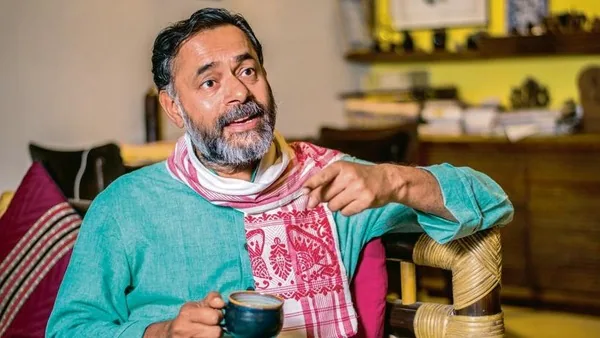
Yogendra Yadav

Yogendra Yadav

Facebook
Twitter
WhatsAppTelegramEmail

The publication of draft electoral rolls after Phase 2 of the Special Intensive Revision (SIR) by the Election Commission of India (ECI) has once again triggered a predictable political reaction. Even before voters or political parties could examine the data in detail, a familiar chorus emerged accusing the constitutional authority of orchestrating mass disenfranchisement. At the forefront of this reaction was Yogendra Yadav, who alleged that nearly one crore voters in Tamil Nadu had been stripped of their voting rights.

On December 21, Yogendra Yadav, speaking to a YouTube platform, claimed that 97 lakh voters had effectively lost their right to vote due to the ECI’s revision exercise. The claim was delivered with dramatic urgency, portraying the revision as an assault on democracy rather than an administrative correction. However, a careful reading of official data reveals that the claim rests on misrepresentation rather than evidence.

What the numbers actually say

According to figures released by the Election Commission, Tamil Nadu’s electorate in the current draft electoral roll stands at approximately 5.4 crore, compared to around 6.4 crore earlier. This reduction of about 97.3 lakh entries formed the basis of Yadav’s allegation. Yet, the raw number alone does not explain why those names were removed.

The ECI’s own data provides a clear breakdown. Of the 97.3 lakh deletions in Tamil Nadu, approximately 26.9 lakh entries belonged to voters who were officially recorded as deceased. Another 66.4 lakh names were removed because the individuals had migrated, were permanently absent from their registered addresses, or could not be located during door-to-door verification. Around 4 lakh entries were found to be duplicate registrations, meaning the same individual was enrolled at multiple locations.

In Gujarat, a similar pattern was observed. The state’s electorate reduced from about 5.1 crore to 4.3 crore, with 73.7 lakh names removed. Of these, 18.1 lakh voters were recorded as deceased, 51.8 lakh had shifted residence or were untraceable, and about 3.8 lakh were duplicate entries.

These figures, taken together, indicate not a sudden erasure of living voters, but a systematic clean-up of outdated and erroneous entries.

Verification is not disenfranchisement

Yogendra Yadav’s claim rests on a critical sleight of hand, equating deletion from a draft roll with permanent loss of voting rights. This is a fundamental distortion of how electoral roll revision works. Draft rolls are, by definition, provisional. They exist precisely so that errors can be identified and corrected before final publication.

In Tamil Nadu, the ECI has also flagged around 1.2 crore voters for verification notices due to logical inconsistencies, such as implausible age differences between parents and children or unusually large numbers of offspring linked to a single parent. These entries have not been deleted. They are under scrutiny for verification, a standard safeguard to ensure data accuracy.

By conflating verification flags with deletions, Yadav’s narrative blurs the line between administrative caution and political conspiracy.

Special Intensive Revision is not a novel or extraordinary exercise. It is a constitutionally mandated process carried out periodically to ensure electoral rolls reflect ground realities. Without such revisions, voter lists would continue to include deceased individuals, migrated populations and duplicate registrations indefinitely.

Ironically, the very people now accusing the ECI of weakening democracy have, in the past, raised concerns about bogus voters and electoral manipulation. SIR addresses precisely those concerns. Leaving outdated entries untouched would undermine the integrity of elections, making them vulnerable to impersonation and fraud.

To portray this process as an attack on democracy is not only misleading, it is counterproductive.

Remedies exist, but are conveniently ignored

The Election Commission has clearly stated that claims and objections can be filed until January 18, 2026. Any voter who believes their name has been wrongly removed or flagged has a defined, time-bound remedy. Political parties are also empowered to submit objections through booth-level agents.

Yet, Yogendra Yadav’s commentary makes no reference to these safeguards. Instead, it creates the impression of finality, as though the deletions are irreversible and malicious. This omission is not accidental. It is essential to sustaining the narrative of victimhood and crisis.

Yadav’s rhetoric fits into a broader pattern where routine administrative processes are framed as existential threats. By using emotionally charged language like “snatching voting rights,” he shifts the debate from data to distrust. The target of this distrust is not merely the Election Commission, but the democratic system itself.

Such narratives carry serious consequences. They risk eroding public faith in institutions that function precisely to ensure fairness. When citizens are told, repeatedly that elections are rigged at the stage of voter lists, the damage extends far beyond one revision cycle.

Selective silence on key facts

Notably, Yadav has offered no explanation for why deceased voters should remain on electoral rolls, or why duplicate registrations should not be corrected. Nor has he addressed the fact that migration is a demographic reality, especially in states with high labour mobility. These omissions are telling.

By focusing exclusively on headline numbers and ignoring the underlying causes, the narrative becomes less about democratic concern and more about political mobilisation.

There is a critical difference between questioning institutions and undermining them. Scrutiny requires engagement with facts, processes and remedies. Sensationalism requires only numbers stripped of context.

Yogendra Yadav’s intervention falls firmly in the latter category. It amplifies fear without acknowledging the procedural safeguards that define India’s electoral system. In doing so, it risks delegitimising an exercise meant to strengthen democracy.

Electoral roll revisions are tedious, technical and often unpopular. They do not lend themselves to dramatic soundbites. But they are essential. Democracy is not protected by allowing inaccuracies to persist; it is protected by correcting them transparently.

When activists with public influence choose panic over precision, the cost is borne by public trust. In this case, the data does not support the claim of mass disenfranchisement. What it supports is the conclusion that voter lists are being cleaned, verified and updated, as they should be.

The real danger lies not in the revision of electoral rolls, but in the deliberate misreading of such revisions to manufacture outrage. In a democracy, vigilance is necessary. But so is honesty.
Topics: Special Intensive RevisionTamil Nadu voter listvoter deletion claimsElection Commission of IndiaElectoral rollsYogendra Yadav
Share
Tweet
SendShareSend
✮ Subscribe Organiser YouTube Channel. ✮
✮ Join Organiser's WhatsApp channel for Nationalist views beyond the news. ✮
Previous News

Veer Bal Diwas: An unforgettable chapter of valour and sacrifice

Next News

Veer Bal Diwas 2025: The Young Fearless Lions of Faith & Freedom Who Made Trembled Mughal Empire

Related News

The Supreme Court of India

“Can the court direct fresh elections like this?”: SC questions TMC plea over West Bengal SIR voter deletion

Telangana CEO C. Sudharsan Reddy addresses the press on SIR draft electoral rolls after meeting recognised party representatives on August 17, 2026

Telangana SIR: Draft rolls published with 2.65 cr electors in 119 constituencies; claims, objections open till Sept 16

Hyderabad MP Asaduddin Owaisi and Telangana CM Revanth Reddy (Left Box)

ECI rejects Telangana Family Register Certificate for SIR; Owaisi misled CM Revanth Reddy and Hyderabad voters

Telangana SIR report: 73.39 lakh enumeration forms uncollectable (This image is generated by AI)

Telangana SIR Report: 73.39 lakh enumeration forms uncollectable, 2.65 cr digitised, draft electoral roll on August 17

RTI Activist Seeks Probe into Abhijeet Dipke's Father's Finances, Questions Funding of CJP's Legal Defence Fund

Who paid for Abhijeet Dipke’s foreign education? RTI activist seeks financial probe

BJP Telangana urges ECI to reject Family Register, alleges AIMIM push to enrol Rohingyas, Bangladeshis during SIR

Load More

Latest News

A 21-year-old Hindu nurse, Uke Shirisha, was sexually assaulted and murdered inside her residential quarters in Thukkuguda, Telangana

Telangana Nurse Murder: Islamist Sanaullah arrested for rape and murder of 21-year-old Uke Shirisha in Thukkuguda

A century-old Hindu Mandir in Pakistan’s Narowal was demolished by Islamic zealots over land encroachment claims

Over 100-year-old Hindu Mandir demolished in Pakistan’s Punjab, Narowal, to make way for madrassa

Prime Minister Narendra Modi in Tashkent

PM Modi pushes for Thirukkural translation in Tashkent as India-Uzbekistan ties reach comprehensive strategic level

The Hague based Permanent Court of Arbitration

India rejects Pakistan-favouring Indus Treaty award, calls Hague-based arbitration body ‘illegally constituted’

Augustine Brothers (inset)

Keralam: ED and SIT to probe Augustine Brothers over Rs 126 Cr deal after Nov ’25 Messi tour cancellation

Indianisation does not mean making all people Hindus; unity can be built on common spiritual reality: Guruji Golwalkar

Jharkhand's former Chief Minister Babulal Marandi (Left) and Union Home Minister Amit Shah (Right)

Bangladeshi infiltration in Jharkhand’s Santhal Pargana a national security threat: Babulal Marandi writes to Amit Shah

From left, India's EAM S. Jaishankar, PM Narendra Modi and NSA Ajit Doval during the 16th BRICS Summit in Kazan, Russia, in 2024

BRICS New Delhi Summit 2026: India to push digital currencies for uninterrupted, cheaper cross-border payments

Guru Amar Das Ji, the Third Sikh Guru

Jyoti Jot Day: Remembering Guru Amar Das Ji, the Guru who strengthened the tradition of langar and equality

Congress MLA Ashok Kumar Rai (Left), Chief Minister DK Shivakumar (Right)

Karnataka ‘7 per cent Commission’ Row: Congress MLA’s charge puts Shivakumar govt under scanner

Load More
  • Privacy
  • Terms
  • Cookie Policy
  • Refund and Cancellation
  • Delivery and Shipping

© Bharat Prakashan (Delhi) Limited.
Tech-enabled by Ananthapuri Technologies

  • Home
  • Search Organiser
  • Bharat
    • Assam
    • Bihar
    • Chhattisgarh
    • Jharkhand
    • Maharashtra
    • View All States
  • World
    • Asia
    • Africa
    • North America
    • South America
    • Europe
    • Australia
  • Editorial
  • Operation Sindoor
  • Opinion
  • Analysis
  • Defence
  • Culture
  • Sports
  • Business
  • RSS @ 100
  • Entertainment
  • More ..
    • Sci & Tech
    • Vocal4Local
    • Special Report
    • Education
    • Employment
    • Books
    • Interviews
    • Travel
    • Health
    • Politics
    • Law
    • Economy
    • Obituary
  • Subscribe Magazine
  • Read Ecopy
  • Advertise
  • Circulation
  • Careers
  • About Us
  • Contact Us
  • Policies & Terms
    • Privacy Policy
    • Cookie Policy
    • Refund and Cancellation
    • Terms of Use

© Bharat Prakashan (Delhi) Limited.
Tech-enabled by Ananthapuri Technologies