





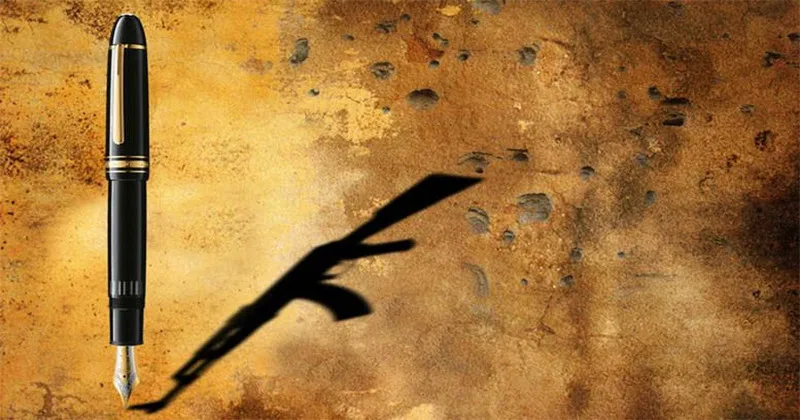
The present times are complex, tumultuous and insecure times. The world is passing through a state of flux, with global peace in tatters, wars ongoing, wars incipient and multidimensional geo-political tensions prevailing. Today, wars are not fought merely on soil, sand, seas or air but also in newspapers, books, news magazines hard and soft with television digital social media channels added to these. Cyber wars, economic wars and media wars are the new dimensions of international warfare. With propaganda machines working at their peak, media warfare has assumed gigantic proportions. In the global context, It is not exactly an age of honest and transparent reporting. It is the age of mixed narratives.
Wartimes or peacetimes, propaganda machinery is ever at work throughout the modern world. Narratives—true, semi-true and false drive mass thinking and build-up of popular perceptions. And the famous adage says it all that ‘a lie repeated hundred times becomes de facto truth’.
India today needs its own strong narratives to redefine its international identity, assert its civilisational values, counter external biases—the products of false, deceitful narratives and ensure that its unique perspective is heard on the global stage. It is emphasized that a strong ‘Bharatiya’ narrative is crucial for effecting India’s political and economic rebalancing in a multipolar world.
India’s need for strong narratives
Countering false external narratives: Historically, the India story has often been told through a Western or colonial lens, sometimes portraying it as a “crawling, voiceless society” or focusing on stereotypes and problems without adequate context. Developing its own narrative will help correct these distortions and present a more authentic and comprehensive picture.
Redefining International Relations: Today, it is being openly stated that international relations are often discussed using Western terminology and concepts, which may not align with India’s interests, civilisational values and cultural milieu. By developing its own narrative rooted in its cultural history and traditions(such as Kautilya’s ideas), Bharat can engage with the world on its own terms and project its vision more effectively.
Asserting civilisational identity: A strong national narrative helps connect the country’s ancient culture and history with its modern aspirations, such as the vision for ‘Amrit Kaal’ or a self-reliant India (Aatmanirbhar Bharat). This cultural revival is seen as essential for national confidence and progress and indirectly even global progress.
National security and influence: In the information age, narrative building is considered a matter of national security. Controlling the narrative prevents external entities from defining India’s image and influencing domestic or international opinion negatively.
Shaping the development agenda: Domestically, strong narratives are needed to build public opinion and support for key reforms(e.g., in the defence or agricultural sectors) and to ensure that national priorities are not overshadowed by sensationalized or manufactured issues. Strong narratives in the domestic sphere will also help to bring about stronger and wider consensus on matters. This will bolster social cohesion and unity, helping in building a stronger Bharat.
Inspiring future generations: Telling India’s own stories, including the contributions of unsung heroes and diverse communities, helps foster a sense of ownership over its history and a shared national identity among its people. This will help in establishing the tenets of true history, thus obliterating false narratives that are a burdensome legacy of the colonial era. Modern youth have a strong logical perspective on things. It doesn’t take anything on its mere face value. Our own national narrative will contain the hard facts of our chequered history as a society of high moral values and sublime culture. It will attract and inspire and also galvanise our young men and women and infuse in them a sense of cultural pride.
Leaders and experts argue that silence is a form of surrender in the global “narrative war”. For India to rise to its full potential as a major global power, it must actively articulate its vision and story to the world and its own citizens. We have seen this happening in the last 5 years or so. Bharat’s benevolent actions through the pandemic phase or in the wake of disasters striking other countries have shown its humanistic face. Bharat have to counter effectively the false and mischievous narratives of some countries, inimically postured against it. This would have gone well with the true image and credentials of Bharat. Even on the domestic scene, Bharat has to counter the nefarious designs of some foreign powers who incited their stooges here to sabotage progressive national policy actions. It is strongly suggested that the government may build up its own specific media platforms and narratives to showcase its true history, present policy perspectives and vision for the future.









Comments