





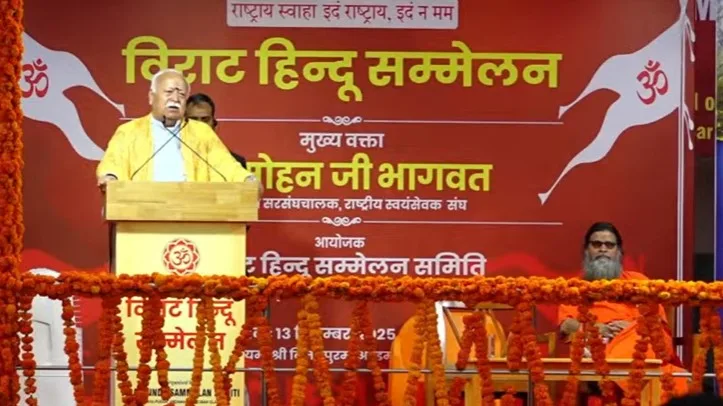
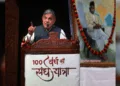
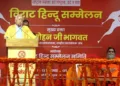
Andaman: Rashtriya Swayamsevak Sangh (RSS) Sarsanghchalak Dr. Mohan Bhagwat on December 13 delivered a wide-ranging address underlining the civilisational responsibility of India and the Hindu society, asserting that the world looks to Bharat for a new path rooted in Sanatan values at the Virat Hindu Sammelan in Andaman and Nicobar. Stressing unity, social harmony, and collective strength, Bhagwat said Bharat’s ancient ethos holds the key to restoring balance in a world grappling with conflict, instability, and moral uncertainty.
Highlighting the limitations of various global experiments carried out over the last two millennia to ensure human happiness, Dr Bhagwat said none had succeeded in bringing lasting peace. According to him, there is growing global expectation that India, drawing from its timeless cultural and spiritual traditions, will present a living example of a balanced and harmonious way of life. He noted that while India possesses truth and moral clarity, the world often responds to strength, making organised collective power essential.
Dr Bhagwat emphasised that strength is not derived from individuals acting alone but from unity, organisation, and the ability to stand together. He urged society to avoid excessive focus on problems and instead work actively on solutions. “Crises often hide opportunities,” he remarked, adding that those who identify and act on such opportunities benefit both themselves and society at large. He said Hindu society, in particular, must develop this proactive mindset.
Describing India’s civilisational mission, Bhagwat ji said the nation has been entrusted with the responsibility of offering dharma to the world—one that restores the lost equilibrium of creation. He asserted that as long as India exists, dharma will endure, and therefore Bharat is an immortal nation. Without dharma, he warned, the very existence of the world would be under threat.
Reflecting on history, he recalled centuries of invasions, persecution, and forced attempts at religious conversion, noting that despite immense suffering, Hindu society preserved its spiritual core. This resilience, he said, is why Sanatan Dharma continues to thrive. He underlined that India, Hindu society, and Sanatan Dharma are enduring realities that cannot be erased.
Dr Bhagwat also rejected the notion that unity requires uniformity. Instead, he said diversity is the true ornament of unity in Indian civilisation. While many societies believe sameness is essential for cohesion, Hindu thought accepts and celebrates plurality. “Differences are often artificial,” he said, adding that India’s strength lies in recognising diversity without allowing it to become division.
He outlined five key action areas that must guide social conduct and national life. He stressed the need for Samajik Samarasta (social harmony) by removing discrimination and ensuring the entry of all into temples. Emphasising Kutumba Prabodhan (family awakening), he called for weekly family gatherings and meals, where discussions should centre on ancestors, culture, the nation, and individual responsibility towards society.
On Paryavaran (environment), he urged protection of nature through the removal of single-use plastic, conservation of water, and active participation in tree plantation. Highlighting Swa-Aadhar (self-reliance), he advocated the use of Indian products and the promotion of Swadeshi. He also underlined Nagarik Kartavya (civic duty) as an essential aspect of desh bhakti, calling on citizens to pay taxes, follow traffic rules, respect elders, and uphold unwritten social values.
Calling for greater social cohesion, Bhagwat ji stressed the importance of strengthening the family, which he described as the fundamental unit of society. He said values, social responsibility, and economic stability are nurtured within families, making them the starting point for societal transformation.
He said that the family gives training for proper behaviour in society. He stated that the basic unit of society is the family and that Bharat follows a family-based economy. Therefore, he said, Bharatiya sanskriti should be preserved at the family level, and training for organising society should also be imparted through the family.
There is a need to inculcate five small but important practices at the family level. Emphasising unity, he said differences must be eradicated by increasing the sense of togetherness through lively contact and friendship with all Hindu families in the locality, while respecting their traditions, festivals, and languages.
Bhagwat ji said that three issues should be discussed at the family level at least once a week: kul (ancestry) and kul riti (family traditions), what the nation is and what its traditions are, and what each individual is doing for society.
He further said that even a house should reflect a Hindu identity. He posed a question on whether a home should display a photograph of Swami Vivekananda or that of a pop icon like Michael Jackson, stressing the importance of cultural consciousness in daily life.
Referring to family travel (bhraman), Bhagwat ji said that while there is no issue in exploring the world and visiting places such as Paris or Singapore, families should also visit places of national importance such as Shri Vijaypuram and the Cellular Jail. He said that people today are able to enjoy foreign travel because many freedom fighters spent their lives in jail there, did not bow down, did not break down, and lived with the resolve to see an independent Bharat.
Outlining a practical roadmap, RSS Sarsanghchalak urged Hindus to focus on five key areas: eliminating social discrimination and promoting harmony; ensuring equal access for all Hindus to temples, water sources, and cremation grounds; spending quality time together as families at least once a week; protecting the environment at the household level; and living with self-respect rooted in indigenous culture, language, attire, food, and traditions while following laws and civic duties.
Concluding his address, Bhagwat ji called for fearless action combined with goodwill for all. He urged individuals to increase their social engagement and work toward strengthening society for the welfare of the entire world. His message, blending cultural pride with social responsibility, reinforced the RSS vision of India as a moral and civilisational guide in an increasingly fragmented global order.










Comments