






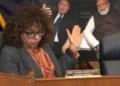
New Delhi: Three members of the US House of Representatives on Friday introduced a resolution seeking to terminate President Donald Trump’s national emergency declaration that enabled the imposition of tariffs of up to 50 per cent on imports from India. The lawmakers described the measures as illegal, economically damaging, and harmful to American workers, consumers, and US–India relations. The resolution has been introduced by Representatives Deborah Ross, Marc Veasey, and Raja Krishnamoorthi. It follows a recent bipartisan move in the US Senate aimed at ending similar emergency-based tariffs on Brazil and limiting the President’s authority to use national emergency powers to impose import duties.
According to the official release, the House resolution seeks to revoke the additional 25 per cent “secondary” duties imposed on Indian goods on August 27, 2025. These duties were added on top of earlier reciprocal tariffs, effectively raising total import duties on several Indian-origin products to as high as 50 per cent. The tariffs were imposed under the International Emergency Economic Powers Act (IEEPA), a statute that Democrats argue is being misused for unilateral trade actions. The lawmakers emphasised the economic stakes involved, particularly at the state level. Representative Ross highlighted that North Carolina has deep economic and social linkages with India through trade, investment, and its Indian American community. She pointed out that Indian companies have invested more than a billion dollars in the state, generating thousands of jobs in key sectors such as life sciences and technology. At the same time, North Carolina-based manufacturers export hundreds of millions of dollars’ worth of goods to India each year, making the tariffs especially disruptive to local businesses and workers.
Representative Veasey underlined the domestic economic impact of the tariffs, arguing that they function as a tax on American consumers. He noted that India is a vital cultural, economic, and strategic partner of the United States and that the tariffs disproportionately burden ordinary Americans, particularly at a time when households are already facing rising costs. Representative Krishnamoorthi criticised the tariffs as counterproductive, stating that they disrupt supply chains, undermine American workers, and increase prices for consumers. He argued that ending the duties would help restore momentum in US–India economic engagement and strengthen cooperation on broader security and strategic priorities. According to him, the tariffs fail to advance US interests and instead weaken a critical partnership at a time of global economic uncertainty.
US lawmakers Deborah Ross, Marc Veasey, and Raja Krishnamoorthi introduced a resolution to terminate President Donald Trump’s national emergency authorizing tariffs of up to 50 percent on imports from India.
Statement: https://t.co/sZ9tw01Hu0 pic.twitter.com/uN8AMMyh2t
— Sidhant Sibal (@sidhant) December 13, 2025
The resolution is part of a wider effort by congressional Democrats to challenge what they describe as the President’s unilateral and misguided trade policies. In October, Ross, Veasey, and Krishnamoorthi, along with Representative Ro Khanna and 19 other Members of Congress, formally urged the President to reverse his tariff decisions and take steps to repair strained bilateral ties with India. The release accompanying the resolution stated that ending the India tariffs is also aimed at reasserting Congress’s constitutional authority over trade policy. Democrats argue that the repeated use of emergency powers to impose sweeping tariffs undermines legislative oversight and sets a dangerous precedent for executive overreach.
The tariffs in question were imposed in two stages earlier this year. In August, the Trump administration slapped a 25 per cent tariff on Indian imports effective August 1, followed by an additional 25 per cent increase days later.









Comments