






Trade and defence cooperation deepen as India strengthens its strategic position, while Congress exposes its contradictions and frustration. Russian President Vladimir Putin’s historic two-day visit to India has once again highlighted the strategic clarity of the PM Modi government and the persistent disarray within the Congress Party. While India and Russia laid out a decade-long roadmap to expand trade and deepen defence cooperation, the Congress leadership remained trapped in confusion, reactionary politics and internal contradictions.
President Putin and Prime Minister Modi’s meeting in New Delhi produced decisive outcomes: ambitious trade targets, joint defence production, S-400 upgrades and cooperation linked to the SU-57 programme. These developments showcased India’s rising strategic autonomy and reinforced its global standing.
In stark contrast, the Congress Party attempted to drag foreign policy into the realm of street politics. Irresponsible statements by its leaders seemed designed to undermine India–Russia relations and damage India’s international image.
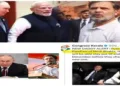
The Kerala Congress unit triggered the biggest embarrassment by posting a crude, derogatory message on its official X handle, mocking President Putin and calling him the new “pav-pav” of Modi supporters. Such language resembled online trolling rather than the conduct expected from a national political party.
Amid this chaos, Rahul Gandhi created fresh controversy by alleging that he was deliberately excluded from the Rashtrapati Bhavan banquet because the government did not want him to meet Putin. His attempt to play the victim collapsed within minutes. Congress MP Shashi Tharoor attended the banquet proving that the government had not excluded the Congress, only Rahul himself. Tharoor’s calm diplomatic presence in the banquet hall highlighted the widening rifts within the party.
Thus, while Rahul complained on social media and Kerala Congress mocked Russia’s President, Tharoor stood shoulder-to-shoulder with the government on a significant diplomatic occasion. The contrast exposed a party uncertain of its own direction.
Meanwhile, India emerged with clear strategic gains. The Modi–Putin engagement reaffirmed India’s independent foreign policy. It disproved the Congress narrative that India is under global pressure or losing ground internationally. Putin openly stated that his relationship with Modi goes “beyond the usual”, a direct rebuttal to claims that India is isolated on the world stage.
As the nation celebrated a diplomatic victory, Congress resorted to sarcasm, confusion and political noise. By insulting a global power and contradicting its own leaders, the party further eroded its credibility.
India–Russia relations now stand on firmer ground, while the Congress continues to sink deeper into its self-created turmoil.







Comments