





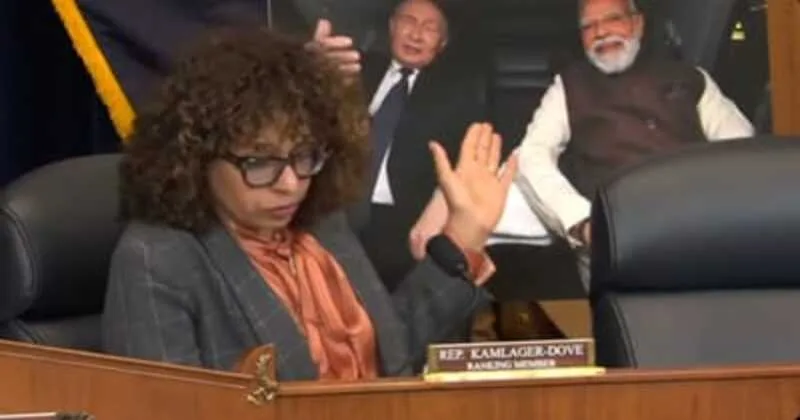
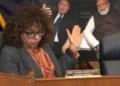
Both Republican and Democratic lawmakers underscored the enduring importance of US–India ties on December 10, even as tensions over tariffs, visa policies and stalled trade negotiations continue to mount. Their remarks came during a congressional hearing on the US-India Strategic Partnership, where Democrat Sydney Kamlager-Dove delivered some of the sharpest criticism of President Donald Trump’s approach, cautioning that the United States risks doing lasting damage to one of its most crucial 21st-century alliances.
Kamlager-Dove framed her warning in unusually direct terms, questioning whether Trump might be remembered as the President “who lost India”, and charging that the 79-year-old leader has jeopardised decades of diplomatic progress through tariff escalations, punitive visa fees and personal political grievances.
The Congresswoman argued that when Trump assumed office earlier this year, the Biden administration had left behind a bilateral relationship at its peak strength, one marked by a reinvigorated Quad, growing defence and technology cooperation, strengthened supply-chain partnerships and broad bipartisan goodwill. She lamented that this reservoir of trust was being squandered: “Flush, flush, flush down the toilet, the capital that Americans have built over decades in service of Trump’s personal grievances and at the expense of our national interests.” Unless Trump alters course, she warned, “Trump will be the American president who lost India, or more accurately, who chased India away while revitalising the Russian empire, while breaking up the transatlantic alliance, and menacing Latin America.”
Kamlager-Dove stressed that India is central to the United States’ position in emerging strategic sectors, including defence, clean energy, AI, space cooperation and advanced technologies. Yet she criticised Trump for alienating a partner that Washington cannot afford to push away. The 50 per cent tariff levied against Indian products, one of the highest rates ever imposed on a US partner besides Brazil, has, she said, severely disrupted senior-level engagement. The additional 25 per cent tariff on Russian oil imports linked to India, she added, has further complicated diplomacy without achieving clear strategic gains. She pointedly highlighted contradictions in the administration’s approach: “Singling out India for 50% tariffs, one of the highest rates imposed on any country, has effectively derailed leader-level meetings between our two countries. Yet the 25% tariff on imports of Russian oil attributed to India looks pretty pointless when Steve Witkoff is striking backroom deals with Putin’s advisors to sell out Ukraine in exchange for some business investment.”
#WATCH | Presenting the photo of PM Modi with Russian President Putin during the latter's recent visit to India, US representative Sydney Kamlager-Dove says, "Trump's policies towards India can only be described as cutting our nose to spite our face… Being a coercive partner… pic.twitter.com/fHcakd75LA
— ANI (@ANI) December 10, 2025
The Congresswoman emphasised that working through the Quad remains critical for maintaining a stable and open Indo-Pacific. She reiterated that India’s partnership is indispensable for shaping the evolving global order: “The US relationship with India will be defining for both countries in how we place ourselves in the 21st-century world order.” In her assessment, the deterioration in ties is not accidental but stems from political choices, including steep tariffs and rapidly rising visa fees. The newly introduced $100,000 H-1B visa application charge, she noted, disproportionately affects Indian professionals, who make up nearly 70 per cent of all H-1B holders. She characterised the measure as a direct blow to the very workforce that has long fuelled US innovation in technology, medicine and research.
Beyond the immediate policy impacts, she said, the fallout is already being felt across Asia, where governments are reassessing Washington’s reliability. Cancelled summits, postponed Quad engagements and tariff battles, she argued, send troubling signals at a moment when Beijing is assessing US resolve. The administration’s approach, she said, amounts to “cutting off your nose to spite your face”, causing “real and lasting damage” to mutual confidence.
Kamlager-Dove urged Congress to intervene quickly to prevent the rupture from widening further. She confirmed earlier to the media reporting that a US–India trade agreement was nearly finalised for signing in July but was unexpectedly halted at the last moment, a move that added yet another layer of uncertainty.
India’s role in ending the Russia-Ukraine war
Congressman Ami Bera, one of the most senior Indian American lawmakers in the US Congress, used his testimony to highlight India’s diplomatic importance concerning the Russia–Ukraine conflict. While acknowledging long-standing American concerns about New Delhi’s close partnership with Moscow, Bera argued that these very ties provide the United States with an opportunity rather than a liability. He stressed that India possesses a unique ability to influence Russian decision-making, influence the West currently does not command. According to him, Washington should be working to leverage that channel rather than undermining it with punitive trade measures. As he put it, “India’s close ties with Russia give New Delhi meaningful leverage in the Ukraine conflict, leverage the United States should be encouraging, not undermining.”
Bera reiterated that the administration’s stated objective is to bring the war to an end. In that context, he argued, India’s connections could prove instrumental: “The President wants the Russia–Ukraine war to end. India can play a role in bringing Russia and Ukraine to the table.” He warned that isolating India through tariff pressure only weakens its potential to serve as a diplomatic bridge. He further noted that New Delhi’s historically strong relationship with Moscow provides access points that Washington and European capitals lack. “We should not be pushing India away,” he said, cautioning that strategy should not be driven by retaliation when a stable partnership offers greater long-term benefits to US foreign policy.
Pramila Jayapal raises alarm on anti-Indian hate
Congresswoman Pramila Jayapal focused her remarks on two escalating concerns: a rise in anti-Indian sentiment across the United States and what she described as an unjust tariff imbalance between India and Pakistan. She said she met earlier that day with an advocacy group monitoring hate incidents against Indian Americans, and their findings were troubling.
Jayapal highlighted the vital role Indian Americans play in the national economy, emphasising their leadership in major corporations, scientific research and innovation. Any rhetoric that targets them, she warned, directly harms social cohesion and undermines America’s competitive advantage. “Indian Americans are extremely important to our economy, running Fortune 500 companies and leading cutting-edge research,” she said, cautioning that anti-immigrant narratives threaten this contribution. She then questioned the logic of tariff disparities that favour Pakistan, a country with far less strategic alignment with the United States. While India faces 50 per cent tariffs, Pakistan’s rate stands at just 19 per cent. Jayapal asked pointedly how New Delhi is expected to view such an imbalance: “How is India feeling as a close partner when Pakistan has lower tariffs than India?” For Jayapal, these decisions do not merely represent economic miscalculations but send damaging diplomatic signals at a time when Washington should be strengthening trust with its most important Asian partners.







Comments