





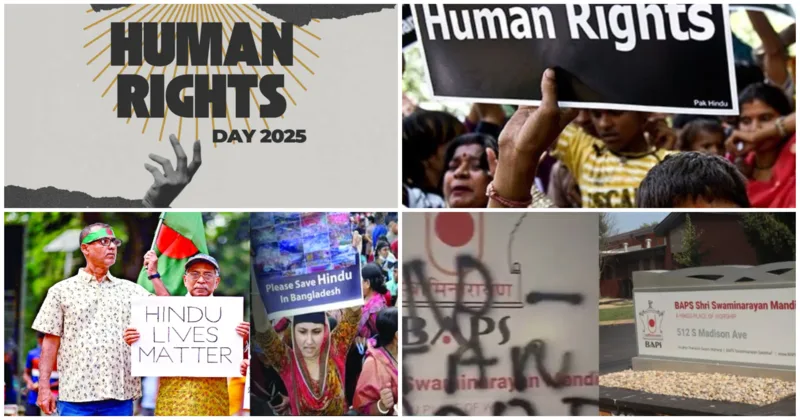
Hindu communities across South Asia and the West face a wide spectrum of discrimination, violence, cultural restrictions, and institutional neglect, despite forming a global minority. Evidence of persecution, temple mismanagement, rising hate crimes, and unequal rights
Hindus are a religious minority, making up about 15 per cent of the world’s population. However, they are a majority in Bharat, where most of the world’s Hindu population lives, and in Nepal. In many other countries with significant Hindu populations, such as Bangladesh, Pakistan, and Malaysia, they are a minority and face various forms of discrimination.
In these countries, Hindus face daily violence, including abductions, forced conversions, and attacks on temples. In Malaysia, the Hindu community experiences institutional discrimination and economic marginalisation due to government policies like the Bumiputra policies.
In Bhutan, there are restrictions on the cultural, linguistic, and religious rights of ethnic Nepali Hindus, and security forces have been accused of abusing Tamil Hindus in Sri Lanka.
Selective targeting of Hindu Festivals in the name of environment
Hindu festivals are consistently scrutinised in global media under the guise of “environmental concern,” despite Sanatan being one of the world’s oldest nature-worshipping traditions. Hindus treat rivers as mothers, mountains as gods, plants and animals as sacred embodiments. The anti-Hindu lobby often criticise sacred Hindu festivals like Diwali and Holi for causing pollution or noise, often ignoring the industrial factors actually responsible for environmental degradation. At the same time, there is no outrage over animal sacrifice during Eid, tree cutting on Christmas, or fireworks used widely on Western New Year across globe.
Systemic Persecution of Hindus in neighbourhood
Bangladesh
- United States Commission on International Religious Freedom (USCIRF) recorded 92 attacks on religious minorities in the first three months of 2025, including 11 murders, 3 rapes, 25 temple attacks, and 28 cases of vandalism, with Hindu women.
- During the violence following Sheikh Hasina’s resignation (August-September 2024), 2,010 attacks targeted minorities across Bangladesh, including 69 mandirs and the looting or burning of 157 homes. In Khulna Division alone, 295 Hindu homes and businesses were destroyed, including 50 houses torched in Jashore, and five Hindus were killed, one of them being retired teacher Mrinal Kanti Chatterjee.
- According to Bangladesh Jatiyo Hindu Mahajote’s 2019 data, there were 3,000+ persecution incidents, including 148 forced conversions, 449 temple attacks, 246 idols destroyed, and 371 Hindu families forced to flee. Additional 2024–25 cases include kidnappings such as 16-year-old Bristi Chakrabarty and extortion threats to Khulna temples demanding 5 lakh taka during Durga puja.
Pakistan
- According to Pakistan’s Centre for Social Justice (CSJ), there were 109 registered cases of abduction, forced conversion, and forced marriage of Hindu women and minor girls between January and November 2023, with figures likely higher due to underreporting and fear of retaliation. Of these, 80 involved Hindus and 13 involved Christians
- CSJ data shows at least 421 cases of forced conversion and abduction of minority girls between January 2021 and December 2024, including 282 Hindu girls, 137 Christian girls, and 2 Sikh girls. 71 per cent of victims were minors, with nearly half aged 14-18 and 22 per cent under 14. 69 per cent of cases occurred in Sindh and 30 per cent in Punjab
- HRCP cites Pakistan’s blasphemy dataset noting 329 blasphemy accusations in 2023, of which approximately 75 per cent targeted religious minorities, including Hindus. Between 2021 and 2025, more than 750 individuals, a large number belonging to minority communities, were imprisoned under blasphemy laws
Malaysia
Hundreds of century-old Hindu temples on former estate lands were reclassified as “illegal,” leading to widespread demolitions. Deities were often shifted into tin sheds that devotees said looked “just like a cattle barn,” reflecting deep cultural humiliation
Thailand
Thailand is home to an estimated 80,000-100,000 Hindus, including Thai nationals of Indian origin and Nepali, Tamil, and Sindhi communities. Despite this sizeable population, Thailand has zero licensed open-air Hindu cremation grounds. Hindu antyeshti requires an open pyre, family involvement, and full visibility of the final rite, none of which are permitted. As a result, Hindu families often conduct partial rites or rely on makeshift riverside cremations
Sri Lanka
Sri Lanka’s Northern and Eastern Provinces, home to over 1.6 million Tamil Hindus, have faced state-enabled seizure of Hindu sites. The 2020 Presidential Task Force for Archaeological Heritage, led to the redesignation of Hindu temples as Buddhist heritage zones. Many Hindu devotees have been assaulted or detained during festivals like Maha Shivaratri.
Hindu Deities Mocked From US Textbooks to Commercials
Hindu Gods in the United States and West have repeatedly been degraded and misrepresented, especially in California.
A California school textbook once described Hanuman with the line: “The monkey-king Hanuman loved Rama so much that it is said he is present every time the Ramayana is told. So look around — see any monkeys?” This was widely condemned for mocking a revered deity and trivialising a sacred epic.
Similarly, Goddesses Durga and Kali were described in some books as “terrible and extremely bloodthirsty,” a portrayal that many Hindus saw as offensive and completely inaccurate. Hindu scriptures were reduced to terms like “myths,” “legends,” or “ancient poems,” while rituals and beliefs were often explained in dismissive language. The disrespect extended beyond textbooks. In 2025, California-based company CafePress sold underwear, flip-flops, dog T-shirts, pet bowls and yoga mats printed with images of Hindu deities.
Rising Wave of Anti-Hindu Hate in the West
- United States: Since 2023, the US has witnessed a documented surge in anti-Hindu hate incidents, including five mandir vandalisation cases reported to Bharat’s Parliament between 2024-2025. On March 8, 2025, the BAPS Mandir in Chino Hills, California was defaced with “Hindustan Murdabad” and other anti-Hindu slurs.
- Canada: The Indian MEA recorded four mandir vandalisation cases in Canada in the past year alone. Among the most serious was the assault on devotees at Hindu Sabha Mandir, Brampton, where extremist groups harassed and physically attacked worshippers. In April 2025, the Lakshmi Narayan Mandir, Surrey was defaced with pro-Khalistan graffiti, part of a two-year trend of temple desecrations. Rising community fear pushed authorities, most notably Mississauga Council in 2025 to formally condemn anti-Hindu hate, a rare official acknowledgment in North America.
- United Kingdom: On June 14, 2025, three British Hindu men were violently assaulted in a London park in a racially motivated hate attack, targeted for their Bharatiya/Sri Lankan identity. Past flashpoints, such as the 2022 Leicester unrest, where Hindu homes, temples, and businesses were attacked, continue to shape community fear. Diaspora groups warn that many incidents remain unreported due to mistrust in authorities and social isolation, pointing to a larger climate of institutional neglect toward anti-Hindu threats.
Draining of Hindu Temple Funds
Karnataka manages over 34,000 state-run Hindu temples, with some temples earning gross annual incomes exceeding Rs 25 lakh. The state proposed diverting 10-18.5 percent of income from wealthier temples to Government schemes, raising concerns over using temple funds for non-religious purposes. Tamil Nadu oversees more than 36,000 temples with annual revenues estimated at Rs 33,000 crore. RTI inquiries revealed around Rs 7,400 crore in unaccounted temple funds, with many donations diverted for unrelated or administrative expenses, leaving heritage temples neglected and priests unpaid. Tamil Nadu’s temple lands face massive encroachments, resulting in losses exceeding 99 percent of potential rental and revenue income. Recovery efforts account for only a fraction of possible earnings, indicating systemic mismanagement and misappropriation under State oversight.
When Minority Protections Exclude Hindus
In India, Christians, Muslims and many other religions receive minority status that grants them benefits in education, government schemes, and various institutional fields. However, in States and Union Territories where Hindus themselves are a numerical minority such as Jammu & Kashmir, they do not receive similar minority protections.
A recent example is from Vaishno Devi medical college admission, where out of 50 medical seats, 42 were allotted to Muslim candidates, raising serious concerns about fairness, representation, and the absence of minority safeguards for Hindus in regions where they are numerically disadvantaged.
Atrocities Against Hindus in Bharat
- Kashmir : Between January-March 1990, nearly 100,000 Kashmiri Hindus fled after targeted killings, threats from extremist groups, and open calls for their extermination. Over the next decade, the displaced population grew to 350,000-400,000.
- Kerala, West Bengal, Nagaland, Northeast
- Police records show 65 members of Hindu organisations were killed in Kerala between 2000 and 2017.
- Hindu-rights trackers and national persecution lists record 100+ anti-Hindu incidents annually in Kerala, 2023-2025 include temple vandalism and targeted murders.
- Jharkhand: In Uttar Palashachi (Sahibganj district, Santhal Pargana), Jharkhand 35 Hindu families live surrounded by nearly 11,000 Muslim households, creating conditions of social intimidation and demographic domination across a stretch where no Hindu home exists for over seven kilometres. Hindu residents are forced to stop music five times a day, avoid rangoli on public streets, and refrain from DJ or band music at weddings, as any deviation reportedly triggers attacks, verbal abuse, or mob aggression. Hindus pay an informal ‘tax’ on agricultural produce, face cow theft.
Hindu Devotees betrayed by Sabarimala management
In late November 2025, the sacred Sabarimala Temple, one of India’s most revered shrines, became the centre of a scandal that shocked devotees and exposed serious mismanagement. Hundreds of thousands of Hindu pilgrims who thronged the temple experienced utter chaos: interminable queues, collapsing pilgrims (including women, the elderly, and children), a severe lack of drinking water and food, and many were forced to abandon their vows and leave without darshan.
In parallel, investigations uncovered a brazen gold-theft scandal, allegedly orchestrated by temple officials. The shrines’ gold-clad murtis and doors were replaced with copper or low-grade plating, and the original gold is reported to have been siphoned off over several years. Senior figures associated with the Travancore Devaswom Board (TDB), including two former presidents, have been arrested.
The revelations have sparked outrage among pilgrims and the wider Hindu community, fueling renewed calls to free temples from political control and ensure transparent, accountable administration. The case has also triggered legal action: the Kerala High Court has initiated suo motu proceedings and ordered strict crowd-management guidelines, including restricted spot bookings, regulated virtual queues, and a mandate that no more than 80 devotees climb the sacred 18-step staircase (Pathinettampadi) per minute.













Comments