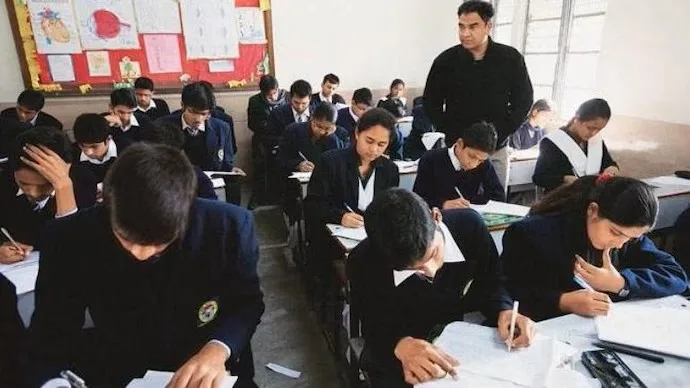
Nearly 85,000 candidates failed the Tamil language paper in the Post Graduate Teachers Eligibility Test (PG TET), a development that has triggered widespread concern among educationists and those who champion Tamil language preservation. The outcome has raised uncomfortable questions for the DMK government which positions itself as the protector and saviour of Tamil within the framework of Dravidian politics and language politics.
Under “Dravidian Model” governance, the stark result, where tens of thousands of degree-holders failed a Class 10-level Tamil Language paper has become a shocker for lovers of Tamil and a worrying indicator of the decline in Tamil language learners across the state.
Tamil Nadu mandates a compulsory Tamil language paper for all aspirants for state government jobs, a rule introduced in 2022. The PG TET held in mid-October aimed to fill 1,996 vacancies for postgraduate teachers, computer instructors, Physical Education Directors and other posts. Out of 2.36 lakh candidates who appeared, nearly 36 percent were eliminated solely because they failed to secure the minimum qualifying 40 percent (20 marks out of 50). Their subject papers were not evaluated further.
Despite holding UG, PG, B.Ed, M.Ed, M.Phil or even PhD degrees, many candidates could not clear an exam that tested only basic Tamil proficiency. Critics argue that this reflects the deteriorating quality of Tamil education, the overwhelming shift towards English language preference, and the poor emphasis on Tamil in private schools contradicting political rhetoric around protecting Tamil identity and resisting the “imposing Hindi” narrative.
A critic observed, “People can obtain degrees, postgraduate qualifications, even PhDs in Tamil Nadu without truly studying Tamil. Many students treat Tamil as a secondary subject and schools do not emphasise it. Even those who performed well in subject papers have now lost opportunities due to failing their mother tongue, this reveals the true crisis.”
The critics further added that DMK leaders and CM Stalin, who frequently accuse the PM Modi or the Governor RN Ravi of being “anti-Tamil”, should introspect. “Most ministers, including the CM and Deputy CM, rely on prepared notes even for simple Tamil statements,” one remarked.
PMK president Dr Anbumani Ramadoss, in a statement issued in November, said he was “shocked” that 85,000 of the 2.36 lakh PG TET candidates had failed the Tamil language paper. He said the situation was the “direct consequence of the education system created by the rulers of Tamil Nadu”.
He recalled that similar results occurred in last year’s Graduate and Secondary Grade Teachers recruitment exams, emphasising that a systemic problem has taken root.
“These are not ordinary candidates; most hold at least three degrees, many hold M.Phil and PhD qualifications. Yet they cannot pass a Class 10-level Tamil paper. This recurring trend exposes deep flaws in Tamil education and highlights the state’s neglect of Tamil learning,” he said.
PMK leaders accused successive governments of undermining Tamil education by failing to enforce the 2006 Compulsory Tamil Learning Act, not pursuing judicial clarity in the Supreme Court, and reducing instructional hours for Tamil under the DMK regime.
“It is a disgrace,” they concluded.
The results have reignited debates around Tamil vs English medium education, Dravidian language politics, and how political narratives around “protecting Tamil” contrast with the educational outcomes now emerging.

Leave a Comment