





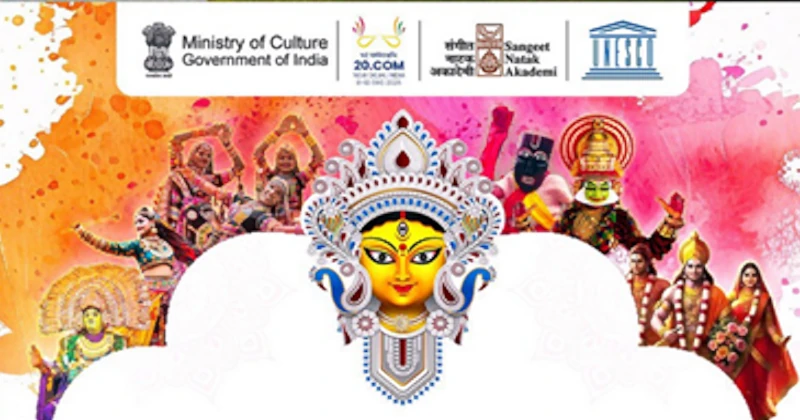
NEW DELHI: The Government of India will host the 20th Session of the UNESCO Intergovernmental Committee for Safeguarding of the Intangible Cultural Heritage (ICH) from December 8 to December 13, 2025 in New Delhi. For the first time ever, India will chair and host the prestigious global gathering, with H.E. Vishal V. Sharma, India’s Permanent Delegate to UNESCO, presiding over the session.
The iconic Red Fort, a UNESCO World Heritage Site and an enduring symbol of India’s civilisational legacy, will serve as the venue bringing together the nation’s tangible and intangible heritage in a moment of powerful cultural convergence. The timing is equally significant: the event coincides with the 20th anniversary of India’s ratification of the 2003 ICH Convention, reaffirming the country’s leadership in safeguarding living traditions.
UNESCO defines intangible cultural heritage as the living practices, expressions, knowledge systems, and skills passed through generations from oral traditions and performing arts to rituals, crafts, festivals, and community practices. These traditions, shaped by communities and strengthened through transmission, are essential to cultural identity and diversity.
India’s decision to host the session signals a bold assertion of its cultural depth and global heritage leadership at a time when modernisation and globalisation continue to threaten traditional knowledge systems worldwide.
Adopted on October 17, 2003 in Paris, the ICH Convention emerged from growing international concern over the erosion of cultural practices amid rapid societal change. It placed communities, indigenous groups, and tradition-bearers at the centre of heritage preservation, emphasising the inseparable link between tangible and intangible heritage.
The Convention’s goals include:
- Safeguarding intangible cultural heritage
- Ensuring respect for cultural traditions
- Raising awareness globally
- Strengthening international cooperation
These principles continue to guide global action on living heritage preservation.
The ICH Committee responsible for implementing the Convention carries out several crucial functions:
- Overseeing global safeguarding efforts
- Recommending best practices
- Managing the ICH Fund
- Mobilising international support
- Drafting operational guidelines
- Evaluating nominations for UNESCO’s ICH Lists
- Deciding on international assistance
Its decisions shape cultural policy across more than 180 countries.
The Ministry of Culture and the Sangeet Natak Akademi (SNA) will jointly organise the 20th Session at the Red Fort, a historically charged location whose walls have witnessed centuries of cultural, political, and civilisational evolution. Hosting the session here sends out a powerful message: India’s heritage ancient yet living, diverse yet unified stands at the forefront of global cultural diplomacy.
India aims to transform the event into a platform for global cooperation and cultural renewal. Major goals include:
- Presenting India’s ICH safeguarding model: India will showcase its integrated approach combining institutional support, community participation, documentation, and national inventory building.
- Strengthening international partnerships: Through joint nominations, cross-border initiatives, knowledge exchange, and technical cooperation, India seeks deeper global engagement.
- Enhancing global visibility of India’s living traditions: From local crafts and community rituals to regional festivals, India aims to spotlight lesser-known heritage expressions before a global audience.
- Inspiring domestic action: The event is expected to fuel fresh momentum for documentation, youth engagement, inventory development, and preparation of nomination dossiers.
- Expanding cultural diplomacy: The session reinforces India’s soft power by showcasing its cultural diversity and civilisational heritage on a world stage.
- Linking heritage to sustainable development: India will advocate heritage as a driver of livelihoods, social cohesion, cultural tourism, and inclusive development.
India’s ICH is among the richest in the world a living cultural reservoir with immense social, educational, economic, and diplomatic value:
- Identity & Social Cohesion: Preserves community identities across linguistic, ethnic, tribal and regional lines.
- Livelihoods & Skills: Supports millions of artisans, performers, and crafts communities, especially in rural India.
- Education & Knowledge Transmission: Carries ecological knowledge, oral traditions, craftsmanship, and indigenous wisdom.
- Soft Power & Diplomacy: Enhances India’s image globally through cultural depth, diversity, and continuity.
To protect its vast living heritage, the Ministry of Culture established the “Scheme for Safeguarding the Intangible Heritage and Diverse Cultural Traditions of India,” supporting:
Documentation and national inventories
- UNESCO nomination dossiers
- Training, workshops, and skill-development
- Education–culture integration
- Performances and festivals
- Capacity building through SNA
- Collaboration with universities, NGOs, state bodies, and practitioners
India currently has 15 elements inscribed on UNESCO’s Representative List, ranging from:
- Kutiyattam, Chhau dance, and Sankirtana
- Vedic chanting, Buddhist chanting of Ladakh
- Ramlila, Ramman, Kalbelia, Garba, and Durga Puja
- Yoga and the Kumbh Mela
- Metalcraft of the Thatheras of Jandiala Guru
- Novruz (multi-national tradition)
This year, India has nominated Chhath Mahaparva and Deepawali two deeply rooted cultural celebrations for consideration.











Comments