





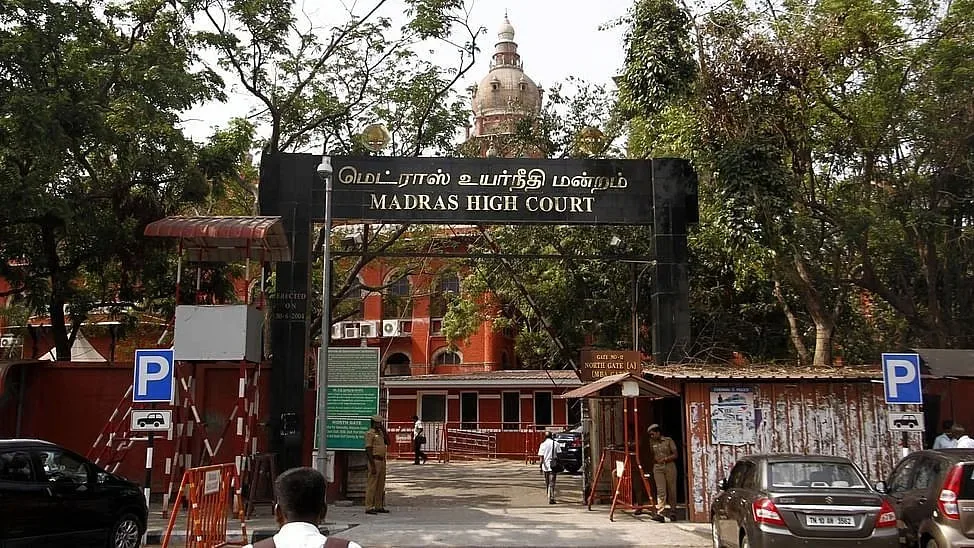
A fresh controversy has unfolded in Dindigul even as tensions persist over the Thiruparankundram Karthigai Deepam issue. In Dindigul district, a group of Christian residents opposed the lighting of a traditional lamp at the Mandu Koil site, an episode that mirrors the recent stand-off in Madurai, where the District Magistrate (DM) and Commissioner of Police allegedly obstructed a similar order. According to petitioners, officials in Dindigul specifically the District Collector (DC) and Superintendent of Police (SP) took comparable steps despite the High Court’s directives.
On December 4, Justice G.R. Swaminathan, who had earlier ordered the lighting of the Deepathoon lamp at Thiruparankundram, heard a related plea concerning Dindigul.
In an 11-page order, he observed: “It is a sad day for the Madurai Bench of the Madras High Court and an even sadder day for the Rule of Law. One Sithan Balraj filed Writ petition seeking permission to conduct Karthigai Dheepam festival at the petition mentioned site which is in the immediate vicinity of Kaaliamman temple at Perumal Kovilpatti, Dindigul District. The site in question has been named as Mandu Kovil and is comprised in Survey No.780/12. A mere look at the FMB sketch would show that the existence of Mandu Kovil has been acknowledged by the revenue authorities themselves. In the village in question, Christians are in majority and Hindus are in minority. All that the Hindu community of Perumal Kovilpatti village want is that they should be allowed to celebrate Karthigai festival in a place where has been recognized as Mandu Kovil in the revenue record itself.”
Justice Swaminathan further noted: “There is also a ‘Peedam’ in the said site. Even while allowing the writ petition, I made it clear that the Hindu community will not be allowed to put up any permanent structure or raise any new construction. In other words, status quo recognised in the revenue record should be allowed to continue.
Since the site in question had been barricaded, bushes have grown. I, therefore, permitted the petitioner to clear the bushes so that the site can be readied for celebration… I specifically noted that by permitting the Hindu community to celebrate the event for few hours today and tomorrow, the rights of the Christian community will not in any way be affected. This is all the more so because the Christian community has no claim over the said site.”
When the contempt petition was taken up on December 5, the judge said: “I had not ordered execution of any person. I had not ordered demolition of any building or structure. By complying with the order of this Court, no irreversible consequence would ensue… The order of this Court was not only not complied with but brazenly defied. The District Collector, Dindigul had issued prohibitory orders on December 2… The Executive cannot sit in judgment over the order I had passed. The District Collector does not exercise appellate jurisdiction over me. He cannot and he dare not pass an order which would have the effect of nullifying my order.”
He continued: “Neither the District Collector, nor the Superintendent of Police, Dindigul can take the frivolous plea that they were not parties and hence, the order of this Court will not bind them… By passing the order dated December 2, the District Collector, Dindigul has prima facie committed contempt. The District Collector has forbidden the usual religious celebrations even. Nothing can be a grosser breach of the fundamental rights of the individual Hindus of Perumalkovilpatti.”
Concluding, Justice Swaminathan directed: “The fig leaf of law and order situation will not deter this Court from enforcing its order. I direct Saravanan, District Collector, Dindigul and Pratheep, Superintendent of Police, Dindigul to appear in person today (December 4) at 3.15 pm and explain what led them to defy the order of this Court.”
The High Court has deferred contempt proceedings in both the Dindigul and Thiruparankundram Deepam cases after the state government filed a Special Leave Petition in the Supreme Court and appeals were admitted before a division bench. The matter will be heard again on 9 December.
In a related judgment delivered earlier in November, Justice Swaminathan had ruled that government-owned public grounds cannot be reserved exclusively for one religious community, permitting Hindus to conduct Annadhanam during a Kumbabishekam on land traditionally used for Easter celebrations. He stated: “When the land in question is not a patta land but belongs to the Government, it should be available to all sections irrespective of religious or communal background.”







Comments