





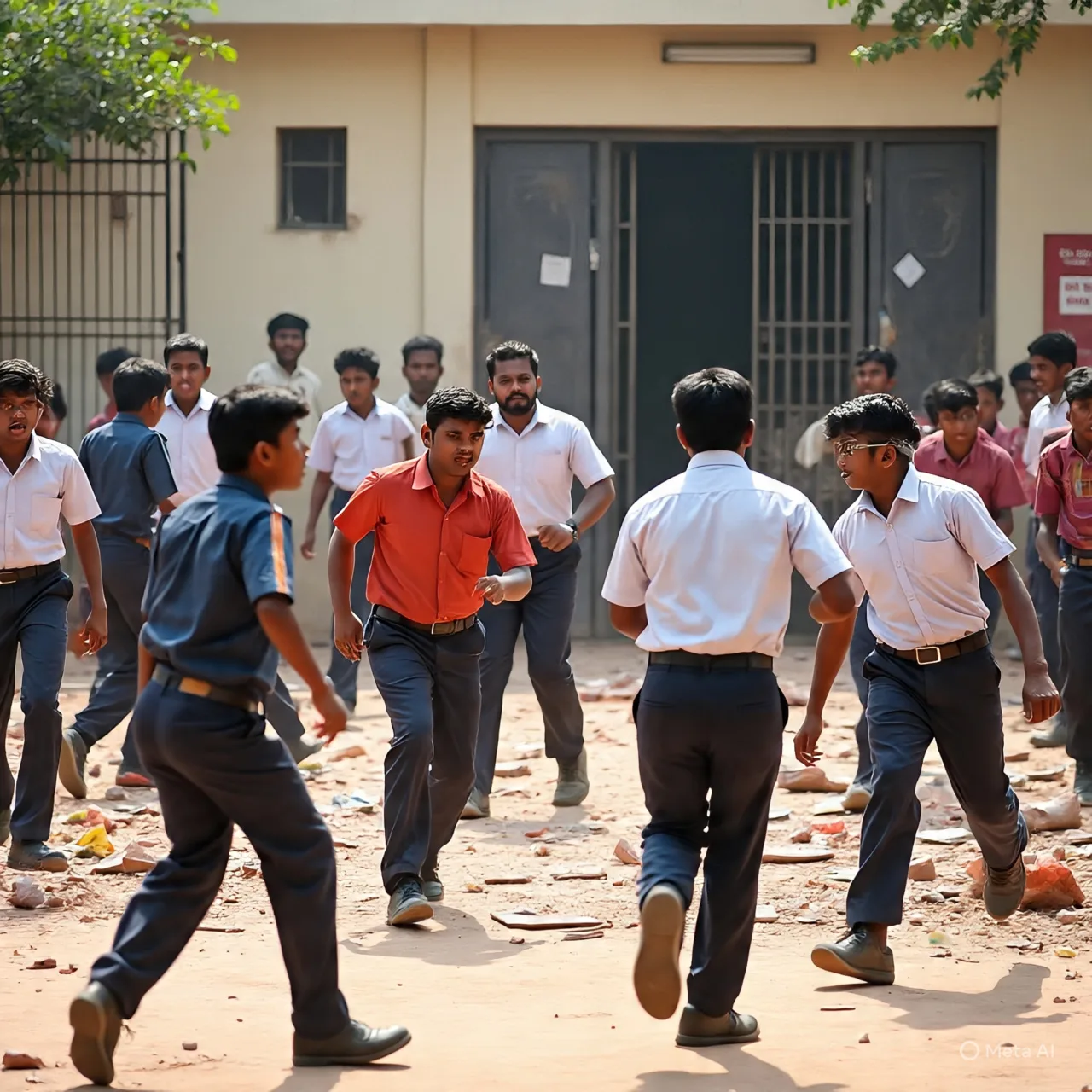
A Class 12 student from Arignar Anna Model Higher Secondary School near Thanjavur has been declared ‘brain dead’ after he was allegedly assaulted by a group of juniors in Pattiswaram on December 4, in yet another incident raising questions over Tamil Nadu’s deteriorating law and order and growing violence within student communities. The episode comes amid repeated concerns about rising assaults on women, children and students under the current DMK’s Dravidian model governance, where both girls and boys have faced sexual and physical attacks from peers and teachers.
According to reports, the clash occurred at Therodum Keelvidhi (East Car Street) near the well-known Durga Maa shrine in Pattiswaram. The victim, a Class 12 student, was attacked by juniors believed to be from Class 11 while passing through the area with his friends. The assault, involving wooden clubs, left him with severe head injuries.
The confrontation reportedly stemmed from a quarrel on December 3 during the school lunch break in the toilet, a continuation of tension that first surfaced three months ago between the same groups. On December 4, the dispute escalated when around 15 Class 11 students allegedly confronted the victim and his friends and attacked them. The victim collapsed unconscious, after which the accused fled the scene.
Classmates rushed him to the Pattiswaram Primary Health Centre for first aid before he was transferred to a private hospital in Thanjavur. Police confirmed that the student succumbed to his injuries around 2:30 am on December 7. On December 5, doctors declared him ‘brain dead’, plunging the family and local community into shock. Despite intensive care at Thanjavur Medical College Hospital, he died soon after.
Following a complaint from the parents, Kumbakonam Taluk Police detained 15 Class 11 students involved in the attack. They were produced before authorities and lodged in the Juvenile Observation Home in Thanjavur on December 5. Police have stepped up security at the victim’s residence, school and surrounding areas to prevent any further tension. Officials said an initial case of attempt to murder will be altered to murder after the post-mortem. Police also confirmed that earlier in September a scuffle between Class 11 and 12 students had resulted in injuries, but intervention from parents led to only a warning being issued.
The government school has nearly 1,000 students, and critics argue that poor supervision and falling academic standards under the Dravidian model have contributed to such violent incidents. They point out that this violence occurred inside a so-called ‘model school’.
This case follows a string of violent incidents involving students in Tamil Nadu. In November, a Class 7 student at the Social Justice Hostel in Ramanathapuram was reportedly assaulted by four senior students over a torn record note. In March, a Class 11 student in Thoothukudi had three fingers severed in an attack allegedly linked to caste tensions after a kabaddi match.
Incidents of sexual assault among girls and boys, physical attacks by teachers, and students wielding lethal weapons have increasingly been reported from schools and colleges across the state. Observers say films glorifying extreme violence and widespread media coverage of brutal crimes are influencing young minds. Suspensions and arrests of college students brandishing machetes on Chennai suburban trains have become frequent, making weapon-wielding youth a recurring menace.
Critics point to a broader decline in social values, highlighting that deteriorating law and order is compounded by a collapse in healthy social interaction among children. They argue that intolerance among students where disagreements escalate to violence is a troubling reflection of society’s collective failure to guide and safeguard its youth.
















Comments