





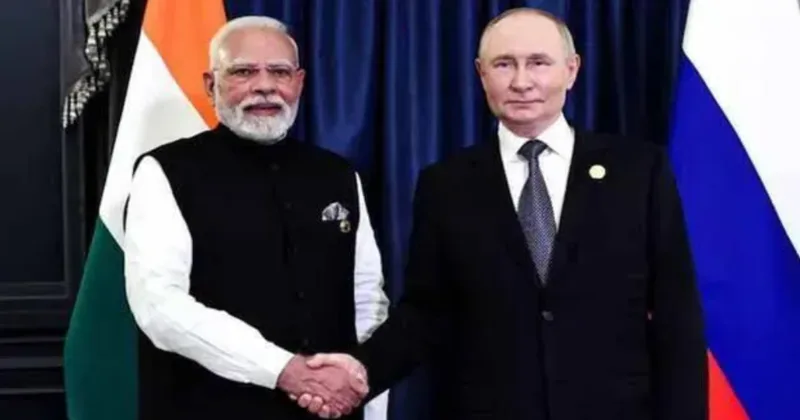
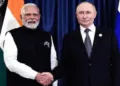
On December 4, President Putin arrived in Delhi after a four-year hiatus, coinciding with the situation surrounding the Russia-Ukraine conflict. His visit to New Delhi is not merely a nostalgic return to Soviet-era ties; it occurs at a crucial moment when Moscow, fatigued by Western sanctions and isolation, views India as a dependable ally-a friend that communicates gently but acts with strategic intent. For India, this visit highlights a significant geopolitical reality: in a fragmented world, longstanding friendships rooted in mutual respect provide considerably more stability than fleeting alliances formed out of convenience. This is an opportune moment for the two old allies to deepen their collaboration not only in strategic or energy sectors but also in a sphere that extends beyond material interests, cultivating civilizational bonds as a shared repudiation of a modernity shaped by the liberal world’s advocates.
You will undoubtedly encounter numerous articles discussing this visit and its implications for trade, particularly regarding India’s need to bridge the import-export divide, emphasizing a relationship that transcends the strategic partnership. Yet, my focus is on India’s quest for decolonization of thought and how it can position itself as a leader of the Global South with Russia’s assistance to counter Chinese dominance in the region. As Prime Minister Modi stated during the sixth Ramnath Goenka Lecture in Delhi, “This decade is critical for the people of India because we need to rectify the damage inflicted by Macaulay’s decisions before 2035, which marks 200 years of the imposition of English in education.” Here, the goal is not only to achieve decolonisation at the domestic level but also internationally. This is where Russia’s role becomes significant. As the world shifts towards multipolarity, India is poised not only to play a balancing act but also to take the lead. The concept of multipolarity cannot be envisioned without India; excluding India would lead to chaos.
India cannot establish itself as a genuine “pole” in the emerging world order solely through economic advancements or military strength; it must first regain its epistemic sovereignty, framing Indian tradition not merely as a relic of the past but as a vision for the future. This is the only solid foundation for a post-globalist world.
The dance of the Elephant-Bear
The “dance floor” is the Fractured Global Forum particularly the Global South-Africa, Latin America, and Southeast Asia regions tired of Western lectures on morality and Chinese debt traps. The Elephant (India) and the Bear (Russia) enter this space not as conquerors, but as distinct alternatives. The Bear disrupts the West’s monopoly on force and energy i.e. beating the collective muscle might of US and NATO in Ukraine whereas the Elephant provides the economic stability and moral legitimacy of a recovered civilization. i.e. India role as a Vishwamitra to the world particularly to the global south as we did the vaccine Maitri during covid 19 and gave ‘economic grants not debts’ to the nation of global south during the time of crisis.
For New Delhi, Russia is not just a legacy partner but a strategic reservoir of critical technology i.e. nuclear (Rosatom), hypersonics, and space propulsion which is necessary to bypass Western conditionality and check Chinese dominance. Russian technology and minerals helps us to bypass the need of China in the global south. By absorbing Russian military-industrial expertise, India accelerates its “Atmanirbhar” (self-reliance) goals, creating a development model for the Global South that rivals China’s Belt and Road. Unlike Beijing’s purely materialist approach, India can offer the Global South a partnership based on civilizational respect rather than debt trap.
The China Question
The so-called “China Question” serves as the implicit fulcrum of the Russia-India partnership. Moscow’s economic dependence on Beijing is balanced by a strategic concern that Russia will become a subordinate partner in a Sinocentric Asia. As a result, Russia actively empowers India by proliferating sensitive nuclear and hypersonic technologies denied to China as part of its attempt to create a necessary counterbalance and safeguard a multipolar Eurasia, not one dominated by China.
For India, China is a state-level threat, relating to territorial integrity and strategic encirclement, rather than from the West, the perceived civilizational threat through cultural erosion. While the recent rapprochements between Beijing and New Delhi are encouraging, New Delhi recognizes that the competition for leadership within the Global South endures. To this end, Russia acts as an important buffering actor.
By staying close to Russia, India prevents the emergence of an overarching Russia-China military alliance. Russia diffuses the Chinese threat by denying Beijing the capability to dominate Eurasian resources. This allows India to contest China’s influence in the Global South, offering a transparent, human-centric alternative to the Belt and Road Initiative backed by the strategic confidence of Russian defence supply, securing India’s rise without provoking a potential two-front conflict.
Civilizational Camaraderie for a fractured Multipolar order.
Today, India and Russia stand at the juncture where strategic alignment is underpinned by a deeper civilizational amity. The world, rapidly wearied by the moral evangelism of the West and the material coercion of China, finds in the Elephant and the Bear together an alternative that is underpinned by mutual respect, balance, and cultural depth. For India, strengthening partnership with Russia is not merely diplomacy; it is, in fact, the path toward epistemic sovereignty and the articulation of a new global narrative. As civilizations dance on the world stage in this evolving drama, India rises-not just as another ‘pole’, but as the moral and stabilizing centre- a Vishwamitra in a fractured multipolar world.








Comments