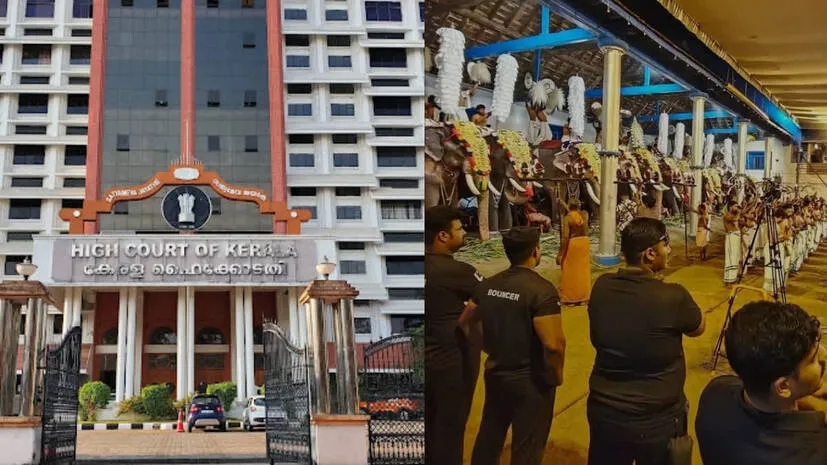
(L) Kerala High Court (R) Bouncers in Trippoonithura temple
Temple management is a sacred responsibility and duty, but Communist leaders serving as members of Kerala’s temple boards continue to treat temples as their private property, exploiting every activity connected with the temple, from funds to crowd management. Their alleged disregard for values and traditions surfaced again after bouncers were deployed to control the crowd during festive rush hours at the Sree Poornathrayeesha temple, Trippoonithura near Kochi.
The development triggered sharp judicial criticism. The Kerala High Court came down heavily on the management of the ancient temple, which is under the administration of the CPM-controlled Kochi Devaswom Board, and issued strong directions on December 3 while hearing a petition filed by N. Prakash. The petitioner argued that using private bouncers is fundamentally against the divinity and culture of the temple.
The Court observed that the deployment of bouncers, clad in black T-shirts with “BOUNCER” inscribed on them and wearing what it termed an undesirable uniform, “should not be repeated under any circumstances”.
The intervention came after the court examined visuals from the Vrushchikolsav festival, where bouncers were brought in to “control the crowd” during the Valiya Vilakku ritual, a key part of the festivities. The bouncers had reportedly been arranged through a private security agency.
Prakash submitted that security and crowd management are duties entrusted to police personnel and Devaswom guards, and the introduction of private bouncers could set a wrong precedent. During the earlier hearing, the Court had already expressed dissatisfaction after noting the stark “BOUNCER” inscription on their T-shirts.
On December 3, the Devaswom Board’s counsel attempted to justify the circumstances that led to their deployment.
In Kerala, the Court noted, bouncers are usually associated with bars, employed to handle drunk individuals who misbehave after excessive alcohol consumption. Their presence inside a temple, a sacred space of worship, caused “bad taste in every mouth”, reinforcing concerns about what observers describe as the CPM leadership’s attitude towards Hindu devotees.
In Kerala, the Court noted, bouncers are usually associated with bars, employed to handle drunk individuals who misbehave after excessive alcohol consumption. Their presence inside a temple, a sacred space of worship, caused “bad taste in every mouth”, reinforcing concerns about what observers describe as the CPM leadership’s attitude towards Hindu devotees.
Communists in general, and Kerala Chief Minister Pinarayi Vijayan in particular, project themselves as atheists while presiding over government administration linked to temples, churches, and mosques. However, in practice, they frequently dictate decisions and actions connected specifically to temple affairs, even as they keep a marked distance from activities related to churches and mosques.
The ongoing investigation into the Sabarimala gold theft case is now revealing how deep the communist involvement runs in temple management, including allegations of siphoning devotees’ donations and diverting them into personal property under the names of top political figures and trusted bureaucrats close to the Communist leadership.

Leave a Comment