





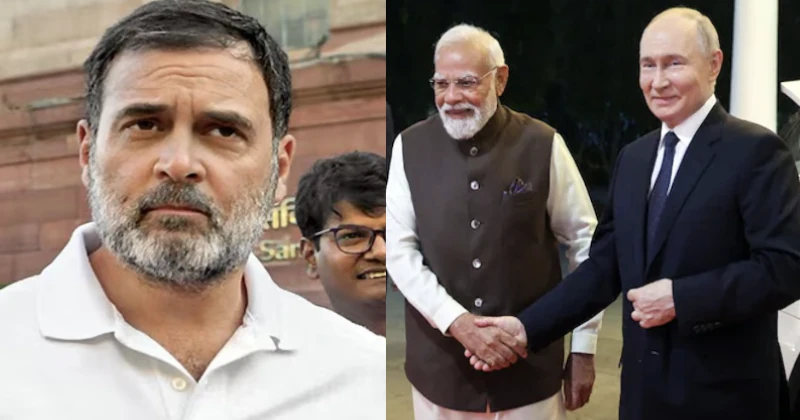
NEW DELHI: Amid Vladimir Putin’s visit to India, Congress leader Rahul Gandhi accused the Modi government of “preventing” him and other opposition leaders from meeting the Russian President. But as official documents, diplomatic protocols, and even Gandhi’s own recent track record come into scrutiny, his allegation appears increasingly shaky.
Within hours of Gandhi’s comment, the Ministry of External Affairs issued a straightforward clarification:
The MEA arranges meetings only between visiting dignitaries and Government of India officials or government institutions. All other engagements including with Opposition leaders are entirely the responsibility of the foreign delegation.
RAHUL GANDHI’s ATTEMPT TO MISLEAD FAILS AGAIN :
Another day, another LIE by Rahul Gandhi fact-checked.
The MEA has made it clear:
It arranges meetings for visiting dignitaries with Government officials and institutions only.
Any meetings outside that are for the foreign… pic.twitter.com/EFAnzEL5fV
— Pradeep Bhandari(प्रदीप भंडारी)🇮🇳 (@pradip103) December 4, 2025
There is no diplomatic protocol, past or present, that obligates the Indian government to schedule meetings between visiting heads of state and the LoP. The absence of such a protocol directly contradicts Gandhi’s claim that earlier governments “always arranged” these interactions.
The biggest blow to Gandhi’s narrative comes from his own calendar. Since becoming LoP on 9 June 2024, Gandhi has met at least five foreign leaders, including three sitting Prime Ministers:
- Sheikh Hasina, former PM of Bangladesh – June 10, 2024
- Anwar Ibrahim, PM of Malaysia – August 21, 2024
- Christopher Luxon, PM of New Zealand – March 8, 2025
- Navinchandra Ramgoolam, PM of Mauritius – September 16, 2025
- Prime Minister of Vietnam – August 1, 2024
If the government truly intended to “block” him, these meetings simply would not have happened.
Union Minister Ramdas Athawale said the government had not “blocked” anything because no request was ever submitted by the opposition. He added that Gandhi’s accusation of “government insecurity” rings hollow, given PM Modi’s record of direct, frequent engagement with global leaders.
Former diplomats point out that foreign dignitaries often prefer to restrict their engagements due to tight schedules. “In high-level bilateral visits, schedules are micromanaged. If the Russian side wanted to meet the opposition, they would have proposed it themselves,” said a former Indian envoy.
The episode fits a larger pattern wherein Rahul Gandhi makes broad allegations without documentary evidence, and later retreats when countered with factual details.
Previous examples:
- Claims about India’s economic slump contradicted by global ratings and growth data
- Comments on India’s stand during Doklam and operations against terrorism
- Assertions about widespread institutional “collapse” contradicted by election turnout, judicial data, and parliamentary activity
In many cases, Gandhi’s remarks have been amplified internationally, often through networks and organisations that Indian officials describe as “habitually critical of India.”
The timing of the claim is notable. Putin’s visit is geopolitically significant his first since the Ukraine conflict. India and Russia are set to discuss:
- Defence procurement stability
- Bilateral trade frameworks
- Energy and nuclear cooperation
- High-technology partnerships
- Labour mobility agreements
Gandhi’s allegation risks distracting from India’s diplomatic priorities at a critical moment. Rahul Gandhi said, “The government is preventing foreign leaders from meeting me.”
Documented facts:
- Gandhi has already met multiple foreign Prime Ministers since 2024.
- There is no formal protocol requiring the government to arrange LoP–dignitary meetings.
- MEA has reiterated that such meetings are entirely up to the visiting delegation.
- No official request for a meeting with Putin was ever filed.
By foregrounding an accusation that is easily contradicted by public records, Gandhi may have unintentionally weakened his political messaging:
- The claim was easily disproved
- It shifted attention away from serious domestic issues
- It created an avoidable face-off on foreign policy a domain where the government maintains strong approval ratings
Political analysts argue that the opposition’s credibility suffers when allegations are not backed by formal documentation, especially on matters as sensitive as foreign relations.














Comments