





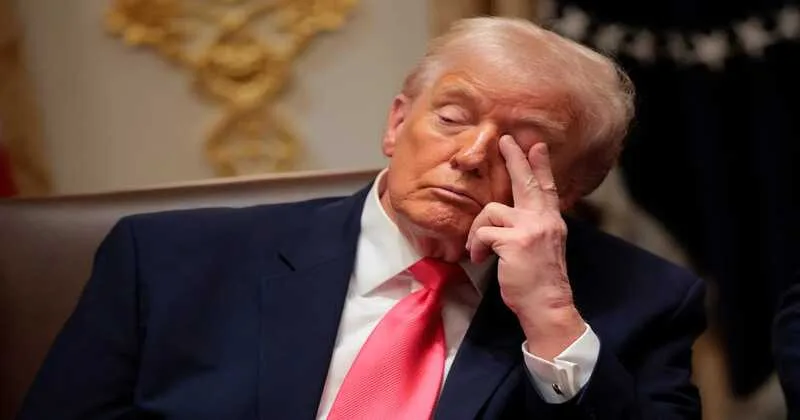
New national polling indicates that a growing share of Americans now attribute the rising cost of living to President Donald Trump, marking a significant political shift as the country heads toward the 2026 midterm elections. According to the latest poll, conducted by research firm Public First, 46 per cent of Americans say the cost of living is the worst they can remember, and notably, 37 per cent of Trump’s own 2024 voters share this view. For months, political strategists in both parties anticipated the moment when Americans would begin transferring blame for high prices from former President Joe Biden to Trump, who returned to the White House on the promise of restoring affordability. Almost a year into his term, the data suggests that moment has arrived.
The poll reports that 46 per cent of Americans believe the current affordability crisis is now Trump’s responsibility, marking a dramatic shift in public perception. Only 29 per cent still place primary responsibility on Biden. The findings also reveal a brewing concern within the Republican coalition: although Trump retains his strong base, his soft supporters, voters essential for a GOP victory in 2026, have begun expressing doubts about his handling of the economy. Republican strategist Ford O’Connell, reacting to a recent special election in Tennessee where Republican Matt Van Epps won but significantly underperformed Trump’s 2024 margin, warned that the results offer an early caution for his party. He said Republicans should treat the outcome as evidence that holding the House in 2026 will require far more coordination and mobilisation than expected.
Trump built his 2024 winning coalition on voters angry about inflation and declining purchasing power. But after taking office and assuming control of the very economy he spent months criticising, the political landscape has shifted. Republicans were already worried about turnout among infrequent voters in a midterm where Trump himself is not on the ballot. Now they must also confront the possibility of defections driven by dissatisfaction with affordability. According to the poll, affordability remains the top national priority for 56 per cent of Americans, far ahead of other issues. In last month’s state-level elections in New Jersey and Virginia, Democrats won key races by relentlessly focusing on rising household costs, an approach they repeated with high impact in Tennessee’s deep-red district, where Democratic candidate Aftyn Behn significantly outperformed expectations by centring her campaign on economic pain.
Republican strategist Barrett Marson noted that the GOP historically enjoyed a consistent advantage on economic issues. But he observed that as long as the economy remains sluggish and prices remain high, voters will ultimately hold the governing party responsible. This emerging political reality represents a dramatic inversion for a party that had long defined itself by economic stewardship. The poll’s findings show a particularly notable divide within Trump’s coalition. While three-quarters of all Trump voters continue to trust the Republican Party over Democrats to manage living costs, the figure drops sharply among those who do not identify as “MAGA Republicans.” Only 61 per cent of these non-MAGA voters expressed confidence in the GOP on affordability, compared with 88 per cent among MAGA-aligned voters. Nearly one in five Trump voters now believe the president holds full responsibility for the current economic conditions.
The White House has rejected the notion that Trump is losing ground on the economy. His spokesperson, Kush Desai, argued that Trump prioritised addressing what he characterised as “Biden’s economic disaster” from the first day of his administration and insisted that the president’s policies would soon produce renewed prosperity. Yet the polling makes clear that across demographic groups, age, race, gender, and income, Americans overwhelmingly name the cost of living as the country’s most urgent problem. The poll illustrates how deeply affordability concerns cut into daily life. Forty-five per cent of respondents said grocery prices were the hardest expenses to manage, 38 per cent cited housing costs, and 34 per cent pointed to health-care expenses. Almost a third of Trump voters said the US now offers less economic opportunity than in the past, a sentiment shared by a wider 43 per cent of all respondents.
With consumer sentiment falling in November to one of its lowest levels on record, frustration remains high even as inflation rates have dropped from a high of 9.1 per cent under Biden to about 3 per cent last month. Biden once sought to counter similar dissatisfaction by highlighting job growth, an approach that Republicans criticised heavily. Now some conservative economists are warning that Trump risks making the same political miscalculation. The survey also suggests that patience among Trump supporters is wearing thin. One in five Trump voters now say the president has had enough time to improve the economy but has not yet done so. Among non-MAGA Republicans, the share holding this view rises to 29 per cent, more than double the rate among Trump’s devoted MAGA supporters. These non-MAGA voters were also more likely to attribute the difficulty of paying for groceries, utilities, and health care directly to Trump administration policies.
Democrats move to capitalise as affordability becomes the midterm battleground
Democrats are already positioning the 2026 midterms as a referendum on Trump’s economic record, seeking to tie Republican candidates at every level to persistently high prices. The party sees the poll’s findings as confirmation that its focus on affordability is resonating with voters who feel squeezed in nearly every part of their lives. State and local Democrats successfully deployed this strategy in the November elections, and national party leaders believe it represents a powerful playbook for next year. Leaders in major Democratic super PACs have said Republicans should expect to face ads accusing them of breaking promises to reduce prices and of supporting Trump’s tariff policies, which critics say have contributed to higher consumer costs.
Republicans rejected this characterisation, insisting they remain focused on lowering costs and reviving economic confidence. A spokesperson for the National Republican Congressional Committee argued that while Democrats are divided internally, Republicans are centring their agenda on easing financial pressures on middle-class families. Even as GOP strategists defend the party’s economic messaging, they acknowledge the risk of a shifting political narrative. Marson, the Arizona-based strategist, said that voters historically do not continue blaming previous presidents for long. In his view, Americans will not excuse Trump by claiming Biden restricted his economic options; instead, they will judge the current administration on whether daily life becomes more affordable.
Democrats, meanwhile, intend to sustain a unified message linking affordability concerns directly to Trump’s policies. Party strategists believe the poll shows that Trump’s coalition, especially non-MAGA voters who supported him in 2024 for economic reasons, is fragile. Their goal is to peel away just enough of these voters to reclaim competitive House districts. These political dynamics coincide with indicators of continued dissatisfaction in the broader economy. Many Americans say the cumulative rise in prices since the pandemic years has permanently damaged their financial stability, and voters remain more concerned about how far their paychecks stretch than about macroeconomic indicators such as GDP growth or unemployment rates.
Trump’s mixed messaging on affordability deepens political risks
While Trump’s advisers argue that he is making an effective affordability pitch, the president himself has delivered inconsistent messages that may be complicating his case with voters. In a recent post on Truth Social, he insisted that drug prices were falling rapidly and suggested that Republicans should easily win the midterms if voters recognise this. He also described himself as “the affordability president,” according to the phrasing summarised in the poll findings. But days later, during a Cabinet meeting, Trump appeared to contradict that narrative, dismissing “affordability” as a political slogan used by Democrats. He argued that the term had no real meaning and maintained that he had inherited what he described as historically severe inflation, asserting that no one was able to afford basic goods when he took office.
This conflicting communication comes at a moment when public perception is especially sensitive. Unlike last year’s campaign environment, when Trump was able to criticise inflation from the outside, he now owns the economic conditions voters are experiencing daily. The poll indicates that Americans do not readily accept arguments that blame the previous administration; many voters have already shifted their expectations to Trump. Analysts at conservative institutions have noted the political danger of minimising voters’ frustrations. Michael Strain of the American Enterprise Institute observed that Trump risks repeating Biden’s tactical mistake: relying on positive macroeconomic statistics while ordinary families feel little improvement in their household budgets.
Whether Trump can reverse these perceptions remains uncertain. The polling suggests that his base remains largely intact, but the edges of his coalition, voters essential in competitive suburban and swing districts, are showing early signs of defection. With affordability likely to dominate the national agenda well into 2026, the economic narrative that once powered Trump’s return to office now presents one of his most serious vulnerabilities.














Comments