





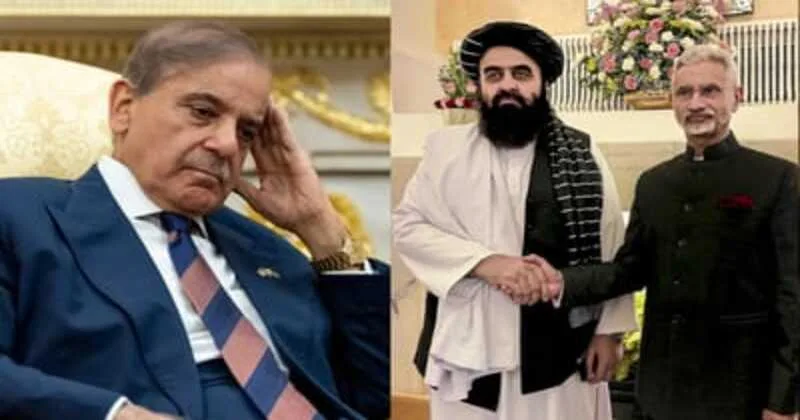
Afghanistan’s Taliban administration has issued a sharp response to Pakistan’s recent criticisms, firmly asserting Kabul’s right to pursue independent political and economic relations with India. Acting Foreign Minister Amir Khan Muttaqi dismissed Islamabad’s allegations that New Delhi was supporting anti-Pakistan armed groups from Afghan soil, and rejected Pakistan Prime Minister Shehbaz Sharif’s remarks condemning his visit to Deoband, the Islamic seminary in Uttar Pradesh.
The growing warmth between Kabul and New Delhi has unsettled Pakistan, which Afghan officials say has attempted to distort the emerging relationship through misinformation and shifting accusations. Speaking to politicians and analysts in Kabul, Muttaqi described Pakistan’s allegations as inconsistent, politically driven, and constantly changing. Addressing a gathering in Kabul, Muttaqi said Pakistan had repeatedly altered its charges against Afghanistan. According to a translation circulated by Kabul-based Aamaj News English and also reported by Kabul Frontline, he noted that Islamabad initially focused on the Tehrik-i-Taliban Pakistan (TTP), later moved to the Baloch Liberation Army (BLA) and other Baloch nationalist groups, and eventually began linking India to anti-Pakistan militancy. He argued that Afghanistan’s stance had remained stable while Pakistan kept shifting its narrative.
Muttaqi said Afghan authorities had held progress-oriented discussions with Pakistan on each of these issues, yet Islamabad continued to raise fresh allegations. He characterised the claims as politically motivated rather than rooted in evidence. The acting minister emphasised that Afghanistan’s foreign policy is sovereign and not beholden to any external pressure. He underlined that Kabul views its relations with India as part of its legitimate political and economic engagement with the region, adding that Afghanistan reserves the right to engage with any country that supports its development.
Deoband visit sparks Pakistani criticism
Muttaqi also drew attention to what he described as Pakistan’s double standards. While Islamabad maintains full diplomatic and trade relations with New Delhi, he said, it questions Afghanistan’s decision to do the same. He argued that if Pakistan can operate an embassy in Delhi and continue trade with India despite decades of hostility, it has no grounds to object to Kabul’s engagement with New Delhi. He reiterated that Afghanistan’s ties with India, or any other state, were not directed against any third country. Kabul, he said, is committed to a balanced foreign policy that avoids entangling Afghanistan in major-power rivalries and refuses to allow its territory to become a ground for destabilising politics. These comments follow the historic diplomatic opening in November 2024, when Muttaqi led the first high-level Taliban delegation to India since the group returned to power in August 2021. The visit, held at New Delhi’s invitation, included talks with External Affairs Minister S. Jaishankar, during which the Taliban leadership assured India that Afghan soil would not be permitted for activities hostile to any nation.
Muttaqi’s subsequent visit to the Darul Uloom Deoband seminary also triggered a strong response from Islamabad. Prime Minister Shehbaz Sharif publicly expressed displeasure over the trip, suggesting it signalled undue proximity between the Taliban and India. In Kabul, Muttaqi questioned why Pakistan viewed the visit as problematic. He reportedly asked whether travelling to India or visiting a historic Islamic seminary violated international norms or diplomatic principles. He argued that cooperation in trade, politics, education, or neighbourhood relations was neither prohibited nor unusual. He also maintained that the Taliban administration had refrained from insulting Pakistan in its public messaging. Afghan officials, he said, respected Pakistan’s ethnic groups and social sensitivities, and avoided using derogatory language about the country’s economic conditions or migrant populations.
Strained relations after airstrikes
Relations between Pakistan and the Taliban government have deteriorated over the past several months, particularly after Pakistan launched airstrikes inside Afghan territory, killing dozens of civilians. Islamabad has repeatedly accused Kabul of harbouring TTP militants responsible for escalating attacks inside Pakistan. Afghan officials deny these allegations, insisting they do not permit any armed group to use Afghan territory against neighbouring states. They insist the Taliban government has cracked down on cross-border militancy and expects Pakistan to acknowledge these efforts rather than respond with military escalation.
In recent months, the Taliban administration has sought to expand Afghanistan’s diplomatic and economic partnerships beyond its immediate neighbourhood. Kabul views the strengthening of ties with India, including humanitarian cooperation, trade, and educational linkages, as part of a broader strategy to diversify its external partnerships. By contrast, analysts say Pakistan appears eager to maintain its historical influence in Afghan affairs, generating friction with the Taliban’s attempts to assert autonomy in foreign policy. As tensions continue, Kabul has reiterated that Afghanistan will not be drawn into regional rivalries and will resist attempts to restrict its diplomatic outreach. The Taliban leadership maintains that it will continue to engage with India and other countries based on national interest, not external pressure.











Comments