





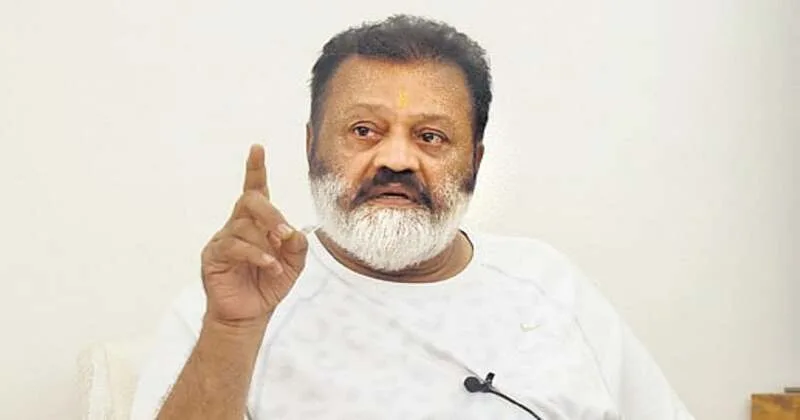
In a charged address blending education, nationalism, and cultural pride, Union Minister of State for Petroleum and Tourism Suresh Gopi on November 29, 2025, described the National Education Policy (NEP) as a “weapon” to expose the “hollowness” and “lies” that, he alleged, have long shaped India’s historical narratives. Speaking in Thrissur, his Lok Sabha constituency in Kerala, the actor-turned-politician said that India’s history had been deliberately distorted and misrepresented for generations. It prevented citizens, especially students, from understanding the true depth of India’s civilisational past.
“History has been wrongly compiled and presented in a manner that hides the truth about our ancestors and our spiritual heritage,” Gopi told a gathering of party workers and local residents. It’s our generation’s duty to fix those mistakes and tell our children the true story.
Without naming specific individuals or groups, the Union Minister alleged that India’s temples were plundered and desecrated during invasions, yet such realities were either softened or completely omitted from mainstream history textbooks. “Shouldn’t it be examined?” he asked, wondering how the idea of secularism could be applied equally to those responsible for such acts of destruction.
Gopi emphasised that the National Education Policy 2020 and the PM SHRI (Schools for Rising India) scheme are steps towards creating an education system rooted in truth, knowledge, and cultural awareness. He said that both initiatives aimed to nurture a generation capable of critical thinking, one that would not blindly accept distorted versions of history but instead seek facts with confidence and curiosity.
“The NEP is not merely a reform in curriculum; it is a movement to restore intellectual honesty,” he remarked. “It gives our children the tools to see through the falsehoods that were planted in our textbooks and understand India’s real story, one of resilience, wisdom, and moral strength.”
Taking a sharp swipe at the Left Democratic Front (LDF) government in Kerala, Gopi accused it of “ideological resistance” to national initiatives like the NEP and PM SHRI scheme. According to him, the Left’s opposition comes from a fear that these reforms would dismantle the outdated, colonial frameworks that have influenced India’s education for decades. “They oppose change because truth challenges their narrative”.
The Minister also targeted the Communist Party of India (Marxist), saying that while earlier leaders of the party were guided by genuine socialist ideals, the current generation had “deviated from those principles” and now thrived on spreading misinformation. He said that today’s Communist leaders no longer follow the values they once believed in. According to him, their politics now depend on spreading false information instead of truth and principles.
Gopi’s comments throw light on a broader national discourse covering education reforms and historical reinterpretation. The NEP, introduced in 2020, aims to modernise India’s education system by promoting multidisciplinary learning, regional languages, and cultural literacy. For many in the ruling establishment, it is also an opportunity to correct what they see as colonial and ideological biases in school textbooks that have persisted since independence.
By calling the NEP a “weapon,” the Minister symbolically positioned it as a tool of intellectual self-defence. A means to decolonise young minds and reconnect education with India’s indigenous roots. He stressed that India’s youth must grow up understanding the truth about their country’s past, free from distortions that diminish its contributions to world civilisation.
“The NEP empowers us to teach children not just science and mathematics, but also self-respect and cultural confidence,” Gopi said. “If we don’t correct what was wrongly written, the future generations will inherit ignorance instead of truth.”















Comments