





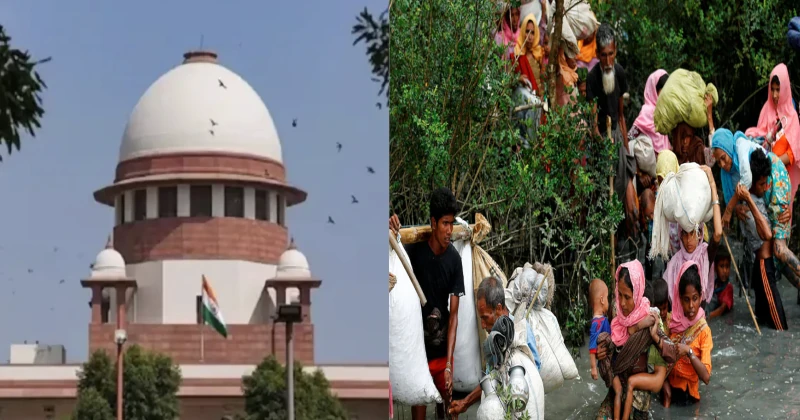
Chief Justice of India Surya Kant, questioned the very basis of petitions filed on behalf of Rohingya migrants, asking whether India bears any legal or moral responsibility to accommodate individuals who entered the country illegally. The Supreme Court’s remarks came during the hearing of a habeas corpus petition alleging the custodial disappearance of certain Rohingya individuals detained in Delhi.
The bench of CJI Surya Kant and Justice Joymalya Bagchi demanded clarity from the petitioner on one fundamental point: Has the Government of India ever declared Rohingyas as “refugees”? The CJI underscored that “refugee” is a defined legal category and cannot be casually attributed without statutory backing.
“Where is the order of the Government of India declaring the Rohingyas as refugees?” CJI Kant asked. “If there is no legal status of a refugee, and somebody is an intruder who enters illegally, do we have an obligation to keep that fellow here?”
#BREAKING "Where is the order of the Govt of India declaring the Rohingyas as refugees? If there is no legal status of a refugee, and somebody is an intruder, and he enters illegally, do we have an obligation to keep that fellow here?" – Chief Justice of India Surya Kant.
"If… pic.twitter.com/ulrX5NMKrl
— Live Law (@LiveLawIndia) December 2, 2025
The petitioner’s counsel argued that the plea was not seeking refugee status for the Rohingyas nor opposing deportation, but simply demanding that any deportation be carried out through lawful procedure and not by “picking people up and making them disappear.”
But the bench did not soften its tone.
“If they don’t have legal status to stay in India, and you are an intruder, do we give them a red carpet welcome?” the CJI asked. “You cross the border illegally, dig tunnels or jump fences, and then once inside claim rights food, shelter, education. Should the law be stretched like this?”
The CJI went on to highlight the competing concern of domestic welfare, stating bluntly that India must prioritise its own citizens. “We have poor people in this country. They are citizens. Are they not entitled to benefits and amenities? Why not concentrate on them?”
At the same time, the CJI made it clear that India cannot resort to brutality. “Even if someone entered illegally, they cannot be subjected to third-degree methods,” he said, cautioning against any extrajudicial treatment.
The petitioner maintained that the sole demand was adherence to the deportation procedure already laid down by the government, including the requirement of issuing deportation orders under due process. The counsel emphasised that the concern was “custodial disappearance,” not granting rights.
This is not the first time the Supreme Court has questioned sweeping allegations regarding the Rohingya issue. In May, a bench led by Justice Kant dismissed as fiction the claim that Indian authorities had dumped Rohingya detainees into the sea, calling it a “beautifully crafted story.” The Court has repeatedly emphasised that Rohingyas cannot automatically claim refugee privileges and may be treated as illegal migrants.
The bench also referenced its own earlier stance repeated in cases involving other foreign nationals that India is not a “dharamshala for the whole world.”
















Comments