





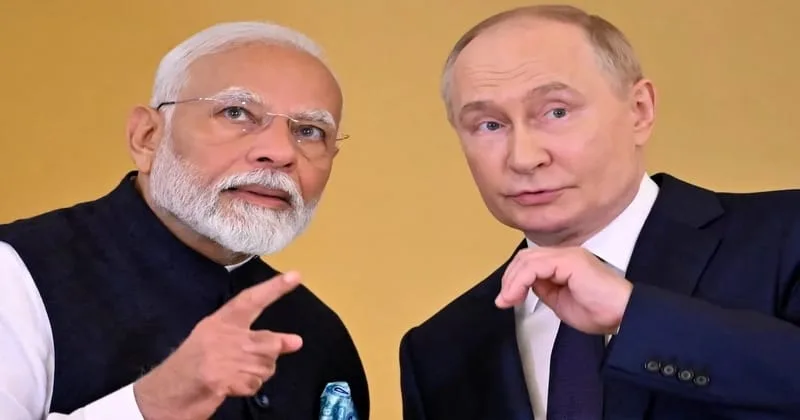
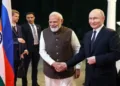
The Ministry of External Affairs on Tuesday firmly stated that Russian President Vladimir Putin’s visit to India, scheduled for December 4 and 5, will centre on strengthening economic cooperation. The clarification came a day after Kremlin spokesperson Dmitry Peskov held a video-streamed briefing ahead of the annual Modi-Putin summit.
Senior MEA officials ruled out any discussion on the Russia-India-China (RIC) grouping during the high-level engagement, instead placing emphasis on trade, manpower mobility, and expanding diplomatic and commercial linkages.
According to MEA officials, India-Russia trade has witnessed “significant and sustained” growth over the past few years, especially following Prime Minister Modi’s recent visit to Moscow. India’s imports of crude oil and fertilisers have contributed to this surge, with New Delhi currently importing between 3-4 million metric tonnes of fertilisers annually from Russia.
Officials said the government is now working to correct the existing trade imbalance by aggressively boosting exports. “Marine products, pharmaceuticals, and consumer goods are showing strong potential,” an official noted, adding that a push is underway to increase outbound shipments to the Russian market.
Recent decisions permitting potato and pomegranate exports to Russia are seen as steps towards diversifying agricultural trade.
A crucial part of the upcoming deliberations, officials said, will be the implementation of a recently finalised agreement allowing the placement of skilled and semi-skilled Indian workers in Russia.
With Russia experiencing manpower shortages, the arrangement is expected to open new employment opportunities for Indian professionals. “This is the single-most important development since the Prime Minister’s visit to Russia,” an MEA official stated, as quoted in media.
The ministry also provided updates on Indians serving in the Russian military. They confirmed that around 50 Indians had been working in the Russian Army, with many already discharged. “Eleven to twelve are missing; dozens have been released. All who are still employed will be discharged and brought back,” the official assured.
Another significant area of focus is the ongoing negotiations for a Free Trade Agreement (FTA) between India and the Eurasian Economic Union (EAEU).
“We have started FTA discussions. The objective is to conclude this agreement at the earliest,” officials said. Such an agreement is expected to sharply increase Indian exports in pharmaceuticals, processed foods, marine goods, and consumer products.
The MEA confirmed that work on the rupee-ruble settlement mechanism is progressing, though challenges remain. Despite the complexities imposed by global sanctions regimes, India and Russia have been exploring multiple avenues to ensure smooth payments for trade.
Officials also highlighted that both sides are attempting to widen the export basket and reduce existing trade imbalances. “The effort is to diversify exports and stabilise financial channels,” they said.
In a move aimed at strengthening people-to-people and business ties, India is set to open new consulates in Kazan and Yekaterinburg, broadening its diplomatic presence across Russia’s regions.
“This will deepen engagement beyond traditional sectors and encourage cultural, educational and commercial exchanges,” officials said.
The India-Russia Annual Summit, one of the oldest institutionalised bilateral mechanisms maintained at the highest level, remains a key platform for strategic dialogue. However, this year’s meeting, officials stressed, will remain firmly economy-centric, with no plans to discuss broader geopolitical platforms like the RIC format.
“The summit is dedicated to advancing economic cooperation and expanding India’s export footprint into the Russian market,” the MEA said.
As New Delhi prepares to welcome President Putin, officials underscore that both countries are entering a phase of pragmatic and mutually-beneficial engagement, driven by trade diversification, labour mobility, and enhanced diplomatic presence.




Comments