





It’s difficult to picture the current world without metal products. Almost everything around us is made of metal, including automobiles, electronic gadgets, bridges, household appliances, jewelry, and dinnerware. All of the rare earth elements are essential to modern technology. They are vitally important for everything, from starter motor magnets to the computer screen you are currently viewing. They are used in the production of semiconductor parts that we use every day. They are necessary for the operation of automobiles, satellites, watches, computers, and optics. Our communication systems rely on them.
As our technological needs grow, so will the need for rare elements. This has led in a huge global scarcity, which is currently impeding the development of renewable technology. The annual demand for REEs has risen in the last 15 years and is predicted to increase further by 2030. The adoption of green technology such as electric vehicles and renewable energy systems is driving this increase in demand.
“Rare metals” are metals that are produced in limited amounts, at a high cost, and are highly valued by high-tech companies. The list of rare metals grows as technology advances: there were around 10 discovered in the 1980s, and there are now about fifty. A hypothetical shortage might have a huge economic impact. This is why they are sometimes referred to as “critical” or “strategic” metals. They include cobalt, lithium, tungsten, antimony, and cadmium, among others. They are not inherently rare, but they are distinguished by their association with other minerals, making isolation difficult and costly. The terms “rare metals,” “rare elements,” and “rare-earth elements” are not entirely accurate because these chemical elements are not particularly scarce. Their typical content in the earth’s crust is equivalent, if not higher, than that of most metals commonly utilized in daily life. Scandium, cerium, lanthanum, lithium, yttrium, niobium, and gallium, for example, are nearly as abundant in the earth’s crust as chromium, zinc, nickel, copper, lead, strontium, zirconium, and rubidium – even more so. Rare earth elements (REEs) are a set of seventeen metallic elements that include the fifteen lanthanides on the periodic table, as well as scandium and yttrium, which share comparable characteristics and are commonly found in ores and deposits.
These elements are split into two categories according to their atomic weights: – Light Rare Earth Elements (LREEs), which include lanthanum, cerium, praseodymium, neodymium, samarium, and europium. Heavy rare earth elements (HREEs) include gadolinium, terbium, dysprosium, holmium, erbium, thulium, ytterbium, lutetium, scandium, and yttrium. These rare metals and earths are required for at least three industries: large-scale electric battery manufacture, motor miniaturization, particularly wind turbines, and numerous industrial sectors (refining, glass and ceramics, alloys, electronics).
Neodymium is utilized to make powerful magnets used in wind turbines and electric automobiles. – Europium and terbium are employed in phosphorescent applications, including LED lights and screens. – Lanthanum is used in automobile catalytic converters to minimize emissions. Smartphones: Tiny, powerful magnets in speakers and vibration devices contain REEs such as neodymium. Digital Cameras: Lanthanum is used in camera lenses to improve clarity and minimize distortion. Computer Hard Disks: Neodymium magnets are required for the read/write heads in hard drives. Fluorescent and LED Lighting: Europium and terbium are used in phosphors to create bright, energy-efficient light. Flat-Screen Televisions and Monitors: Yttrium, europium, and terbium are utilized to produce bright colors on screens.
Motors are present in a variety of machinery. Magnetic elements, such as electromagnets with a ferrite core and copper coil, are necessary for operation. However, some “rare earths” (including neodymium and dysprosium) can be employed as “permanent” magnets, with very small volumes producing a very strong magnetic field. Applications requiring downsizing include ballistic missile guidance systems and high-end vacuum cleaners. Computer hard drives can contain up to 4.5 grams of rare earths, which is considerable when considering the hundreds of millions of units generated on an industrial scale.
Current global situation
Because of the wide range of applications, access to these key metals has emerged as a major geopolitical issue. There are several “rare metals” deposits all over the world, both on land and at water. The IEA predicts that demand will reach roughly 280,000 tons by 2030, driven by the increasing deployment of REE-intensive technologies such as wind turbines, electric vehicles, and different electronic devices. The global rare earth elements market was valued approximately at 175.03 kilotonnes in 2024 and is predicted to reach 214.89 kilotonnes by 2029, expanding at a compound yearly growth rate (CAGR) of 4.19% over the forecast period. This expansion is fueled by rising demand from emerging nations and the reliance of green technology on REEs.
China is especially well endowed, with over half of the world’s known deposits. But, most importantly, it has spent years improving both raw material extraction and the “separation” of numerous rare earths. It does this at a very cheap cost, to the point where several countries, including the United States, have decided to acquire the final ingredients from China rather than create their own supply chains. China controls around 90% of the market. While the majority of these elements are abundant in the Earth’s crust, they are rarely found in economically feasible concentrations. This means that, despite their relative abundance, they are frequently dispersed and insufficiently concentrated to be mined profitably.
According to the International Energy Agency, key mineral output, which includes rare and rare-earth metals, must be greatly increased to satisfy expected demand by 2030. To reach global net carbon emissions targets by 2030, 50 new lithium, 60 nickel, and 17 cobalt mines to be created. Mankind will always try to soar higher, drive faster, and penetrate deeper into the earth’s crust while lowering the cost of the resources required for this. It means that new materials must outperform earlier generations and have novel, distinct features. Rare earth metals can provide these qualities.
Modi government’s initiatives to strengthen REE and related industries
Bharat is determinedly navigating a worldwide technological and energy shift. Rare earth elements (REEs) have emerged as essential minerals in an era of rapid technological advancement and long-term growth. These 17 elements (the 15 lanthanides, plus scandium and yttrium) are used in more than 200 innovative applications. Bharat’s ambition of self-reliance, fueled by pandemic-era supply shortages, has made REEs central to its economic and security policy. The nation is actively seeking to lessen import dependence and leverage its own resources in industries ranging from electronics and clean energy to defense.
Bharat is making a significant effort to become self-sufficient in clean energy and modern technology by issuing a call to train 5.7 million individuals for the mining sector by 2030. The initiative, a collaboration between the Ministry of Mines and the Skill Council for the Mining Sector (SCMS), aims to provide the workforce with the skills needed to fully capitalize on Bharat’s abundant untapped reserves of critical minerals – materials required for the production of batteries, electric vehicles, solar panels, wind turbines, and electronic devices.
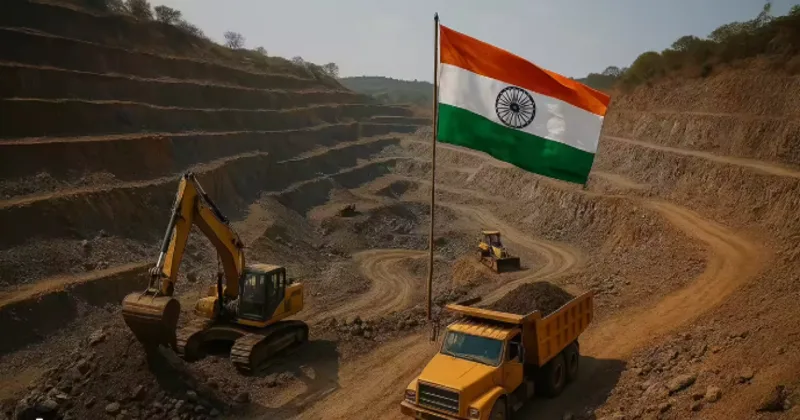
According to the U.S. Geological Survey, Bharat possesses the third-largest reserves of rare earths in the world, totaling 6.9 million tons. However, only a small portion of these reserves are mined because private enterprises invest very little. The National Critical Mineral Mission is a government initiative that was started in April with the goal of achieving sector self-reliance. It has started looking for neodymium, a rare earth that is frequently used in automotive magnets, in recent years. The Union Cabinet led by Prime Minister Narendra Modi has approved the rationalization of royalty rates for graphite, caesium, rubidium, and zirconium in an important move that could help Bharat challenge China’s hegemony in rare earth minerals. The goal is to increase domestic production and lessen reliance on imports. In order to unlock caesium, rubidium, and zirconium as well as related critical minerals like lithium, tungsten, rare-earth elements (REE), and niobium.
The government has emphasized that the supply of vital minerals including lithium, cobalt, nickel, graphite, and rare earth elements will be crucial to achieving energy security and industrial growth. The clean technologies that are essential to the global energy transition are based on these minerals. These commodities are currently mostly imported by Bharat from China and other nations with abundant minerals. With the goal of eradicating this reliance, the National Critical Mineral Mission (NCMM) anticipates Bharat emerging as a major force in the exploration, processing, and environmentally responsible extraction of these vital minerals.
According to officials, the all-inclusive plan aims to increase the mining industry’s current 2.2% GDP contribution to 5% by 2030. Jobs in exploration, mineral extraction, processing, value addition, and sustainability management will be part of the project. Additionally, training facilities will be built in mineral-rich areas and will profit from partnerships with businesses and academic institutions as well as cutting-edge digital learning tools.
Environmental impact
Modern living conditions and technological advancements have increased the body’s consumption of large amounts of harmful substances, which might cause health issues. One of the biggest issues facing the globe today is environmental contamination caused by various harmful inorganic, organic, and organometallic species. The REE group comprises significant environmental factors that require more in-depth research to fully comprehend their impact on human health. The detrimental impacts of well-known hazardous trace elements like As, Pb, Cd, Hg have been the focus of environmental scientists.
Because of REE and the expansion of allied businesses, the need for employees and the GDP of the nation will both see significant improvements in Bharat.
















Comments