Representative Image
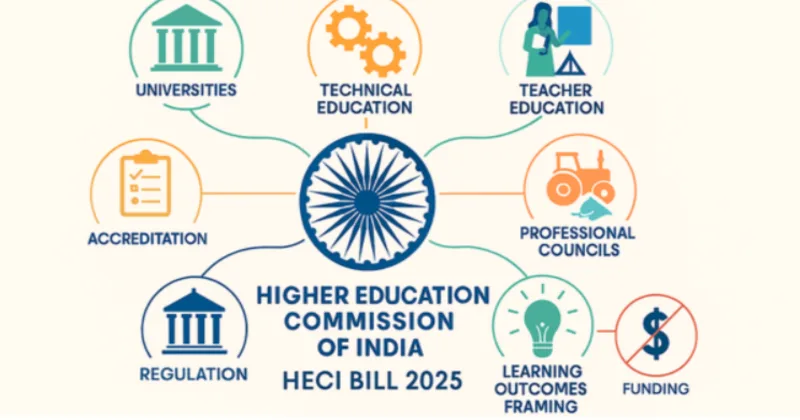
NEW DELHI: As the Winter Session of Parliament begins on December 1, 2025, the Union Government will introduce the Higher Education Commission of India (HECI) Bill, 2025. It is a landmark reform which is aimed at reshaping India’s higher education landscape. The proposed legislation aims to establish a single, overarching regulatory authority that will replace multiple existing bodies such as the University Grants Commission (UGC), All India Council for Technical Education (AICTE), and National Council for Teacher Education (NCTE) excluding medical and legal education.
The Bill is a crucial step towards implementing the National Education Policy (NEP) 2020, which envisioned a more integrated, transparent, and efficient higher education framework. Its primary goals are to improve quality, promote accountability, support institutional freedom, and encourage research-based learning; while removing years of regulatory overlap and bureaucracy.
India’s higher education sector is currently fragmented, with different agencies that are overseeing general, technical, and teacher education. The HECI Bill 2025 seeks to consolidate these functions into a unified structure guided by four verticals, as recommended in NEP 2020:
Each vertical is expected to operate independently under the supervision of a compact, expert-driven HECI body composed of eminent academicians and educationists. The aim is to move away from bureaucratic control and toward academic self-governance.
From UGC to HECI: A Reform Revisited
This is the government’s second attempt to replace the UGC. The earlier HECI Bill of 2018 proposed a similar framework but faced criticism for its potential to centralise the authority. The earlier draft gave the Commission power only to set academic standards. However, the funding stayed with the Education Ministry. After public feedback raised concerns about autonomy and inclusivity, the plan was withdrawn and revised to match the wider goals of NEP 2020.
The new Bill goes beyond structural reform. It attempts to decentralise decision-making within the regulatory framework, streamline approvals, and eliminate conflicts of interest that have long hampered the higher education system.
For decades, Indian universities have struggled under regulatory rigidity and overlapping jurisdictions. The NEP 2020 described the old system as “mechanistic and disempowering,” citing excessive concentration of power, conflicting mandates, and lack of accountability.
The HECI Bill aims to resolve these issues by introducing a transparent accreditation process, standardised quality benchmarks, and enhanced institutional autonomy. It seeks to promote innovation, academic excellence, and outcome-based education. This will allow universities to function as self-governing institutions rather than being bound by excessive compliance

Leave a Comment