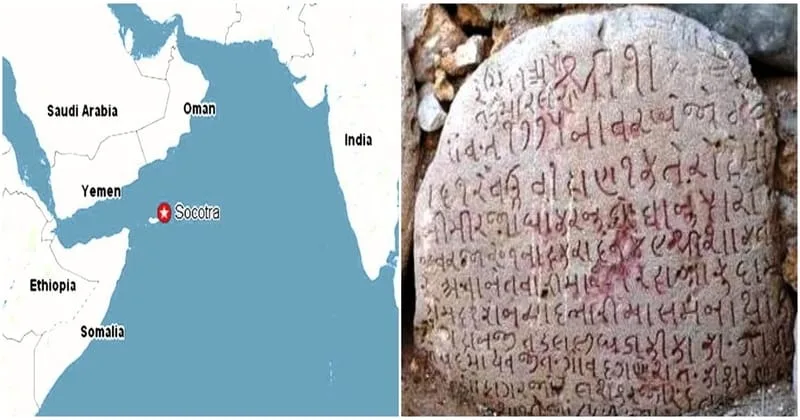
18th-century Gujarati inscriptions in Yemen show centuries-old Gujarat–Arabia sea trade
The discovery of early 18th-century Gujarati language stone inscriptions in Yemen sheds remarkable light on the centuries-old maritime trade relations between Gujarat and the Arabian Peninsula. Among these, a 306-year-old stone inscription dating back to 1719 stands out as an important historical artefact. Although partially legible, it provides invaluable insights into the lives of Gujarati traders and seafarers of the time.
The inscription begins with the traditional Gujarati traders’ honorific title “Shri Sava” and mentions the names of notable individuals, including the Hindu ship crew of the Kharva community: Malam Natha, Dhanji, and Madhavji. It also references the port of Ghogha and its then-Mughal ruler Mirza Jafar. However, the exact purpose of the inscription remains uncertain; scholars debate whether it is a tomb epitaph or a commemorative memory stone.
Gujarat and Arabia share a rich history of maritime trade dating back to ancient times. For centuries, Gujarati sailors and merchants navigated the Arabian Sea and beyond, establishing thriving trade networks. Even the island of Socotra near Aden in Yemen was known as “Sukotar Tapu” by Gujarati navigators, highlighting their detailed knowledge of the region’s geography.
Historical records suggest that around 200 BC, the ports of Arabia and Sri Lanka were significantly influenced, if not controlled, by Gujarati traders. This underlines Gujarat’s position as a powerful maritime and trading hub, with foreign trade practices that are over 2,000 years old. The relationship between Gujarat and the Arab world is estimated to be more than 3,000 years old, evidenced by the settlements of Arab traders along the Gujarat coast in ancient times.
Gujarati sailors were exceptional navigators, rivalling even the renowned Portuguese and Spanish explorers. They possessed an intimate knowledge of the Arabian Sea and the Indian Ocean, and their voyages extended across Arabia, Africa, Sri Lanka, Java, Sumatra, and even China. These maritime expeditions not only facilitated trade in spices, textiles, and other goods but also promoted cultural and knowledge exchanges between distant civilisations.
The Gujarati stone inscriptions in Yemen serve as enduring reminders of the region’s historical global connections. They offer tangible proof of Gujarat’s seafaring legacy, its advanced navigation skills, and its pivotal role in shaping trade networks across the Indian Ocean world.

Leave a Comment