





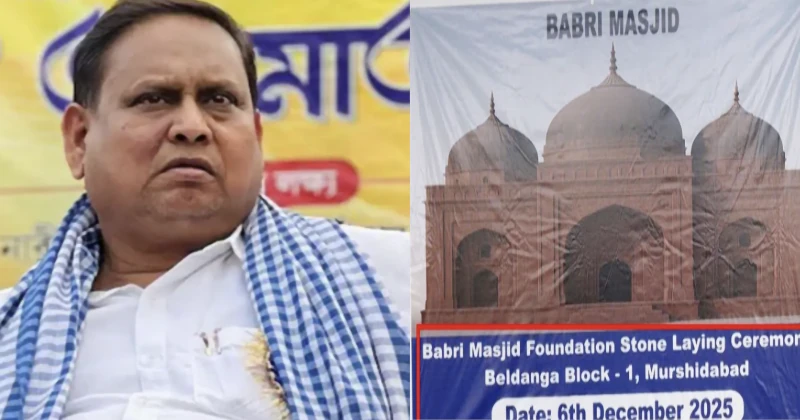
Trinamool Congress (TMC) MLA Humayun Kabir’s announcement that a structure named “Babri Masjid” will have its foundation stone laid on December 6 in Murshidabad has triggered one of the most intense political flare-ups in recent months. The choice of date is not just politically loaded it is a calculated attempt to exploit one of the most emotionally charged moments in India’s modern history. December 6 marks 33 years since the demolition of the disputed structure in Ayodhya, a day synonymous with deep national wounds and communal tensions. Kabir’s insistence on selecting that exact date has raised widespread suspicion that this is not a religious initiative at all, but a political gamble designed to sharpen communal divides for electoral gain.
Kabir’s statement “We will lay the foundation stone of Babri Masjid on December 6 is a clear signal that this is not about faith but symbolism. With posters suddenly surfacing across Murshidabad announcing the construction of a “Babri Masjid,” the timing appears orchestrated, not organic. Kabir doubled down, saying the project would take three years and that various Muslim leaders would be present, turning an already controversial plan into an openly political spectacle. At a time when the nation is moving forward with development, infrastructure, and reconciliation, Kabir’s rhetoric drags West Bengal backward into the politics of provocation.
The BJP has reacted sharply, calling Kabir’s move the worst example yet of TMC’s long-standing appeasement politics. BJP national spokesperson Shehzad Poonawalla did not mince words, describing TMC as a party that has turned communal appeasement into an election strategy. Referring to TMC as “Tushti Karan Mujhe Chahiye”, he argued that Kabir’s announcement was designed to incite and manipulate community sentiments. Poonawalla highlighted Kabir’s previous inflammatory remarks particularly his shocking statement about “chopping off Hindus and throwing them into “Bhagirathi” to illustrate that this was not an isolated incident but part of a disturbing pattern. According to the BJP, Kabir’s latest move only reinforces TMC’s underlying philosophy: abuse Hindu sentiments, harvest vote-bank rewards.
The BJP also pointed out that this “Babri Masjid” stunt fits seamlessly with TMC’s past behaviour. Over the years, party leaders have opposed the chant of ‘Jai Shri Ram’, mocked or disrespected Hindu deities including Maa Durga, Maa Sita, and Maa Kali, and fuelled controversies around the Ram Mandir, Waqf properties, the Citizenship Amendment Act (CAA), and the State Infiltration Register (SIR). Poonawalla argued that Kabir’s announcement was not an aberration but the logical outcome of TMC’s broader political culture, which he described as a systematic attempt to alienate the Hindu population while cultivating communal blocs for votes. The BJP insists that it is precisely this pattern that has kept Bengal trapped in an environment of recurring tensions and sectarian polarisation.
What makes this episode even more significant is the growing discomfort within TMC itself. In a rare instance of intra-party criticism, TMC MLA Nirmal Ghosh publicly distanced the party from Kabir’s remarks, stating that the MLA had “gone beyond the limits” and that his statements were not endorsed by the party leadership. Ghosh said Kabir was “not in contact with the party,” a revealing admission that hints at internal confusion and panic within TMC. When a ruling party is forced to rebuke its own MLA on such a sensitive issue, it signals deep fractures within its organisational control. It also shows that Kabir’s remarks have caused political damage even before the proposed event takes place.
Congress leader Udit Raj attempted to defend Kabir, citing religious freedom and arguing that laying a mosque’s foundation should not be controversial when temple foundations are laid frequently.









Comments