





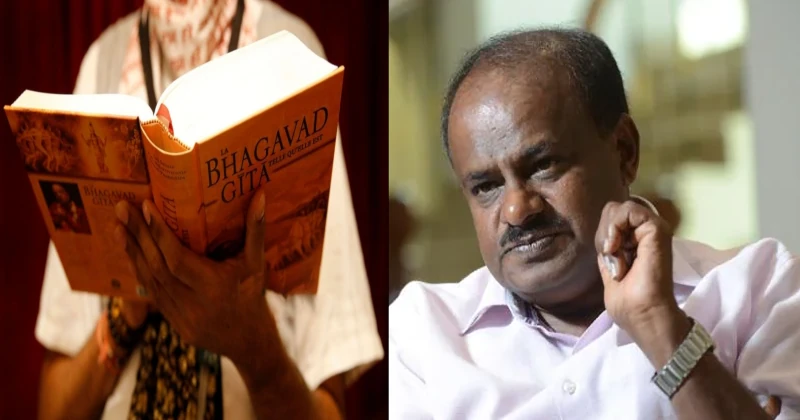
The proposal to introduce the Bhagavad Gita into the curricula of schools, colleges, and universities may soon gain momentum, with Union Minister for Heavy Industries and Steel HD Kumaraswamy announcing that he will discuss the matter with Union Education Minister Dharmendra Pradhan. Speaking at the Bhagavad Gita Abhiyan Mahasamarapane programme held in Shivamogga on Sunday, the minister indicated that the Centre is open to exploring the inclusion of the ancient scripture in mainstream education.
The demand gained prominence during the event when former Deputy Chief Minister K.S. Eshwarappa urged Kumaraswamy to take necessary steps to incorporate the Bhagavad Gita into school textbooks. Responding to the appeal, Kumaraswamy said that preliminary discussions would be initiated at the central level soon.
He emphasised that the teachings of the Gita, along with the Ramayana and Mahabharata, would offer moral guidance to children at a time when society is witnessing an alarming rise in violence, unlawful activities and unrest. “Teaching the Bhagavad Gita has become a necessity today. It is a guiding light for the younger generation and will play a significant role in maintaining peace and harmony. Everyone should adopt the timeless values of the Gita,” he said.
Kerala Governor Rajendra Vishwanath Arlekar, who also addressed the gathering, expressed pride in the Gita’s Indian origins and advocated expanding the Bhagavad Gita Abhiyan nationwide. “The Bhagavad Gita originated in India, and every Indian should feel proud of this. Expanding this campaign across the country will give people from all walks of life an opportunity to engage with its profound teachings,” he said.
The event also featured spiritual leader Gangadharendra Saraswathi, Peethadhipathi of Sonda Swarnavalli Mahasamsthan, who argued that introducing Bhagavad Gita teachings at a young age could help curb crime. “When children learn the Gita early in life, it shapes their thinking and character. It fosters communal harmony and strengthens national integration. Children who study the Gita become guiding lights of the nation,” he said.
Former Chief Minister B.S. Yediyurappa, who shared the stage with Kumaraswamy, highlighted the scripture’s universal relevance, stating that studying the Bhagavad Gita equips individuals with the wisdom needed to face life’s challenges. “The Gita teaches us not to run away from difficulties but to confront them with courage, confidence and strength. It offers solutions to problems and is essential for building a healthy and harmonious society,” he said.
Interestingly, in a landmark academic move, Seton Hall University, a Catholic institution founded in 1856 in New Jersey, has made the study of the Bhagavad Gita compulsory for every incoming student, regardless of discipline. With more than 10,800 students, one-third of them non-Christian, Seton Hall becomes the first American university to introduce the Gita as part of a university-wide core curriculum.
The decision, driven by Stillman School of Business professor A.D. Amar, comes as part of the university’s initiative to create a distinctive identity through a transformational curriculum. Seton Hall wanted a foundational course that would shape students’ character and address perennial questions about life, purpose and human existence. This resulted in the signature program titled “The Journey of Transformation.”
The course, introduced in the freshman year, explores fundamental questions through texts rooted in diverse philosophies. Alongside the Gospels and Dante’s The Divine Comedy, the Bhagavad Gita—in Stephen Mitchell’s translation—was selected for its universal appeal. Although suggested, the Vedas were deemed too complex for introductory students. None of the instructors teaching the Gita are Hindu, but they underwent specialised training to engage meaningfully with the text.
Amar noted that the Committee displayed remarkable openness in approving the Gita, reflecting the inclusiveness of the Catholic academic community. “Seton Hall wanted a course that would influence students’ lives. The Gita provides profound insights into duty, purpose and moral strength,” he said.
The pilot program, launched last year, received enthusiastic student response. The Gita, long admired by American thinkers from Emerson and Thoreau to T.S. Eliot, continues to grow in global academic relevance. Observers say the move reinforces Swami Vivekananda’s century-old prediction that America would grow increasingly spiritual.
Seton Hall’s curriculum now includes three signature courses, culminating in an advanced discipline-specific module in the junior year, that expand on the themes introduced through the Gita and other foundational texts.















Comments