





India as a nation is on “Mission Mode” when it comes to the question scientific innovation. By now, the whole world is aware of India’s indigenous scientific capabilities and Indian scientists are carving a niche for themselves – be it AI, IT Software, Rocket Science and what have you…..All these have become possible primarily due to the Government of India’s focus on science and technology as a tool towards achieving the mission of becoming the “VISHWAGURU”.
Over the past couple of years, the buzz in India’s technology landscape was about the Aditya- L1 mission, followed by Gaganyaan and Group Captain Subhanshu Shukla’s stellar achievement of becoming the first Indian to set foot on the International Space Station viz-a-viz the Axiom-4.
Space Missions aside, India has carved a niche in Polar Science viz-a-viz Antarctica. Prime Minister Shri Narendra Modi has been reiterating at every possible platform about the significance of “Atmanirvar Bharat” – a campaign for pioneering Indigenously built and processed Made-in-India innovations in every sphere of national llife and more so in the domain of science and technology.
India’s flagship Polar Science module – National Centre for Polar and Ocean Research (www.ncpor.res.in) has been at forefront of Polar explorations through the application of cutting edge technology. Today India’s Polar Missions in Antarctica isn’t confined to mere explorations; rather, India’s Antarctic Mission is contributing significantly in the realms of climate change, atmospheric sciences, geoscience, polar biology and geoscience.
Just as our “Jawans” (Indian Army Soldiers) protect India’s sovereignty at the Siachen Glacier – the world’s highest battlefield, defying all odds; India’s Polar scientists at Antarctica too are passionately delivering breakthroughs in Polar Science, on a scale and magnitude of stupendous dimensions!
It may be recalled that India’s first foray into the icy contours of Antarctica was thirty-five years back ( 1981). As of today, a lot has happened and there is more to come.
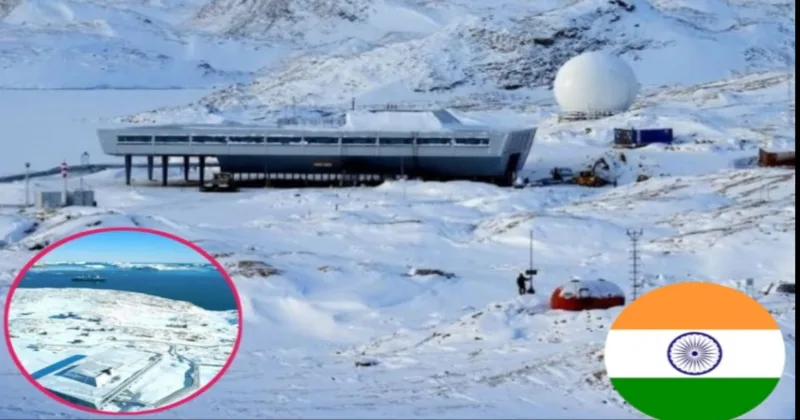
India is among the elite few countries in the world to have a permanent Station in Antarctica, Maitri and Bharati, comprising a Scientific Division as well as a Logistics Division.
The Bharati Research Station in Antarctica’s Larsemann Hills was established back in 2012 and this station is capable of hosting 47 Polar scientists, adhering to strict environmental laws.
India as a nation has always believed in the motto of “Atmano Mokshartam Jagat Hitaya Cha”, which literally means – one’s own salvation for the welfare of the world. And, India’s mission to Antarctica has contributed significantly towards understanding complex issues like climate change, Antarctic haze, ice and Ozone levels.
One recent milestone for India’s ambitious Antarctica Mission was the historic expedition of a giant IL-76 Cargo plane carrying essential items like medicine, food and scientific gadgets from Goa’s Manohar International Airport. According to a top NCPOR official- “This is the first time an IL-76 strategic airlifter, famed for its heavy-lift capabilities, has landed and taken off from the new airport. There will be similar flights in future seasons, but it also depends upon the quantum of cargo, budgets, financial viability, etc.”
The scientific world is now waiting with bated breath to see how India’s next big move in Antarctica- Mission Maitri – II unveils. If all goes well, Maitri -II, located in close proximity to Schirmacher Oasis, will be operational by 2029. This new state-of-the-art Antarctic station is expected to deliver breakthroughs in the sphere of Antarctic ecosystem.
Inspite of adversities and global instability, India has once again come out all guns blazing through Mission Maitri – II, a testimony to the nation’s resilience!
According to India’s Earth Science Minister Shri Kiren Rijiju – “ This upgrade underscores India’s commitment to scientific exploration and international collaboration in Antarctica, aligning with the objectives of the Antarctic Treaty System to preserve the region for peaceful and scientific purposes”.
Already, India’s Polar scientists are well entrenched in the icy contours of Antarctica with state of the art Research facilities and the indigenously built Sagar Nidhi vessel – launched by India’s National Institute of Ocean Research back in 2008 has been used numerous times in the Antarctic region.
The manner in which India has been carrying out research-led expeditions to Antarctica, defying the harsh and rarefied topography deserves kudos. India being a signatory to the Antarctic Treaty, the Indian Antarctic Program has marvelously evolved and Science & Technology being a “Currency” in Antarctica, India has always aligned itself with the core issues of the icy continent and has always been in favor of international collaboration as a path towards unravelling the mysteries of the Cold Continent.
India’s Antarctic Mission has set new benchmarks by way of new breakthroughs and every year, a steady stream of resident scientists visiting Antarctica have contributed immensely towards humanity’s quest for scientific knowledge. The Antarctic challenge is more logistic then scientific, as one has to make judicious use of scarce resources to minimize the human footprint. It needs no reiteration to state that the International Polar Years laid a rock solid platform on which the global scientific community, of which India is an integral part, to realize the motto of “Science Beyond Borders” that enables the dissemination of scientific knowledge in a seamless manner.
By the way, the Indian Antarctic Program being a multi-institutional and multi-disciplinary in nature, with more than 120 of India’s best scientific institutions involved in cutting-edge scientific innovation and research, as thoroughly transformed India’s Antarctic capabilities, which now is at par with countries like USA, UK, Norway and Japan. According to Dastidar and Ramachandran – “Since the 1980s, the proportion of international collaborative publications in relation to total polar publications has risen from 10% to 41% by 2007”, a testimony which is self explanatory!
In terms of global acceptability, the Department of Posts opened its second postal outlet at the Bharati Research Centre in Antarctica after a four decade long hiatus. Letters to Antarctica can now be addressed to the new Pin Code – MH – 1718. In terms of geo-strategic explorations, the presence of an Indian Post Office in Antarctica is being perceived as a major geo-strategic victory for India’s Antarctica Mission and symbolic of India’s stewardship on preserving the world’s environment.
India’s very own Post Office in Antarctica aligns perfectly with the Antarctic Treaty, which ensures peaceful exploration and lawfully debars any use of Antarctica’s topography for military and nuclear use.
Every year, under the stewardship of India’s Ministry of Earth Science, Antarctic expeditions are flagged off from faraway South Africa, Cape Town to be precise, which carries Polar scientists, R&D experts and research scholars from renowned institutions like IITs etc….
India’s abiding belief on multilateralism and world peace was once again on display at the 46th Antarctic Treaty Consultative Meeting at Kochi, wherein the Indian delegation unequivocally made it crystal clear about India’s commitment towards non-endorsement of any territorial claims in the Antarctic region.
For India to become a truly global Polar leader/pioneer, the next few years are going to be significant as the nation’s Polar scientists dive deep into the icy contours of Antarctica and come out with startling discoveries on a range of issues affecting mankind like -oceanography, climate change, glaciology and biodiversity preservation.
With a Prime Minister, who is focussed on Indigenously inspired “Atmanirvar Bharat” as the cornerstone for excellence, India’s Antarctic aspirations looks set for stupendous growth with further heavy investments, state of the art Polar vessels and dedicated Research Stations conducive of 24/7 Research work.
This definitely will be India’s decade in the Antarctic.












Comments