





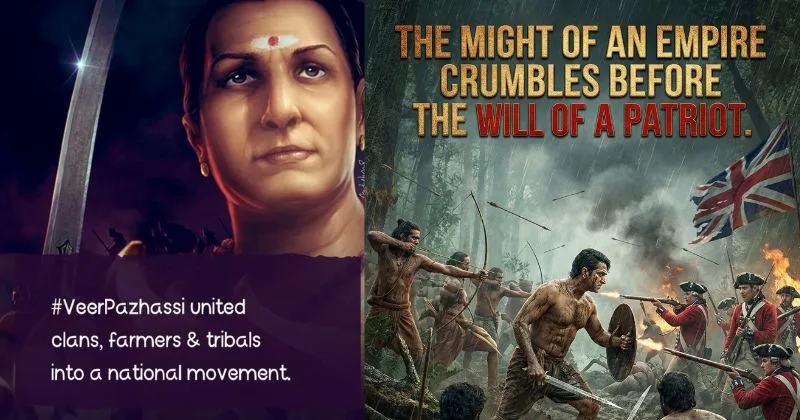
Kerala Varma Pazhassi Raja is a name written in golden letters in the history of India’s freedom struggle. When all of India stood frozen in fear under the flag of British Imperialism—the empire on which the sun never set—he was the lion who roared against that massive power from the northern end of Kerala. Taking up the sword against foreign dominance half a century before the First War of Independence in 1857, Pazhassi Raja still lives in the hearts of the people as the “Lion of Kerala.” Every native of Kuttiyadi can be proud of the fact that the soil of Kuttiyadi and its brave people gave the most strength to Pazhassi Raja in this fight.
Childhood and the Kottayam Dynasty
Kerala Varma Pazhassi Raja was born in 1753 into the Kottayam royal dynasty of North Kerala. The Kottayam dynasty, headquartered at ‘Puralimala’, was very famous at that time. Regions including present-day Kuttiyadi were part of the Kottayam dynasty then. Even in his youth, he demonstrated extraordinary skill in martial arts and administrative matters. He was a king who loved his subjects like his own children. Therefore, the people stood firmly with him in the war against the British.
Conflict with the British
When most kings of Malabar fled to Travancore during Tipu Sultan’s military campaign, Pazhassi was not willing to abandon his subjects. However, the British, who later seized power in Malabar, began to squeeze the people to collect taxes. Pazhassi Raja could not tolerate this. He raised the question, “What authority do the white men, who came across the sea, have to demand a share of what yields from our soil?” This marked the beginning of the historically renowned Pazhassi revolutions.
The Historical Importance of Kuttiyadi
Kuttiyadi holds a very important place in the legendary battles of Pazhassi Raja. As the gateway to Wayanad, the Kuttiyadi Pass and surrounding areas were of great strategic importance.
● Defense at Kuttiyadi: It was at Kuttiyadi that Pazhassi Raja’s army built the strongest defense to prevent the British army from entering Wayanad. The hills and forests of Kuttiyadi were ideal places for Pazhassi’s guerrilla warfare.
● People’s Participation: The ordinary people of Kuttiyadi provided all kinds of help to Pazhassi Raja. Our ancestors took the lead in leaking the movements of the British army and delivering food and medicine to the King in hiding.
● The Advance of 1802: The capture of Panamaram Fort in 1802 was a decisive phase in the Pazhassi struggle. In this spirit, strong attacks were launched against the British in Kuttiyadi as well. Pazhassi’s army attacked British outposts in Kuttiyadi and Thottilpalam. It was in these regions that Edachena Kunkan and Thalakkal Chanthu made the British tremble. There is a history that the soil of Kuttiyadi turned red with the blood of foreign aggressors.
War Tactics and Brave Warriors
It was the tactic of ‘Guerrilla Warfare’ that enabled Pazhassi’s bows and arrows to hold out against the guns and cannons of the British army. He skillfully used the topography of Kuttiyadi and Wayanad for this purpose.
Many of Pazhassi’s loyal followers were active in this region. Thalakkal Chanthu, the chief of the Kurichiya force, and Edachena Kunkan, the commander-in-chief, led armies through this soil. Irrespective of caste and religion, Nairs, Muslims, and tribal communities fought shoulder to shoulder here.
Betrayal and the End
Realizing that Pazhassi and the warriors of Kuttiyadi could not be defeated in direct combat, the British employed the tactic of ‘treachery’. They advanced by using spies and blocking food supplies to the people. Finally, on November 30, 1805, the British army surrounded Pazhassi at Mavilathodu. Without giving the enemies a chance to touch him, that Lion of Kerala embraced a heroic death (there are opinions that he shot himself, and others that he died in a clash with the British).
British Sub-Collector Baber cremated his body with respect. Baber noted, “I have never had to face such a brave enemy.”
Message to the Children of Kuttiyadi
Dear friends, the soil of Kuttiyadi where we live is not ordinary soil. It is a holy land where the blood of thousands of patriots who sacrificed their lives for freedom has fallen. We walk today along the paths imprinted with the footsteps of Pazhassi Raja and his soldiers, who stood with their chests expanded before the cannons of British imperialism.
The freedom we enjoy today is the result of the sacrifice of people like Pazhassi Raja. The memories of that brave patriot should spread as a wave of inspiration in each of us. Pazhassi Raja’s life teaches us to react against injustice, to love our land, and to stand together as human beings beyond thoughts of caste and religion.
Conclusion
The voice of Pazhassi Raja was the first to be heard loudly against foreign dominance on the soil of Kerala. It was our Kuttiyadi that gave strength to that voice. Although that life ended at Mavilathodu, the lamp of patriotism he lit still stands unextinguished. Every child in Kuttiyadi should proudly say, “I am a native of Pazhassi’s land.” Let that bravery and patriotism always burn bright in our hearts.











Comments