The swift and decisive action taken by the Delhi Police in the first ten minutes after the November 10 Red Fort blast not only saved several lives but also laid the foundation for an uncompromised and rapid terror investigation. What began as a distress call about an “explosion” near one of India’s most iconic monuments soon turned into a tightly coordinated multi-agency operation that contained panic, ensured immediate evacuation, prevented secondary damage and preserved crucial forensic evidence. Those first ten minutes, marked by urgency, improvisation and unwavering commitment, ultimately shaped the trajectory of a probe that later revealed the involvement of a Jaish-e-Mohammad suicide-bombing module.
At 6:52 pm, the phone of the Deputy Commissioner of Police (North District) buzzed with an urgent call. The voice on the other end gasped: “There’s been an explosion in front of Red Fort… a lot of people are injured… many vehicles damaged.”
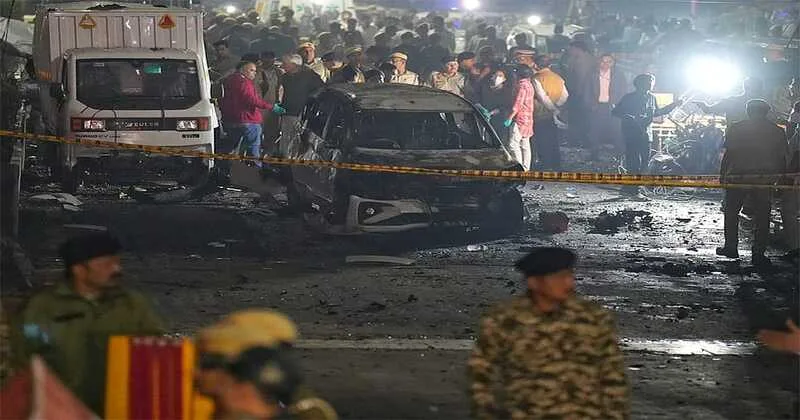
Officers had no indication yet that this was a terror attack. Some initially believed it might be a CNG or cylinder explosion because of the heavy presence of autorickshaws and private vehicles on Netaji Subhash Marg. But even without clarity on the cause, the response was immediate and instinctively structured around evacuation, rescue, and securing the location.
A police force of about twelve to thirteen personnel stationed at the Red Fort police post rushed in two teams, one to pull out the injured and the other to begin isolating the area, pushing back the crowd and preventing the fire from spreading to nearby petrol-run vehicles.
In the very next minute, head constable Than Singh emerged as one of the earliest rescuers. He spotted a middle-aged woman lying unconscious and bleeding heavily near the divider. Realising that ambulances might take time in dense traffic, he lifted her into an e-rickshaw and instructed the driver to take her directly to LNJP Hospital. He even sent a local volunteer along to ensure the driver followed instructions.
Seconds later, a man with severe burns was placed into an autorickshaw and sent off the same way. Police familiarity with local rickshaw operators, market association members and commuters proved crucial at this moment. Many locals rushed in to help, offering vehicles, assisting in lifting victims and guiding officers through congested patches. Their involvement significantly increased the speed of evacuation and directly contributed to keeping casualties low.
By 6:54 pm, the distress message had been circulated widely across Delhi Police networks. Nearby police stations were alerted, additional personnel were summoned, and emergency service partners, from the Delhi Fire Service to medical responders, were informed.
Officers on the ground could already see the scale of devastation and understood that managing the crowd was just as important as rescuing the injured. Because Red Fort lies at a major junction connecting Old Delhi Railway Station, Daryaganj and central Delhi, the area witnesses heavy evening footfall and bumper-to-bumper traffic. Without fast containment, rescue operations could easily have been slowed or compromised.
Within the next minute, Delhi Police took a critical step: they shut down and cordoned off Netaji Subhash Marg. This triggered an immediate traffic jam, but officers rapidly began diverting vehicles, creating human chains to block choke points and using barricades to seal the immediate blast zone. Blockades were placed at Chatta Rail Junction, Shanti Van Road and Ansari Road. Traffic police and locals together helped turn vehicles around in the cramped lanes leading away from the site. What could have become a chaotic gridlock that trapped ambulances and fire tenders was transformed into a navigable corridor through sheer manual intervention.
At 6:56 pm, attention turned to the Lal Quila Metro station, barely twenty metres from the blast. Officers rushed to the station to alert the CISF personnel, restrict entry and prevent commuters from pouring out into the impact zone. The Chandni Chowk–Red Fort stretch is among Delhi’s busiest transit corridors, and had the Metro exit not been controlled immediately, thousands of commuters might have unknowingly walked straight into a hazardous and unstable environment. Controlling access in those first few minutes not only prevented panic but also kept the area free for the arriving fire brigade and medical teams.
Two minutes later, with the fire brigade still navigating the choking traffic, officers improvised. They accessed the firefighting system of the underground Metro station and pulled out hoses to douse the blazing vehicles on the main road. Several e-rickshaws were partly charred and posed the risk of exploding due to their battery systems. Police personnel swiftly removed the batteries and threw them aside to prevent further danger.
Their quick presence of mind prevented fresh fires and reduced the likelihood of additional casualties. This firefighting effort also ensured that vital evidence, vehicle fragments, metal shrapnel, chemical residues, remained relatively undisturbed for forensic teams.
Meanwhile, amid the screams, smoke and confusion, a specially assigned police team conducted a sanitisation sweep of the immediate blast radius. Even though the exact nature of the explosion was unknown at the time, officers were aware of the possibility of a secondary device, a tactic often used in terror attacks to target first responders. Every vehicle, dustbin, debris pile, roadside flowerpot and garbage mound was checked manually or with handheld devices.
Despite the ongoing rescue and the severely chaotic atmosphere, officers persisted with this sweep to ensure there was no additional threat to the public or to emergency personnel.
At 6:59 pm, with the crowd swelling despite barricades, police activated public announcement systems. Loudspeakers urged people to step back, clear the main road and allow emergency teams to work. The main gates of the Chandni Chowk side of the market were shut, barricades were reinforced, and officers positioned themselves deep inside the bylanes to stop curious onlookers from approaching. Crowd control in such dense localities is always complex, but rapid PA announcements and decisive entry restrictions prevented overcrowding at the impact site.
At 7:00 pm, Delhi Fire Service teams finally arrived. Their tenders pushed through the diverted lanes toward the Red Fort stretch and immediately began extinguishing the remaining flames. Cooling operations followed, a delicate process, because excess water could wash away trace evidence like explosive residue, metal fragments, chemical signatures or patterns that indicate blast direction. Firefighters worked closely with police to ensure the integrity of the site. Most critically injured victims had already been taken to LNJP Hospital by police and locals, often using improvised stretchers fashioned from plywood planks, metal rods and even detachable e-rickshaw seats.
By 7:01 pm, senior officers, including the Joint Commissioner of Police, reached the location with reinforcements. More ambulances also began arriving, though remarkably, many of the gravely injured had already been moved to hospitals because of the quick early response. The scene was by now stabilised, fires doused, perimeter secured, crowds pushed back, and only the remaining injured requiring minor assistance waiting to be moved.
At exactly 7:02 pm, just ten minutes after the blast, the first medico-legal certificate (MLC) was issued at LNJP Hospital for one of the injured victims. This document, detailing the nature, severity and probable cause of injuries, became the earliest official medical evidence in the case. DCP Raja Banthia later explained that MLCs are crucial because they help determine what type of explosive was used, whether shrapnel was involved, the blast’s intensity and the structural pattern of injuries, all of which guide forensic analysis.
Within hours, investigators traced signatures of an explosive commonly used by Jaish-e-Mohammad modules, confirming the attack was a planned suicide-style bombing rather than an accidental blast.
Together, these ten minutes altered the outcome of what could have been a large-scale mass casualty event. The Delhi Police’s rapid evacuation, impromptu firefighting, careful sanitisation, precise cordon formation and quick communication with allied agencies not only saved lives but also protected the evidence that would lead to the identification of the terror module responsible. Their speed prevented further harm, reduced chaos and set the stage for a clear, efficient investigation.
These moments serve as a powerful reminder of how seconds matter during terror incidents and how trained responders, local support and decisive action can turn potential disaster into controlled, life-saving order.