





By advocating a train-the-trainer model aimed at creating one million certified trainers in Africa over a decade, India is positioning itself as a genuine partner in Africa’s rise, not an opportunistic actor. This aligns with India’s instrumental role in securing the African Union’s permanent membership in the G20 during its 2023 presidency
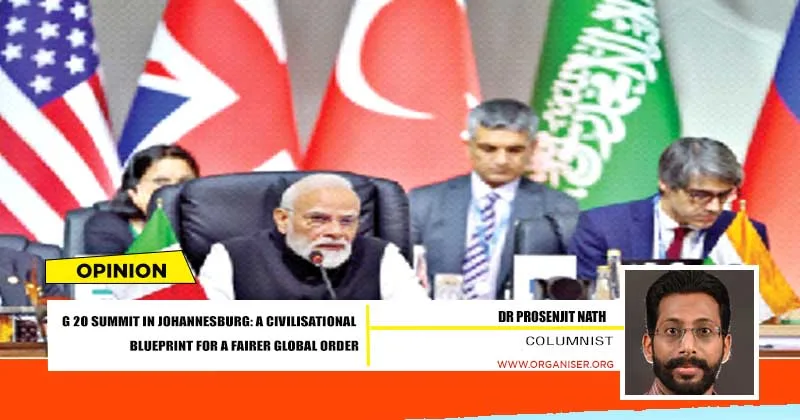
Prime Minister Narendra Modi’s address at the inaugural session of the G20 Summit in Johannesburg marks one of the most important ideological interventions India has made on the global stage in recent years. At a time when the so-called custodians of global development primarily Western economies continue to push metrics that have too often favoured the wealthy while burdening the developing world, Prime Minister Narendra Modi’s message was clear: the old frameworks have failed, and it is time for a reset rooted in inclusivity, sustainability, and civilisational wisdom.
PM’s Clarion Call
This year’s G20 Summit is historic not merely because it has brought the world’s most influential economies to African soil for the first time, but because it offers a chance to correct long-standing global asymmetries. Africa has, for decades, borne the brunt of predatory development models, resource exploitation and external interference. Modi, recognising this, used his platform to call for a profound rethinking of the very parameters by which development is measured. His assertion that “now is the right moment for us to revisit our development parameters” was not rhetorical; it was a direct challenge to the prevailing Western-dominated frameworks that have left vast populations deprived and ecosystems damaged.
Popularising Pt Deendayal’s Philosophy
What makes Prime Minister Narendra Modi’s intervention particularly powerful is his grounding of the argument in India’s own civilisational ethos. By invoking the philosophy of Integral Humanism, PM Modi reminded the world that India’s approach to development has always been people-centric, harmony-oriented, and respectful of nature concepts that the West is only now beginning to acknowledge after centuries of extractive economic practices. For Africa, which continues to navigate the aftershocks of colonial exploitation, this message resonates deeply.
Civilisational Glory of Bharat
Prime Minister Narendra Modi’s proposals were not to abstract principles but actionable blueprints for a fairer global future. The first, the G20 Global Traditional Knowledge Repository, is a visionary move. In an era where Western institutions often appropriate indigenous wisdom as “new discoveries,” India is championing a respectful, collaborative and transparent way of preserving and sharing traditional knowledge. This repository, rooted in Indian Knowledge Systems initiative, would finally give formal global recognition to the eco-balanced, socially cohesive ways of living that many ancient cultures including those of Africa have followed for centuries. It is a pushback against the intellectual monopoly that Western academia has long enjoyed.
Explaining Why Africa’s Progress is Vital
The second proposal, the G20-Africa Skills Multiplier Initiative, carries enormous potential for transforming the continent’s development trajectory. PM Modi’s emphasis that “Africa’s progress is vital for global progress” is more than a diplomatic nicety; it is a geopolitical truth that the world can no longer ignore. By advocating a train-the-trainer model aimed at creating one million certified trainers in Africa over a decade, India is positioning itself as a genuine partner in Africa’s rise, not an opportunistic actor. This aligns with India’s instrumental role in securing the African Union’s permanent membership in the G20 during its 2023 presidency, a milestone that further underscored India’s commitment to democratising global governance.
Implementing Vasudhaiva Kutumbakam
The G20 Global Healthcare Response Team, PM Modi’s third proposal, is a lesson that the world should have learned during COVID-19. The pandemic exposed the fragility of global health systems and the selfish hoarding of resources by certain wealthy nations. India, which supplied vaccines and medicines to over 100 countries, now proposes multinational medical teams ready for rapid deployment during crises. This is a humane, practical, and timely idea that reflects India’s belief in Vasudhaiva Kutumbakam, the world as one family.
Perhaps the most hard-hitting segment of Prime Minister Narendra Modi’s speech was his call for a G20 Initiative on Countering the Drug–Terror Nexus. In a world where synthetic drugs like fentanyl are wreaking havoc and simultaneously funding terror networks, Modi’s warning could not be more relevant. The West, particularly North America, has been slow to respond to this twin threat of public health and security. By proposing unified financial, governance, and security tools to dismantle trafficking networks and choke illicit flows, India is urging the G20 to confront an issue many have preferred to downplay. His appeal to “weaken the wretched drug-terror economy” underlines the moral clarity that has come to define India’s foreign policy under his leadership.
Prime Minister Narendra Modi’s address in Johannesburg was not a mere speech, it was a civilisational offering, a strategic roadmap, and a moral reminder. For a world grappling with inequity, climate concerns, health crises, and terror threats, India is not just participating in the conversation; it is shaping its direction. And with Africa as the host, there could not have been a more fitting moment for India to champion a genuinely inclusive global order.












Comments