





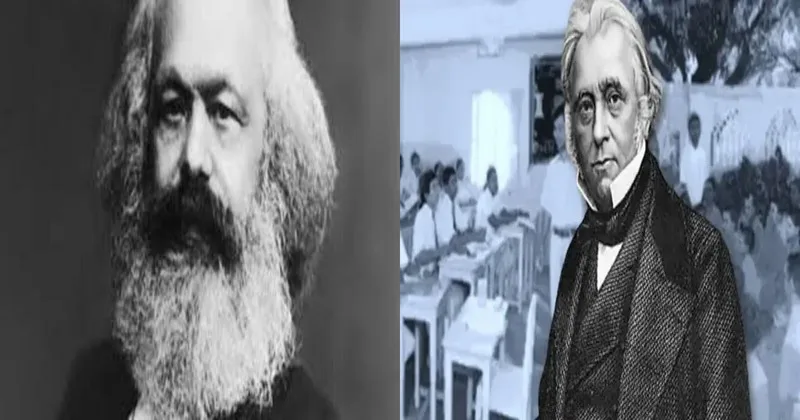
Bharat got her freedom in 1947, but our brain was washed again; and that process has been continuing still now. What Macaulay thought in his infamous Minute on Education in 1835, we are carrying its impact even today. That is why we have witnessed anti-national slogans being shouted inside our top premier educational institutions. And our so-called intellectuals have been buttering this trend for a long time, romanticising it in the name of “freedom of speech” and “freedom of expression”, often just for their own ideological interests.
This distorted intellectual environment has created an even more dangerous by-product: the systematic branding of the word “Hindu” as communal, regressive, majoritarian or radical, while conveniently overlooking radical and extremist forces emanating from other religions across the world. Just think how ironic it is that the very Dharma which proudly proclaimed ‘Vasudhaiva Kutumbakam’ is branded as communal or radical. This is not merely an academic problem. It is a political strategy and a civilisational challenge.
Macaulay’s 1835 Minute did not merely propose an education system; it proposed a mental architecture meant to reshape Indians into admirers of British values and sceptics of their own civilisation. While political independence dismantled colonial governance, the epistemic colonial apparatus retained its fortress inside universities, academic circles and elite institutions. The British left; the framework didn’t. And over time, this colonial reflex merged seamlessly with the ideological project of the post Independence Left. Be sceptical of Hinduism; be sympathetic to every other identity. This moral asymmetry became institutionalised in universities, editorial boards and public discourse. The result is a new habit: to speak of “Hindu” is to speak of danger.
For decades, India’s public discourse has been shaped less by facts and more by ideological filters installed within the commanding heights of the nation’s knowledge-production ecosystem. Universities, humanities departments, cultural institutions, media houses and even artistic circles were captured early by a self-anointed intelligentsia that emerged from India’s Left ideological mould. Through these platforms, certain narratives were not only manufactured but also imposed. Among the most consequential of these has been the systematic weaponization of the word “Hindu”. A term that historically signified a civilizational identity, a geographical marker, a cultural ethos and an inclusive way of life was gradually twisted into a label for communalism, majoritarian aggression and political extremism. This weaponization was not accidental; it was strategic, sustained and deeply institutional.
Yet, what stands out in this narrative war is the glaring asymmetry. While the Indian Left endlessly projected the Hindu identity as inherently radical or communal, the nation has repeatedly faced violent extremism from other quarters—religious radicalism operating openly, often globally funded and frequently lethal. But these realities, instead of being confronted directly, were often explained away, relativised or simply ignored by a large section of the same intellectual class. The question is not merely one of hypocrisy but of an orchestrated ideological project that continues to influence public understanding and policy debates today. And it is time that these “breaking India” forces are exposed for what they are.
The ideological transformation of the term “Hindu” began during the Nehruvian years, but its crystallisation occurred during the later decades when the Left, both global and Indian, captured academic institutions. In universities like JNU and similar centres across the country, Marxist historiography became the default academic lens. Through it, Indian civilizational identity itself became suspect. Marxist intellectuals approached Hindu society with preconceived categories, oppressor/oppressed, dominant/subaltern, feudal/anti-feudal. These categories were mechanically superimposed on Indian history, reducing the entire Hindu cultural universe to a repository of inequalities.
This framework produced several convenient ideological outcomes: Hindu identity became equated with upper-caste hegemony; Hindu institutions became symbols of oppression; Hindu assertion became synonymous with political majoritarianism. This transformed academia into a narrative factory. A term that historically unified diverse communities under a shared civilizational umbrella was fragmented into mutually antagonistic constituencies, so that the very idea of Hindu unity could be delegitimised.
The most powerful tool used in this narrative war has been the association of “Hindu” with “communal”. While communalism certainly exists in all communities and political formations, the Left establishment’s selective spotlight ensured that Hindu identity alone became shorthand for communal aggression. Any mobilisation rooted in Hindu identity, whether cultural or political, was dismissed not on its merits but on the simplistic label that it was “communal”. Instances of religious extremism from other communities were routinely explained by “alienation”, “marginalisation”, or socio-economic factors. The problem was never ideological; it was structural, systemic or external. The individuals were victims; the Hindu majority was the oppressor. The Left positioned itself as the gatekeeper of secularism. To question their interpretation of secularism was to risk being branded communal. This moral monopoly allowed them to police public discourse for decades. Thus, the term “Hindu” became a liability in elite circles. It could be studied but only critically; it could be spoken but only defensively; it could be expressed but only with disclaimers. For a billion people, their civilizational identity was turned into a political slur.
Even as Hindu identity was demonised, India witnessed multiple waves of radicalism emerging from other quarters. Violent extremism, global jihadist networks, separatist movements with religious motivations and targeted communal attacks occurred repeatedly. These were not theoretical problems but existential challenges for the nation. Yet the Left intellectual machinery responded with predictable evasions: Avoid naming the ideology; Redirect blame towards economic or political factors; Portray the perpetrators as victims of majoritarian structures; Accuse the state of overreaction whenever action was taken.
This created a dangerous imbalance. The ideological forces that were genuinely radical, supremacist and violent escaped scrutiny because identifying them honestly would collapse the Left’s carefully crafted narrative of the Hindu as the primary problem. India paid heavy costs for this intellectual dishonesty. Policy paralysis, delayed security responses, distorted public debates and confused media narratives all stemmed from the refusal to recognise the nature of the threats facing the country. The astonishing fact is that while Hindu identity was caricatured as “radical”, actual radicalism rooted in global networks, violent doctrines and separatist politics was often sanitised by the very scholars who weaponised the term “Hindu”.
The influence of Left intellectuals did not remain confined to academia. Their students entered journalism, bureaucracy, international NGOs, publishing houses and even global think tanks. The result was a self-replicating ideological ecosystem. Those who control vocabulary control perception. Terms like “saffronisation”, “majoritarianism”, “Hindu Right”, and “fascism” became routine descriptors, forcing Hindu identity into a defensive corner. Indian Left-leaning intellectuals collaborate with Western academia, often painting India as a land sliding into majoritarian authoritarianism. This globalised narrative creates diplomatic and academic pressure on India.
To preserve India’s civilizational inheritance, it is imperative to lay bare the ideological apparatus working tirelessly to erode it from within. This network operates through a familiar set of tactics: manipulating historical narratives, vilifying the majority identity, whitewashing or rationalising extremist ideologies, splintering society through hyper-politicised academic activism and mobilising global platforms to discredit India’s cultural and political reawakening. The purpose of this machinery is singular: to loosen India’s connection to its own civilizational foundations. And the easiest point of entry is to attack the very word ‘Hindu’. When that identity is mocked, delegitimised or branded as inherently problematic, the deeper civilizational essence becomes vulnerable. Target the word and the world built around it becomes easier to dismantle.
India stands today at a civilizational moment. For the first time since Independence, the narrative monopoly of the Left establishment is being seriously challenged. The weaponization of the term “Hindu” is being recognised as an ideological project rather than an academic conclusion. The path ahead requires clarity: Hindu identity is not communal; it is cultural, ethical, pluralistic and civilizational. It is the very soul of Bharat as said by Swami Vivekananda or Sri Aurobindo. The real communal danger comes not from this identity but from those who seek to hollow it out through distortion and deceit. To reclaim the narrative is not an act of aggression, it is an act of civilizational self-respect.









Comments