





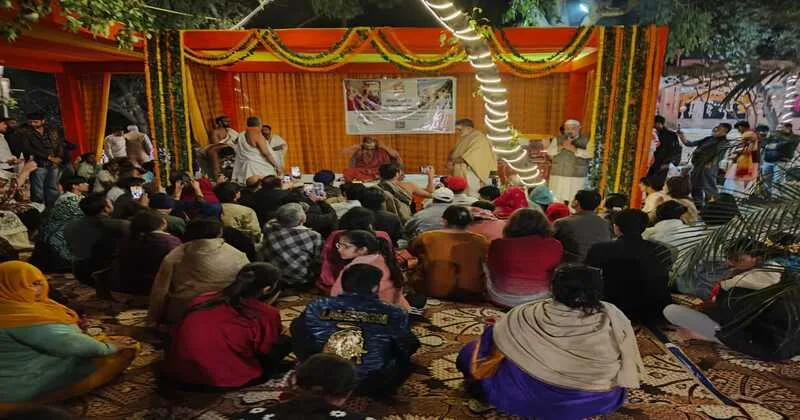
JAMMU: Sringeri Shankracharya has strongly advocated for reopening of Sharda Sarvagnya Peeth in Pakistan Occupied Jammu Kashmir (POJK). In his address at Bani Dham Gaushala Temple at Gurugram, Shankracharya of Sringeri H H Vidhushekhra Bharti ji said struggle to get the route opened to Shri Sharda Peeth will continue. He was addressing a large number of Kashmiri Pandits who had gathered there to listen to him.
The Shankaracharya did “pushp archana’’ at the site of proposed Sharda temple on a hillock opposite Bani Dham temple. He also visited the Gaushala at Bani Dham which is being jointly run and managed by Bani Dham Gaushala and Kashmiri Pandits (KPs) living in the Delhi National Capital Region (NCR).
The Sringeri Shankracharya was in the NCR and areas around it for the last 20 days. On Friday, it was the first ever visit organised by the internally displaced Kashmiri Pandits for the Shankaracharya. All India Kashmiri Samaj (AIKS) president Ravinder Pandita, in his welcome address, stressed the need for creating a religious corridor to the revered Sharda Peeth on the lines of Kartarpur corridor.
He greeted Shankaracharya and took him along with hundreds of Kashmiri Pandits to the proposed Sharda temple site in the complex and lit the oil lamp at Sharda Peeth portrait. “All the four Shankaracharya mutts should write to Prime Minister Narendra Modi for reopening of Sharda Peeth in POJK,” Pandita said.
Sharda Peeth Location
Sharda Peeth is located in the town of Sharda in the Neelum Valley, approximately 136 kilometers north-east of Muzaffarabad, the capital of POJK. The ruins of this ancient Hindu temple and center of learning are a significant religious site dedicated to the goddess Sharada (Saraswati). In fact, the goddess of wisdom is considered the presiding deity of Kashmir and is invoked in a shloka thus: Namaste Sharda Devi, Kashmirpur Vasini …
Sharada Peeth is one of the three holiest sites of pilgrimage for the Kashmiri Pandits, along with the Martand Sun Temple and the holy cave of Amarnath (Shri Amareshwar teerth). The original Martand temple was constructed by powerful Hindu king of Kashmir, Lalitadiya Muktapida. It was later demolished by Islamist Sikander Butshikan and its ruins are still visited by devotees.
No clarity or definitive history exists regarding the beginnings of the Sharada Peeth. Answering the questions regarding its origins is also not possible because Sharada Peeth might have been both a temple for worhip and an educational institution of repute. It was probably commissioned by Lalitaditya Mukapida who ruled from 724 CE to 760 CE. However, no definitive evidence exists in favour of this widely held belief. One major reason for attributing its commissioning to Lalitaditya is that he set up many grand temples and bestowed them with endowments to run their affairs.
The Sharda Peeth was once a major center of higher learning, particularly between the 6th and 12th centuries, with scholars travelling from far away to access its library. It is said that Shankaracharya had visited it during his lifetime when he wandered in Kashmir and established the famed Shankaracharya Shiv temple at Gopadri hill in Srinagar.
Indian Knowledge System
It is considered a significant Shakti Peeth in Hinduism, a shrine where a part of goddess Sati fell when she immolated herself in Kankhal (near Haridwar) at his father Daksha’s yagya sthal. It is believed that the right hand of Goddess Sati fell at Sharda Peeth. This site is considered a Maha Shakti Peetha, one of the 18 grand and 51 total sacred locations where pieces of her body fell after her self-immolation.
The ancient Sharada script, the original script of Kashmir, is named after the goddess and was developed here. Efforts are on to preserve and carry forward the Sharda script and for this accessing the ancient manuscripts is one of the first identified steps.
Some universities are nowadays offering short term courses on Sharda script and a lead role has been taken by the Central University of Jammu (CUJ). Faculty member Ajay Kumar Singh, who works in the Centre for Comparative Religions & Civilisations (CCRC), is a key person in this regard for the spread of knowledge regarding Sharda script.
One major research project on Sharda script has been going on for the last 18 months and it been sponsored by Indian Council of Social Science Research (ICSSR). Under this project, collection of manuscripts in Sharda Peeth is an ongoing process. Major socio cultural invasion has happened in Jammu & Kashmir, and Ladakh, following the change in script of the land from Sharda to Nastaliq (Arabic).
Ajay Kumar Singh, an expert in Indian Knowledge System (IKS), says that Christo-centric narratives may have distorted facts regarding the Sharda script. He said that Saraswati or Sharda may be the original script as it is also a synonym for Brahmi.
Ravinder Pandita
Ravinder Pandita has taken a lead role in establishing a Sharda Peeth temple at Teetwal in Kupwara near the banks of sacred Kishenganga river which is now open to the devotees. Located bang on the Line of Control (LoC), sacred rituals are now conducted at this spot, including “Ganga aarti’’, and this is considered as first step towards reopening of the road to the Sharda Peeth which is now lying in ruins.
Bani Dham Gaushala members Pt. Keshvanand, Madan ji, Ajay Pandita, Suneel Kachroo, Ashwini Pandita and many others took a comprehensive tour of Gaushala where more than a thousand cows have been kept.
Ravinder Pandita presented Sharda Shawls to Shankracharya and his followers, which was followed by prasad vitran.















Comments