





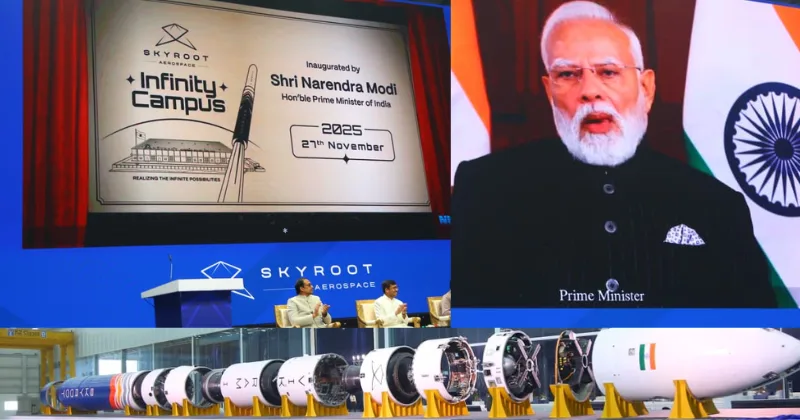
On 27 November 2025, Prime Minister Narendra Modi inaugurated Skyroot’s Infinity Campus in Hyderabad, Telangana, through video conferencing. Addressing the gathering, the Prime Minister said the nation was witnessing an “unprecedented opportunity in the space sector” as India’s space ecosystem experienced a major leap with the entry of private players.
He said the new campus symbolised “India’s new thinking, innovation and youth power”, adding that the innovation, risk-taking ability and entrepreneurship of India’s youth were “reaching new heights”. He also unveiled the Skyroot’s first orbital rocket, Vikram-I, with capability to launch satellites to orbit.
Calling the event a reflection of how India is poised to emerge as “a leader in the global satellite launch ecosystem”, Modi extended his wishes to Pawan Kumar Chandana and Naga Bharath Daka, the young founders of the company. He said their journey would inspire “countless young space entrepreneurs across the country”, praising them for trusting themselves and not shying away from risk. Their success, he said, had made the entire country proud.
Speaking at the inauguration of Skyroot’s Infinity Campus. It is a significant leap forward for India’s space sector and its future. @SkyrootA https://t.co/EcLEWEcdIx
— Narendra Modi (@narendramodi) November 27, 2025
The Prime Minister recalled the early days of India’s space programme, noting that the journey began with extremely limited resources. He said that from “carrying rocket parts on a bicycle to developing the world’s most reliable launch vehicles”, India had demonstrated that the height of ambition was determined not by resources but by determination. “ISRO has for decades given new wings to India’s space journey,” he remarked, stating that credibility, capacity and value had established India’s distinct identity in the global space sector.
Modi noted that the sector had expanded rapidly and now formed the backbone of communication, agriculture, marine monitoring, urban planning, weather forecasting and national security. This, he said, was why the government had undertaken “historic reforms” by opening the sector to private innovation and releasing a new Space Policy. Efforts were also made to connect startups and industry with research, including the establishment of IN-SPACe to enable access to ISRO’s facilities and technologies for private companies.
“In just the past six to seven years, India has transformed its space sector into an open, cooperative, and innovation-driven ecosystem,” he said.
The Prime Minister highlighted that India’s youth consistently placed national interest above all else, and had seized new opportunities wholeheartedly. He pointed out that over 300 space startups were now shaping the future of India’s space ambitions. Many of these ventures, he noted, had started with only two to five people working in small rented rooms, but had moved ahead with determination. “This spirit has given birth to the Private Space Revolution in India,” he said, noting that young engineers, designers, coders and scientists were creating new technologies across propulsion systems, composite materials, rocket stages and satellite platforms.
ISRO has powered India's space journey to new heights for decades. Through its credibility, capacity and value, India has carved out a distinct identity in the global space landscape. pic.twitter.com/50wE3B9cPh
— PMO India (@PMOIndia) November 27, 2025
He said India’s private space talent was gaining global recognition and that international investors were now looking at India with high expectations. The demand for small satellites was rising worldwide, and so were launch frequencies. With new companies entering satellite services, Modi said “space has now established itself as a strategic asset”.
Highlighting India’s advantages in the sector, he said, “India possesses space sector capabilities that only a few countries in the world have,” including expert engineers, a high-quality manufacturing ecosystem, world-class launch sites and a culture that encourages innovation. He added that these capabilities were both cost-effective and reliable, making India an attractive destination. “Global companies want to manufacture satellites in India, avail launch services from India, and seek technology partnerships with India,” he said, urging the country to make the most of this opportunity.
The Prime Minister said that over the past decade, India had seen a surge of startups across FinTech, AgriTech, HealthTech, ClimateTech, EduTech and DefenceTech. He lauded the Gen-Z workforce, saying their creativity, positive mindset and capacity-building abilities could inspire the youth of the world.
Modi emphasised that India had become the world’s third-largest startup ecosystem. What was once limited to big cities had now spread to small towns and villages. The country had over 1.5 lakh registered startups, many of which had reached unicorn status. He added that India was no longer confined to apps and services alone, as the country was advancing rapidly towards deep-tech, manufacturing and hardware innovation.
Union Minister G Kishan Reddy also attended the inauguration.
The newly launched Skyroot Infinity Campus spans 200,000 square feet and is designed for end-to-end processes including design, development, integration and testing of multiple launch vehicles. It has the capacity to build one orbital rocket every month.
Founded by IIT alumni and former ISRO scientists Pawan Chandana and Bharath Daka, Skyroot became the first Indian private company to launch a rocket into space in November 2022, when it successfully launched the sub-orbital Vikram-S.










Comments