





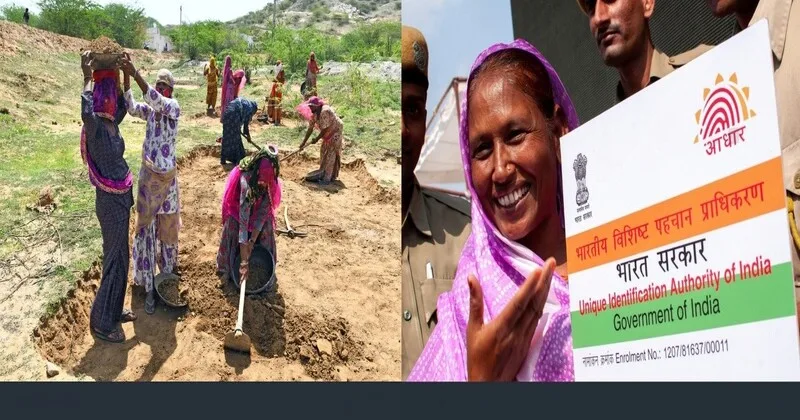
The Mahatma Gandhi National Rural Employment Guarantee Act (MGNREGA) remains one of India’s largest right based welfare programmes, guaranteeing at least 100 days of unskilled manual work to rural households. Today this scheme covers 2.69 lakh Gram Panchayats and more than 26 crore registered workers.
It not only provides wage security but also strengthens the rural asset through water conservation, land development, rural connectivity and climate-resilient structures. In FY 2024–25 the programme generated over 290 crore person-days, while women consistently constituted close to 58% of all workers with female participation. Electronic payments under this scheme has reached near-universal level of employment, with 99% of wage disbursals routed through digital systems, demonstrating how governance reforms have reshaped the execution of this vast programme.
Why Aadhaar Seeding is Necessary
MGNREGA system had faced challenges related to duplication of job cards, identity mismatch, wage delays and leakages at various stages. Aadhaar seeding was therefore introduced as a structural reform to strengthen accountability, ensure correct identification of workers and streamline wage payments. With 99.67% of active workers already Aadhaar-seeded, according to the Ministry of Rural Development’s internal assessment. Aadhaar integration emerged as an essential step towards eliminating fraudulent job cards and ensuring that only genuine beneficiaries receive entitlements Aadhaar seeding links a worker’s identity, bank account and job card into a single verified record thus minimizing the possibility of duplication or impersonation and ensuring that wage claims are authentic.
Aadhaar-Linked Verification System
To operationalise Aadhaar-based verification, the government has introduced the e-KYC feature within the National Mobile Monitoring System (NMMS) app. This system facilitates the capture of a worker’s live photograph at the field level by field-level staff such as Gram Rozgar Sahayaks, matched instantly with the Aadhaar records. Verification for each worker is done in less than a minute, enabling quick and transparent authentication. States have been advised to conduct e-KYC either at worksites or through special camps, making the process convenient for workers by providing them with multiple options. In first half of 2025, more than 56% of active workers had already been verified under e-KYC verification, indicating remarkable progress in reinforcing the reliability of job card records.
Verification of Job Cards and Deletion of Invalid Entries
Verification of the job card under MGNREGA is a continuing statutory requirement, but its renewal is required once in five years according to Schedule II of the Act. The Ministry supported the states in this regard by issuing a comprehensive SOP in January 2025, entailing transparent and uniform guidelines for deletion or renewal of job cards. The SOP ensures that no genuine worker is deleted and deletions made are supported by verifiable evidence. States were advised to use e-KYC as a primary tool for verification, thus enabling a systematic clean-up of outdated, duplicate, or inactive job cards. The exercise was imperative to maintain the database and utilize public money properly. The Ministry monitors compliance with SOP to prevent arbitrary deletions and secure the rights of workers.
Why Aadhaar-based systems improve efficiency
Aadhaar seeding is fundamentally changing the payment architecture of the MGNREGA. Once Aadhaar gets linked to a bank account, payments are routed through APBS an Aadhaar Payment Bridge System that works as a financial address for beneficiaries. This decreases reliance on manual intervention and ensures that wages reach the workers accounts directly by minimizing the chances of diversion. Aadhaar also works in tandem with attendance-based monitoring tools like NMMS, which captures daily photographs of workers at the worksite, providing digital proof of presence. Along with the geo-tagging of assets and real-time updates of the muster roll, Aadhaar-enabled systems mark the transition towards complete digital governance in rural employment schemes.
The Aadhaar-linked reforms has generated visible outcomes across states. Wage payments became more accurate, tamper-resistant and accountable with each transaction traceable. Secondly the removal of ghost workers and duplicate job cards ensures that budgetary resources reach genuine beneficiaries. Third Aadhaar seeding has promoted financial inclusion as workers had to have operational bank accounts linked to the digital payment system. Fourth, the reduction in paperwork and manual validation processes freed up local functionaries to devote more time to timely work allocation, redressal of grievances and monitoring of assets. Overall, Aadhaar seeding has helped in building a more credible, efficient and corruption-resistant administrative structure.
Implementation Challenges and State-Level Variations
In implementation progress, some states continue to face problem on the Aadhaar-based systems. Anomalies such as poor network connectivity, non-operational bank accounts, biometric mismatches and low digital awareness appear to be common issue among workers in remote areas. There are also sections where larger number of workers are yet to become eligible for receiving Aadhaar-based payments due to incomplete linkage of Aadhaar with bank accounts or job cards. Such gaps sometimes lead to temporary delays in wages or disruptions in the employment allotment. The Ministry has advised States to deploy mobile e-KYC units, conduct village-level camps and coordinate with banks to activate/update dormant accounts. The focus is on ensuring that no eligible worker gets left out due to minor technical glitches.
Complementary digital reforms have significantly evolved the transparency framework of MGNREGA. Geo-tagging of more than 6 crore assets across states facilitates the monitoring of physical works. Real-time muster roll updation, NMMS attendance records, Aadhaar-based payments and public dashboards together create an end-to-end audit trail. The Aadhaar-enabled architecture ensures that every stage-from registration and attendance to the disbursal of wages and completion of assets-remains traceable and verifiable. This alignment of technology and governance is one of the most significant changes in rural development administration in the last decade.
Aadhaar and the Protection of Worker Rights
Aadhaar seeding is viewed as a technology enhancement for workers, its deeper impact lies in safeguarding worker entitlements. Verification through e-KYC ensures that genuine workers are consistently recognized during card renewal. Aadhaar-based payments reduce opportunities for wage diversion, hence protecting workers from malpractices at the local level. The Ministry monitoring and SOP-guided verification processes ensures that deletions are carried out only on duly documented grounds, hence protecting the rights of vulnerable households. This focus on rights resonates with the original intent of MGNREGA, created to guarantee work and wages legally, free from discrimination and exploitation.
In strengthening the system, consolidation of gains in Aadhaar-based systems requires action like 100 per cent linkage of Aadhaar, bank and job cards in the states, particularly in tribal and geographically isolated areas. Increased digital literacy amongst workers to allow them to track payments independently. Banking infrastructure needs strengthening on a continuous basis for timely credit of wages in remote areas. Making the grievance redressal system more responsive and with clear escalation channels in case of failure of payment or biometric mismatch.
Creating durable assets with particular emphasis on water management, agriculture and climate resilient, remains important since these works create long-term local benefits beyond immediate wage support. Linking Aadhaar under MGNREGA is an important administrative reform for increasing transparency, efficiency and protection for the workers. The near-universal coverage of Aadhaar among its active workforce and high penetration of different digital verification tools have gradually pushed the scheme toward a sound governance framework. There are challenges but with the combination of e-KYC, APBS payments, NMMS-based attendance and geo-tagged assets. MGNREGA is now probably one of the most digitally monitored public programmes in the world.
















Comments